



Question: Problem 1: The Pauli spin matrices in quantum mechanics are C A = (). B = ( ). c = ( ). They are
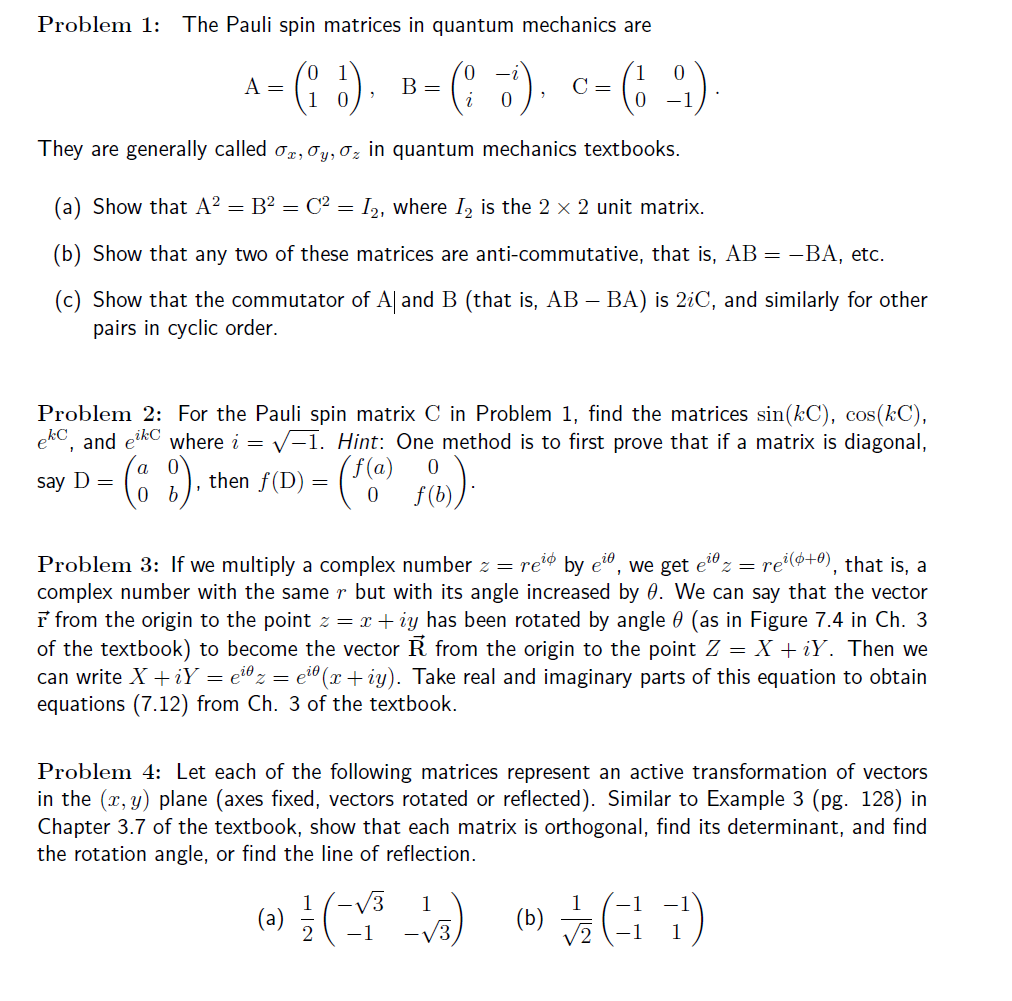
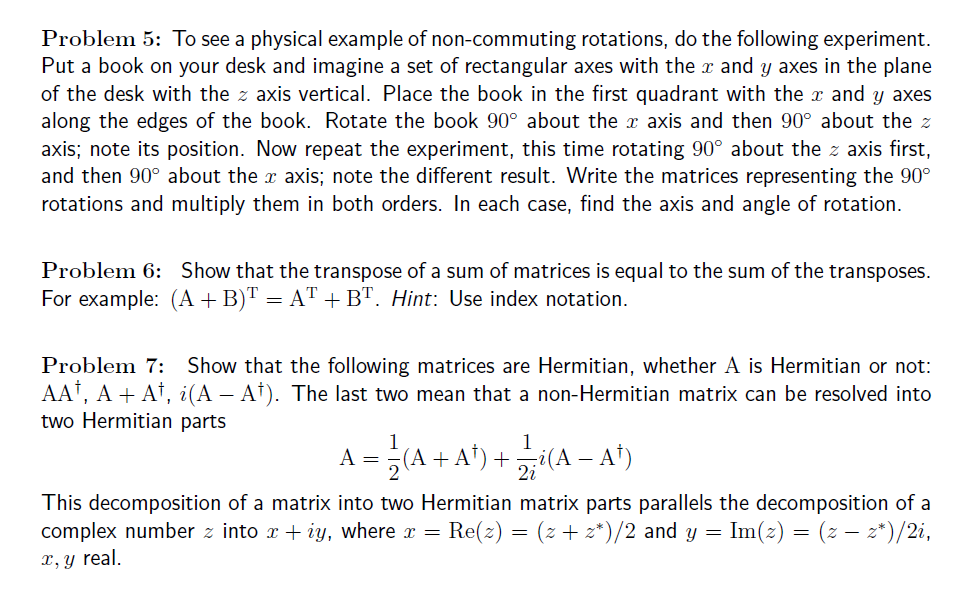
Problem 1: The Pauli spin matrices in quantum mechanics are C A = (). B = ( ). c = ( ). They are generally called x, y, z in quantum mechanics textbooks. (a) Show that A = B = C = 12, where I2 is the 2 2 unit matrix. (b) Show that any two of these matrices are anti-commutative, that is, AB = -BA, etc. (c) Show that the commutator of A and B (that is, AB - BA) is 2iC, and similarly for other pairs in cyclic order. Problem 2: For the Pauli spin matrix C in Problem 1, find the matrices sin(kC), cos(kC), ekC, and eik where i = 1. Hint: One method is to first prove that if a matrix is diagonal, say D = (a 9). then f(D) = =(F(a) 0 Problem 3: If we multiply a complex number z = re by eid, we get ei z = rei(+0), that is, a complex number with the same r but with its angle increased by 0. We can say that the vector F from the origin to the point z = x + iy has been rotated by angle & (as in Figure 7.4 in Ch. 3 of the textbook) to become the vector from the origin to the point Z = X + Y. Then we can write X+iY = ez = e (x+iy). Take real and imaginary parts of this equation to obtain equations (7.12) from Ch. 3 of the textbook. Problem 4: Let each of the following matrices represent an active transformation of vectors in the (x, y) plane (axes fixed, vectors rotated or reflected). Similar to Example 3 (pg. 128) in Chapter 3.7 of the textbook, show that each matrix is orthogonal, find its determinant, and find the rotation angle, or find the line of reflection. 1 (a) ( -1 1 1 3) (1) (111) Problem 5: To see a physical example of non-commuting rotations, do the following experiment. Put a book on your desk and imagine a set of rectangular axes with the x and y axes in the plane of the desk with the z axis vertical. Place the book in the first quadrant with the x and y axes along the edges of the book. Rotate the book 90 about the x axis and then 90 about the z axis; note its position. Now repeat the experiment, this time rotating 90 about the z axis first, and then 90 about the x axis; note the different result. Write the matrices representing the 90 rotations and multiply them in both orders. In each case, find the axis and angle of rotation. Problem 6: Show that the transpose of a sum of matrices is equal to the sum of the transposes. For example: (A+B)T = AT + BT. Hint: Use index notation. Problem 7: Show that the following matrices are Hermitian, whether A is Hermitian or not: AA, A + A, (A - A). The last two mean that a non-Hermitian matrix can be resolved into two Hermitian parts 1 A = (A + A) + (A A) This decomposition of a matrix into two Hermitian matrix parts parallels the decomposition of a complex number z into x + iy, where x = Re(z) = (z + z*)/2 and y = Im(z) = (z z*)/2i, x, y real.
Step by Step Solution
There are 3 Steps involved in it

Get step-by-step solutions from verified subject matter experts