







Question: Problem 1 (the setup is similar to the cases we discussed in class): Part (a): Assume that you put $100 in a risk-free savings
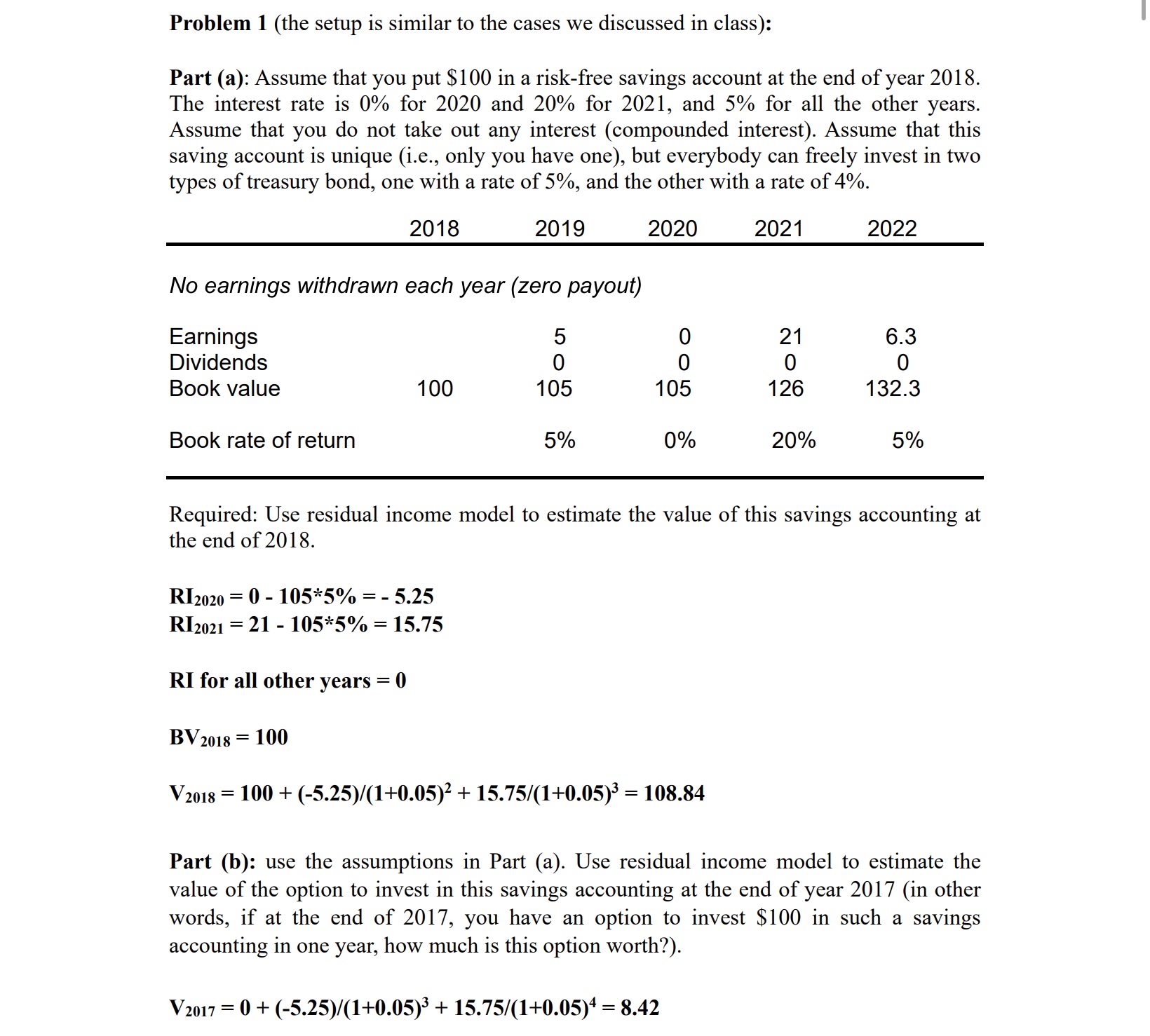
Problem 1 (the setup is similar to the cases we discussed in class): Part (a): Assume that you put $100 in a risk-free savings account at the end of year 2018. The interest rate is 0% for 2020 and 20% for 2021, and 5% for all the other years. Assume that you do not take out any interest (compounded interest). Assume that this saving account is unique (i.e., only you have one), but everybody can freely invest in two types of treasury bond, one with a rate of 5%, and the other with a rate of 4%. 2018 2019 2020 2021 2022 No earnings withdrawn each year (zero payout) Earnings 5 0 21 6.3 Dividends 0 0 0 0 Book value 100 105 105 126 132.3 Book rate of return 5% 0% 20% 5% Required: Use residual income model to estimate the value of this savings accounting at the end of 2018. = RI 2020 0 105*5% = -5.25 = RI 2021 21 105*5% = 15.75 RI for all other years BV 2018 = 100 = 0 V2018 100+ (-5.25)/(1+0.05) + 15.75/(1+0.05) = 108.84 = Part (b): use the assumptions in Part (a). Use residual income model to estimate the value of the option to invest in this savings accounting at the end of year 2017 (in other words, if at the end of 2017, you have an option to invest $100 in such a savings accounting in one year, how much is this option worth?). V2017=0+(-5.25)/(1+0.05) + 15.75/(1+0.05)4 = 8.42
Step by Step Solution
There are 3 Steps involved in it

Get step-by-step solutions from verified subject matter experts
 Study Help