







Question: Problem 1. Use the product theorem from Lecture 13 to prove: (1) cos?(#) + sin?(0) = 1 (2) sin(a + B) = sin(a) cos(B) +
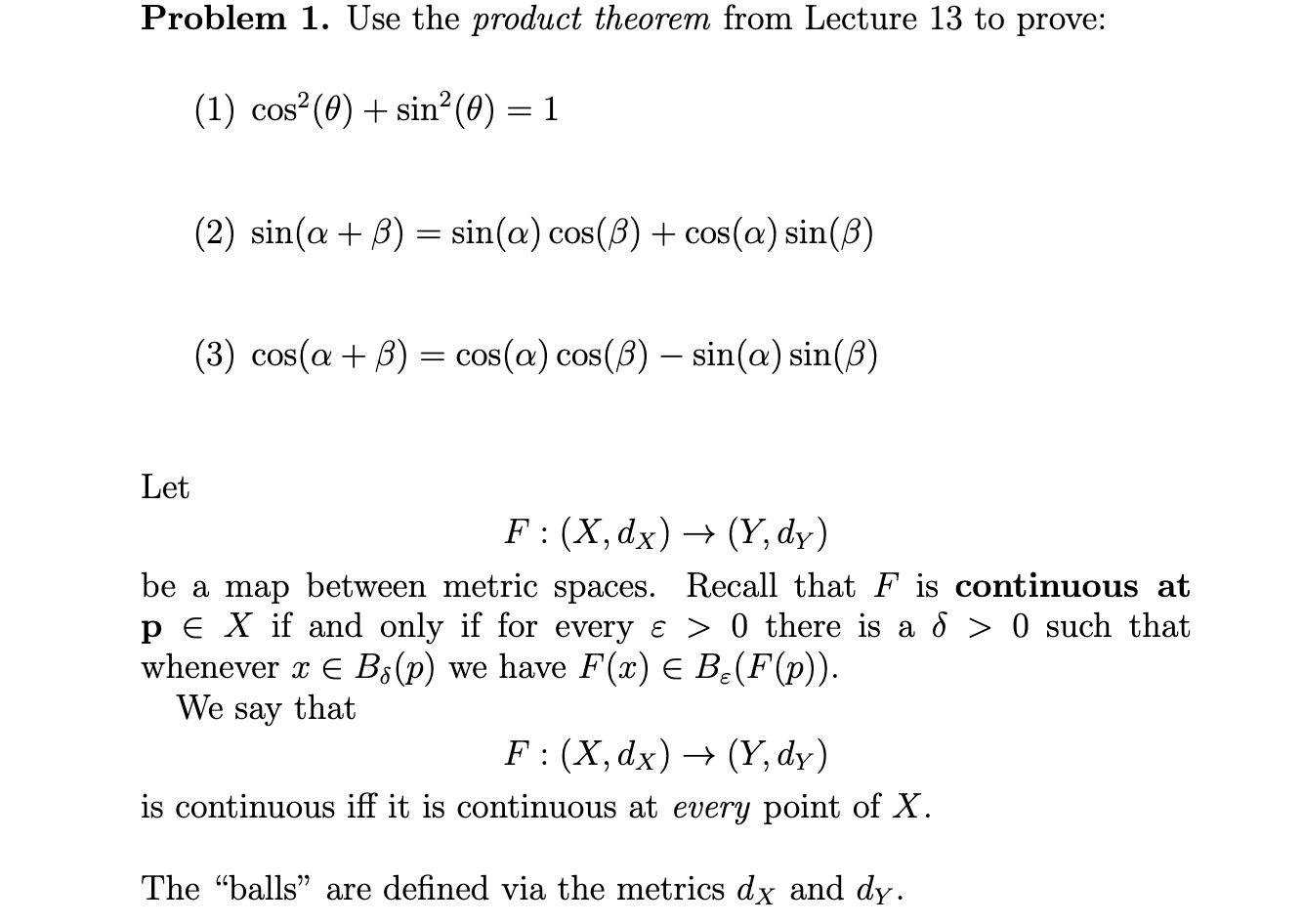
Problem 1. Use the product theorem from Lecture 13 to prove: (1) cos?(#) + sin?(0) = 1 (2) sin(a + B) = sin(a) cos(B) + cos(a) sin(B) (3) cos(a+ B) = cos(a) cos(B) sin(a) sin(f) Let F (X, dx) (Kdy) be a map between metric spaces. Recall that F' is continuous at p X if and only if for every > 0 there is a 6 > 0 such that whenever z B;s(p) we have F(z) B.(F(p)). We say that F: (X, dx) (Kdy) is continuous iff it is continuous at every point of X. The \"balls\" are defined via the metrics dx and dy
Step by Step Solution
There are 3 Steps involved in it
1 Expert Approved Answer
Step: 1 Unlock

Question Has Been Solved by an Expert!
Get step-by-step solutions from verified subject matter experts
Step: 2 Unlock
Step: 3 Unlock
 Study Help