







Question: Problem 1: We discussed in class the column sweep algorithm as it applies to parallelize the following matrix recurrence problem: X = C + AX
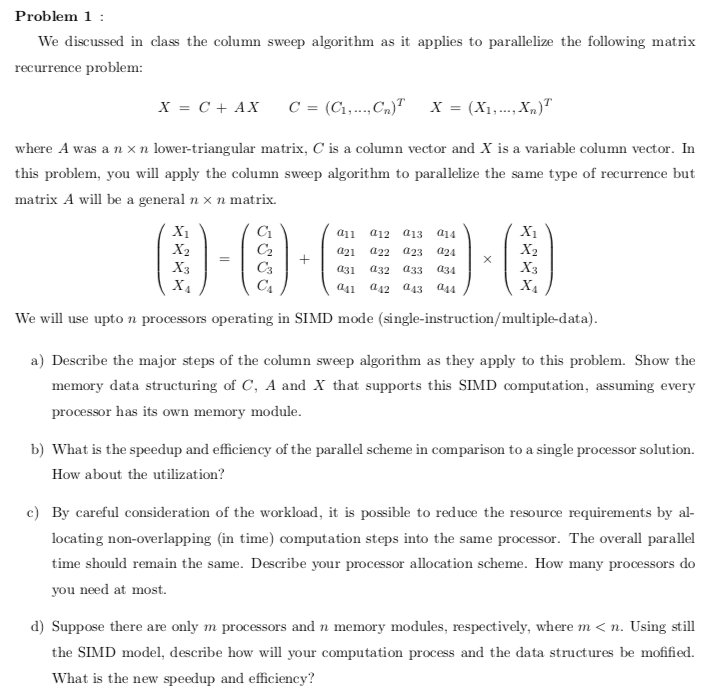
Problem 1: We discussed in class the column sweep algorithm as it applies to parallelize the following matrix recurrence problem: X = C + AX C = (G, ,Cn)T X = (X1 , , xn)T where A was a n n lower-triangular matrix, C is a column vector and X is a variable column vector. In this problem, you will apply the column sweep algorithm to parallelize the same type of recurrence but matrix A will be a general n n matrix. C1 C2 C3 11 a12 a13 a14 121 22 23 124 31 a32 33 434 41 42 43 44 We will use upto n processors operating in SIMD mode (single-instruction/multiple-data) a) Describe the major steps of the column sweep algorithm as they apply to this problem. Show the memory data structuring of C, A and X that supports this SIMD computation, assuming every processor has its own memory module b) What is the speedup and efficiency of the parallel scheme in comparison to a single processor solution How about the utilization? c) By careful consideration of the workload, it is possible to reduce the resource requirements by al- locating non-overlapping (in time) computation steps into the same processor. The overall parallel time should remain the same. Describe your processor allocation scheme. How many processors do you need at most. d) Suppose there are only m processors and n memory modules, respectively, where m
Step by Step Solution
There are 3 Steps involved in it

Get step-by-step solutions from verified subject matter experts
 Study Help