







Question: Problem 1 . What is a digital signal and how does it differ from an analog signal? Give two examples of digital phenomena and two
Problem What is a digital signal and how does it differ from an analog signal? Give two examples of digital phenomena and two examples of analog phenomena.
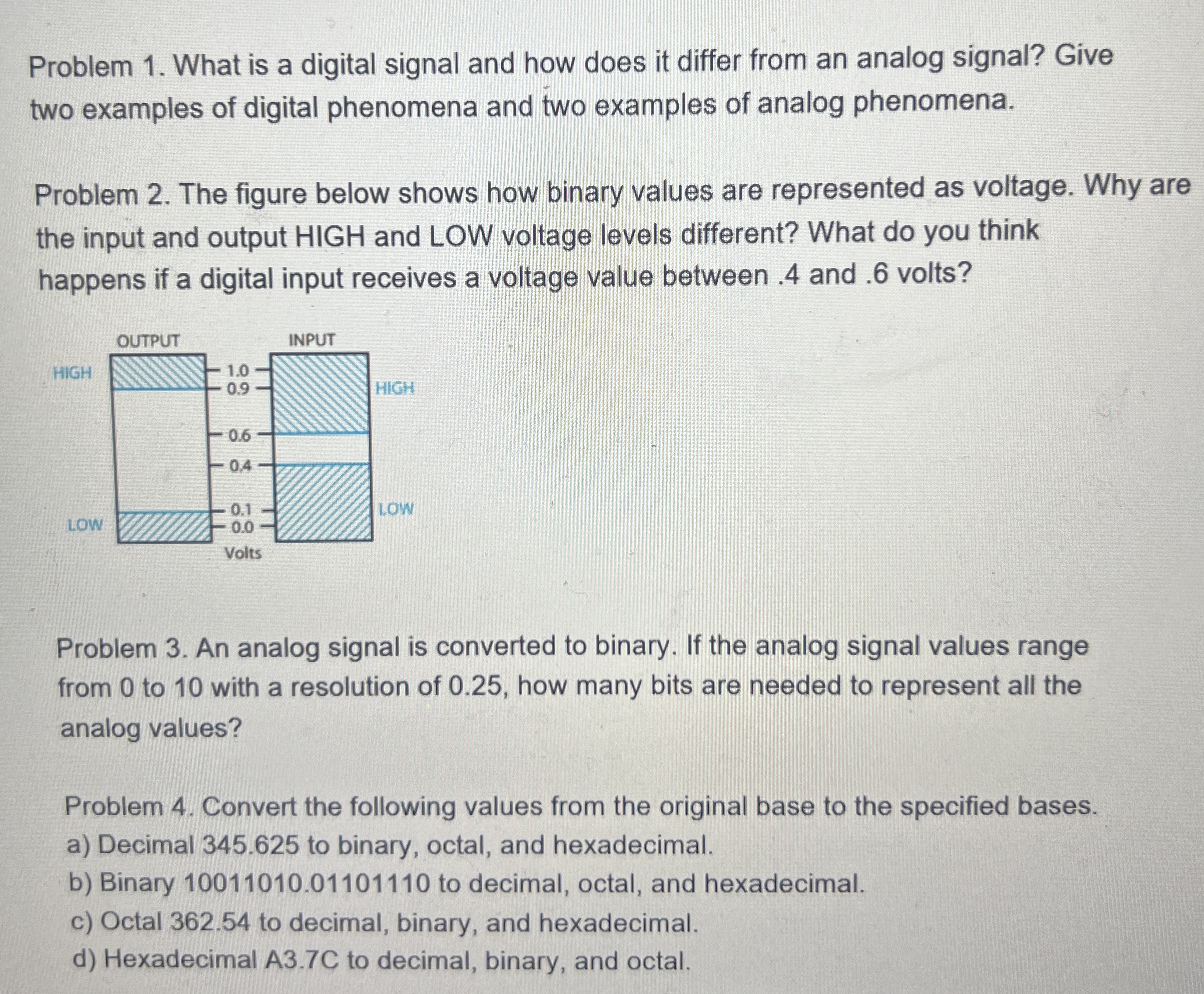
Problem The figure below shows how binary values are represented as voltage. Why are the input and output HIGH and LOW voltage levels different? What do you think happens if a digital input receives a voltage value between and volts?
Problem An analog signal is converted to binary. If the analog signal values range from to with a resolution of how many bits are needed to represent all the analog values?
Problem Convert the following values from the original base to the specified bases.
a Decimal to binary, octal, and hexadecimal.
b Binary to decimal, octal, and hexadecimal.
c Octal to decimal, binary, and hexadecimal.
d Hexadecimal AC to decimal, binary, and octal.
All of question and please!
Step by Step Solution
There are 3 Steps involved in it
1 Expert Approved Answer
Step: 1 Unlock

Question Has Been Solved by an Expert!
Get step-by-step solutions from verified subject matter experts
Step: 2 Unlock
Step: 3 Unlock
 Study Help