







Question: Problem 1 You are given an integer array A and two integers i and j. You can assume that i j and that A
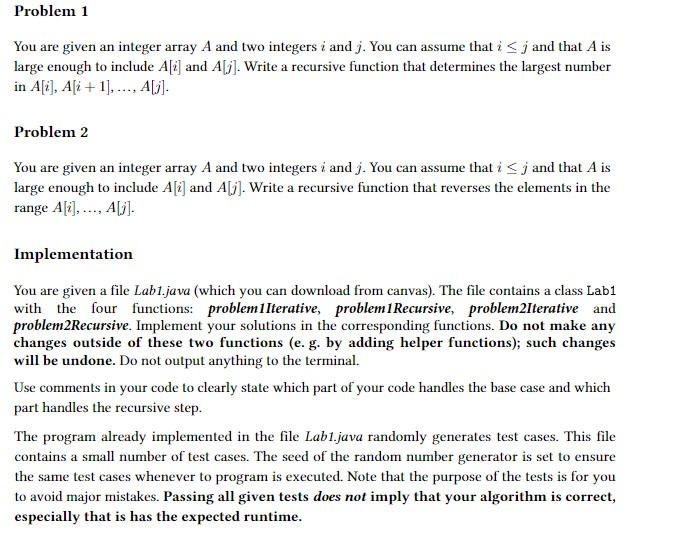
Problem 1 You are given an integer array A and two integers i and j. You can assume that i j and that A is large enough to include A[i] and A[j]. Write a recursive function that determines the largest number in A[i], A[i+1], ..., A[j]. Problem 2 You are given an integer array A and two integers i and j. You can assume that i < j and that A is large enough to include A[i] and A[j]. Write a recursive function that reverses the elements in the range A[i], ..., A[j]. Implementation You are given a file Lab1.java (which you can download from canvas). The file contains a class Lab1 with the four functions: problem 1Iterative, problem 1 Recursive, problem2Iterative and problem2Recursive. Implement your solutions in the corresponding functions. Do not make any changes outside of these two functions (e. g. by adding helper functions); such changes will be undone. Do not output anything to the terminal. Use comments in your code to clearly state which part of your code handles the base case and which part handles the recursive step. The program already implemented in the file Lab1.java randomly generates test cases. This file contains a small number of test cases. The seed of the random number generator is set to ensure the same test cases whenever to program is executed. Note that the purpose of the tests is for you to avoid major mistakes. Passing all given tests does not imply that your algorithm is correct, especially that is has the expected runtime.
Step by Step Solution
There are 3 Steps involved in it
The implementations for the given problems in the Lab1java file import javautilRandom public class Lab1 public static int problem1Iterativeint A int i ... View full answer

Get step-by-step solutions from verified subject matter experts
 Study Help