







Question: Problem 1 You are trying to help your client, Bobby Hoying, construct a portfolio, Bobby has a quadratic utility function. There are three assets in
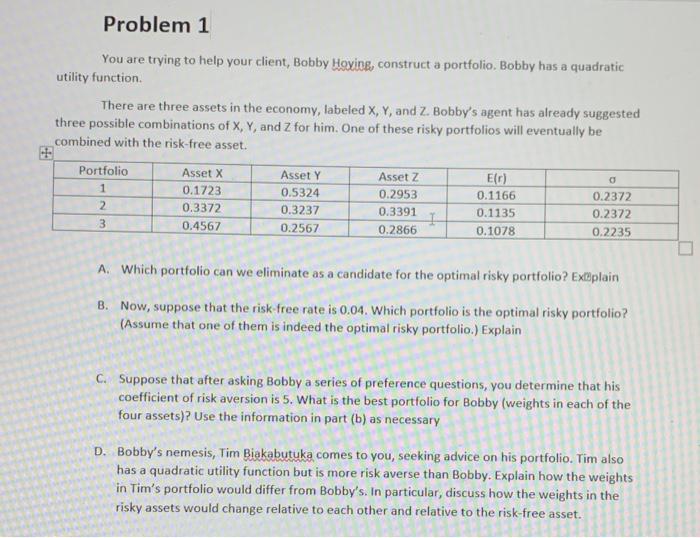
Problem 1 You are trying to help your client, Bobby Hoying, construct a portfolio, Bobby has a quadratic utility function. There are three assets in the economy, labeled X, Y, and Z. Bobby's agent has already suggested three possible combinations of X, Y, and Z for him. One of these risky portfolios will eventually be combined with the risk-free asset. Portfolio 1 2 3 Asset X 0.1723 0.3372 0.4567 Asset Y 0.5324 0.3237 0.2567 Asset Z 0.2953 0.3391 0.2866 Er) 0.1166 0.1135 0.1078 I 0.2372 0.2372 0.2235 A. Which portfolio can we eliminate as a candidate for the optimal risky portfolio? Explain B. Now, suppose that the risk-free rate is 0.04. Which portfolio is the optimal risky portfolio? (Assume that one of them is indeed the optimal risky portfolio.) Explain C. Suppose that after asking Bobby a series of preference questions, you determine that his coefficient of risk aversion is 5. What is the best portfolio for Bobby (weights in each of the four assets)? Use the information in part (b) as necessary D. Bobby's nemesis, Tim Biakabutuka comes to you, seeking advice on his portfolio. Tim also has a quadratic utility function but is more risk averse than Bobby. Explain how the weights in Tim's portfolio would differ from Bobby's. In particular, discuss how the weights in the risky assets would change relative to each other and relative to the risk-free asset. Problem 1 You are trying to help your client, Bobby Hoying, construct a portfolio, Bobby has a quadratic utility function. There are three assets in the economy, labeled X, Y, and Z. Bobby's agent has already suggested three possible combinations of X, Y, and Z for him. One of these risky portfolios will eventually be combined with the risk-free asset. Portfolio 1 2 3 Asset X 0.1723 0.3372 0.4567 Asset Y 0.5324 0.3237 0.2567 Asset Z 0.2953 0.3391 0.2866 Er) 0.1166 0.1135 0.1078 I 0.2372 0.2372 0.2235 A. Which portfolio can we eliminate as a candidate for the optimal risky portfolio? Explain B. Now, suppose that the risk-free rate is 0.04. Which portfolio is the optimal risky portfolio? (Assume that one of them is indeed the optimal risky portfolio.) Explain C. Suppose that after asking Bobby a series of preference questions, you determine that his coefficient of risk aversion is 5. What is the best portfolio for Bobby (weights in each of the four assets)? Use the information in part (b) as necessary D. Bobby's nemesis, Tim Biakabutuka comes to you, seeking advice on his portfolio. Tim also has a quadratic utility function but is more risk averse than Bobby. Explain how the weights in Tim's portfolio would differ from Bobby's. In particular, discuss how the weights in the risky assets would change relative to each other and relative to the risk-free asset
Step by Step Solution
There are 3 Steps involved in it

Get step-by-step solutions from verified subject matter experts
 Study Help