







Question: Problem 10.1: Hamiltonian with vector potential. (20 points) a) Show that the Lorentz force law, F = q6+qu x B, (1) can be written as
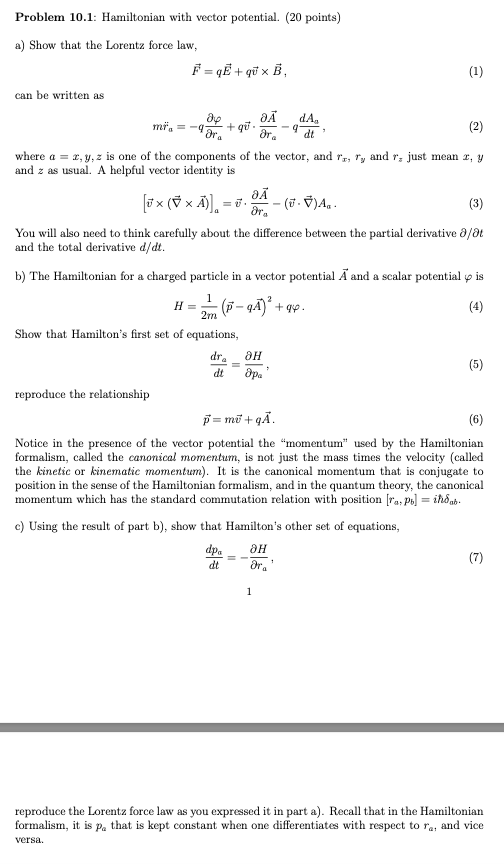
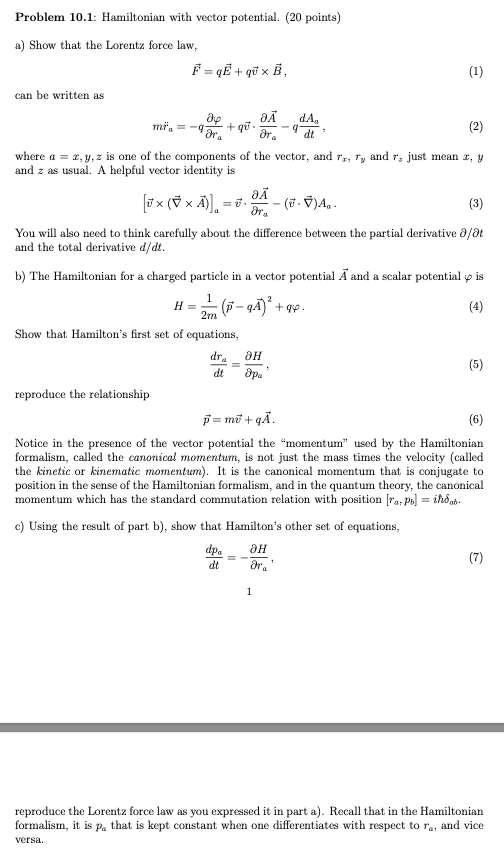
Problem 10.1: Hamiltonian with vector potential. (20 points) a) Show that the Lorentz force law, F = q6+qu x B, (1) can be written as mis = -4pra -+ q7- - (2) where a = c, y, z is one of the components of the vector, and rr, r, and r, just mean I, y and z as usual. A helpful vector identity is 7x(V x A) =0 # - (4. V)A. . (3) You will also need to think carefully about the difference between the partial derivative 0/Of and the total derivative d/di. b) The Hamiltonian for a charged particle in a vector potential A and a scalar potential y is H = 1 2m ( F - 94) + 94. (4) Show that Hamilton's first set of equations, dra OH dt (5) Opa reproduce the relationship p = mo +qA. (6) Notice in the presence of the vector potential the "momentum" used by the Hamiltonian formalism, called the canonical momentum, is not just the mass times the velocity (called the kinetic or kinematic momentum). It is the canonical momentum that is conjugate to position in the sense of the Hamiltonian formalism, and in the quantum theory, the canonical momentum which has the standard commutation relation with position [r.; p;] = this. c) Using the result of part b), show that Hamilton's other set of equations, apa OH dt or a (7) 1 reproduce the Lorentz force law as you expressed it in part a). Recall that in the Hamiltonian formalism, it is p. that is kept constant when one differentiates with respect to r, and vice versa
Step by Step Solution
There are 3 Steps involved in it

Get step-by-step solutions from verified subject matter experts
 Study Help