







Question: Problem 11.1: Harmonic oscillator in transient electric field. (30 points) Consider a one-dimensional harmonic oscillator with frequency parameter wo. At time t = 0,
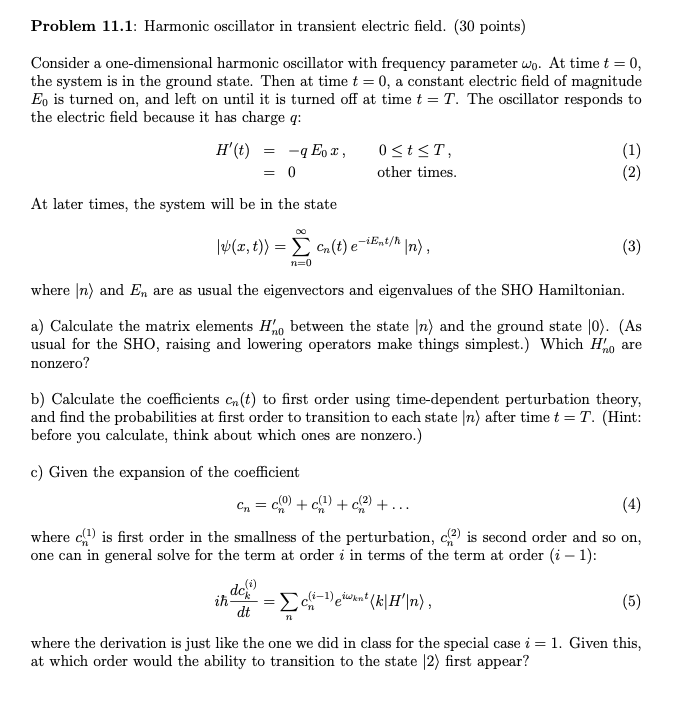
Problem 11.1: Harmonic oscillator in transient electric field. (30 points) Consider a one-dimensional harmonic oscillator with frequency parameter wo. At time t = 0, the system is in the ground state. Then at time t = 0, a constant electric field of magnitude Eo is turned on, and left on until it is turned off at time t = T. The oscillator responds to the electric field because it has charge q: H' (t) q Eox, = = 0 At later times, the system will be in the state 0tT, other times. -iEnt/h ), (x, t)) = c(t) e-i n=0 where n) and En are as usual the eigenvectors and eigenvalues of the SHO Hamiltonian. (1) (2) (3) a) Calculate the matrix elements H between the state (n) and the ground state [0). (As usual for the SHO, raising and lowering operators make things simplest.) Which Hare nonzero? b) Calculate the coefficients cn(t) to first order using time-dependent perturbation theory, and find the probabilities at first order to transition to each state (n) after time t = T. (Hint: before you calculate, think about which ones are nonzero.) c) Given the expansion of the coefficient Cn = c(0) + c()+c(2) + ... (4) where c() is first order in the smallness of the perturbation, c(2) is second order and so on, one can in general solve for the term at order i in terms of the term at order (i - 1): de(i) ih dt = cent (k|H'n), n (5) where the derivation is just like the one we did in class for the special case i = 1. Given this, at which order would the ability to transition to the state (2) first appear?
Step by Step Solution
There are 3 Steps involved in it

Get step-by-step solutions from verified subject matter experts
 Study Help