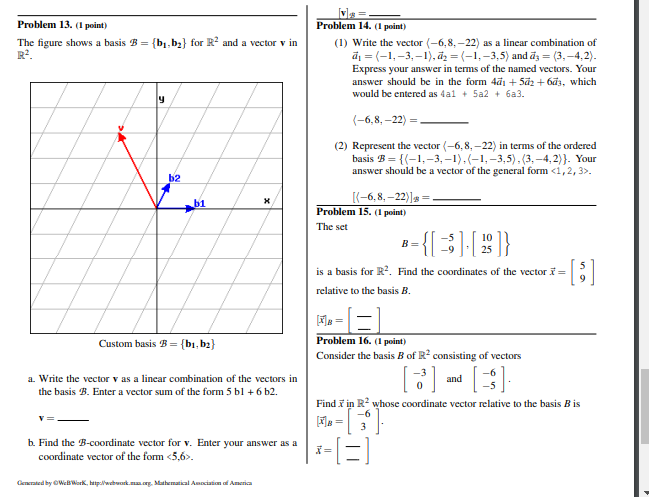
Question: Problem 13. (1 point) Problem 14. (1 point) The figure shows a basis $ = {bj,by} for R and a vector v in (1) Write
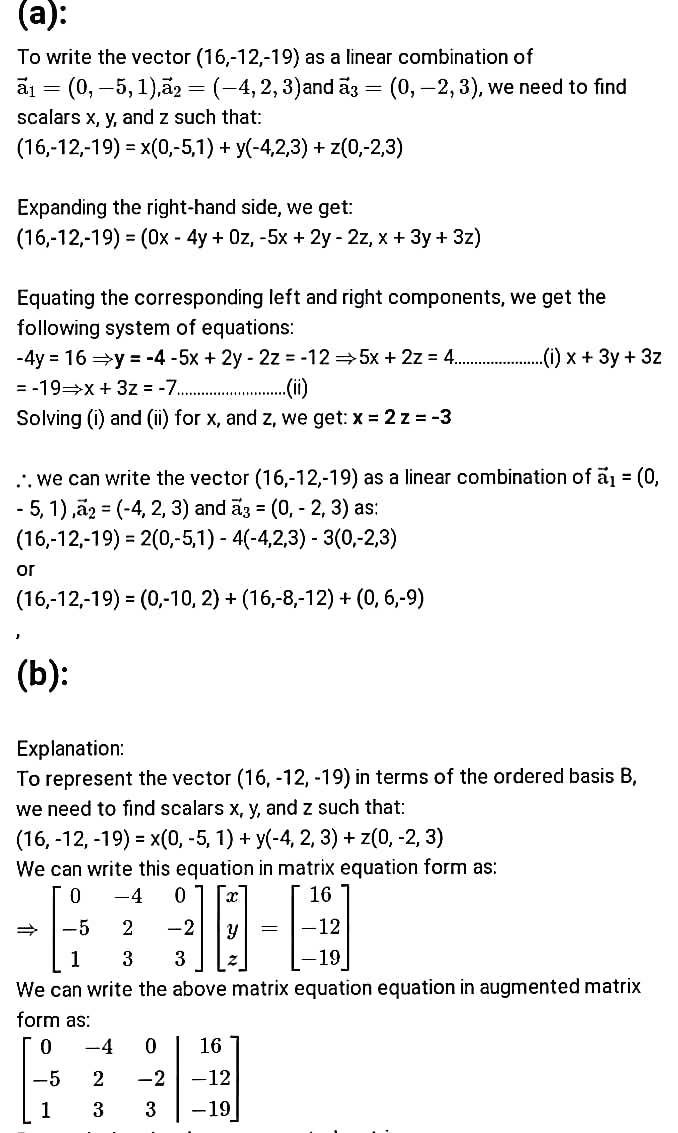
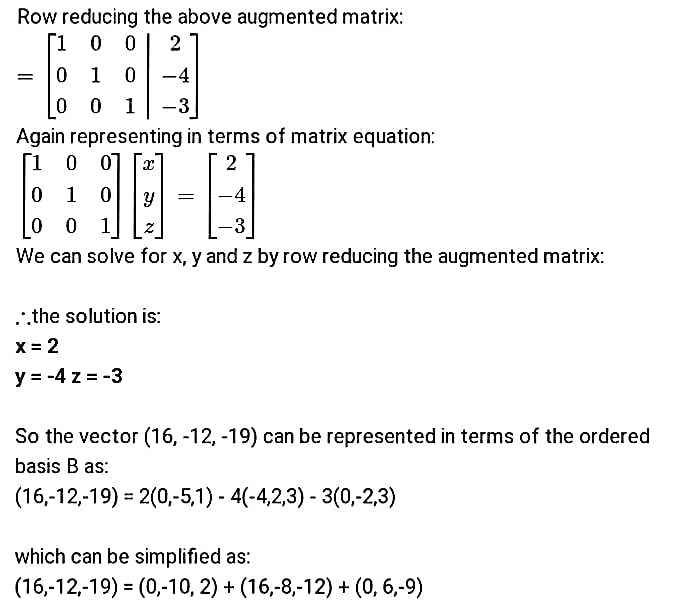
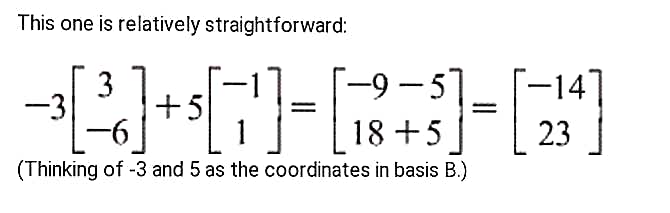
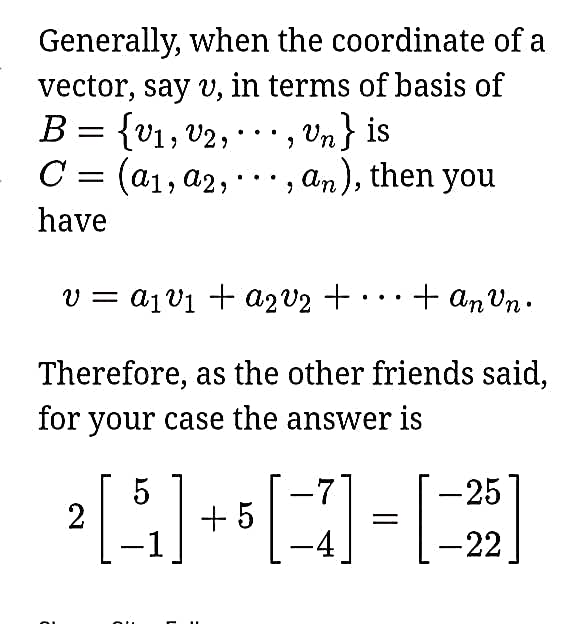
Problem 13. (1 point) Problem 14. (1 point) The figure shows a basis $ = {bj,by} for R and a vector v in (1) Write the vector (-6,8, -22) as a linear combination of al = (-1, -3, -1), ay = (-1, -3,5) and a; = (3, -4,2). Express your answer in terms of the named vectors. Your answer should be in the form 4an + 5a2 + 603, which y would be entered as 4al + 582 + 623. (-6,8, -22) =. (2) Represent the vector (-6,8, -22) in terms of the ordered basis # = {{-1, -3, -1). (-1, -3,5), (3, -4,2)}. Your answer should be a vector of the general form . h2 (-6.8, -22)18 = -b1 Problem 15. (1 point) The set B = is a basis for R3. Find the coordinates of the vector * = relative to the basis B. Custom basis B = {b1, by} Problem 16. (1 point) Consider the basis B of R consisting of vectors a. Write the vector v as a linear combination of the vectors in the basis 3. Enter a vector sum of the form 5 bl + 6 62. [ ] and [ =$]. Find Y in R' whose coordinate vector relative to the basis B is -6 Me= 3 b. Find the B-coordinate vector for v. Enter your answer as a coordinate vector of the form - *=[=] Generated by 0Well Work, Hip /webwork.man.my. Mathematical Amexiation of America(a): To write the vector {16,-12,-19} as a linear combination of 512(0,5,1],g = (4, 2, 3)and 5.3 = (0, 2, 3), we need to find scalars x, v, and 2 such that: (1 6,-12,-1 9) = x(0,-5,1) + y(-4,2,3) + z{D,-2,3) Expanding the right-hand side, we get: (16,-12,-19)=(x - 45: + 02. -5x + 25! - 2:, x + 3v+ 32) Equating the corresponding left and right components, we get the following system of equations: -4y=16:'y:-4-5x+2v-2z=-12=>5x+22=4 ...................... (i)x+3v+32 = -19=>x + 32 = -7(II) Solving (i) and {ii} for x, and I, we get: it = 2 z = -3 we can write the vector (16:12-19) as a linear combination of 51 = (D. - 5,1),52 = (4, 2, 3) and 3'3 = (CI. - 2, 3) as: (16,42,491) = 2(D,-5,1) - ail-4,2,3) - 3(U,-2,3) or (1 6,-1 2,-1 9) = (0,-10, 2} + (15,-3.4 2) + (o, 6,-9) (b): Explanation: To represent the vector (16, -12, -1 9) in terms of the ordered oasis B, we need to find scalars x, y, and 2 such that: (16: '12: -19) = X[DJ '51 1) + y'(-4r 2; 3) + 2(0: '2; 3) We can write this equation in matrix equation form as: U 4 0 a: 16 z:- 5 2 -2 y = 12 1 3 3 z 19 We can write the above matrix equation equation in augmented matrix form as: U 4 U 16 5 2 2 12 l 3 3 19 Row reducing the above augmented matrix: 1 0 0 2 0 1 0 0 1 Co O Again representing in terms of matrix equation: 0 07 0 0 y 0 0 We can solve for x, y and z by row reducing the augmented matrix: .the solution is: x = 2 y = -4z =-3 So the vector (16, -12, -19) can be represented in terms of the ordered basis B as: (16,-12,-19) = 2(0,-5,1) - 4(-4,2,3) - 3(0,-2,3) which can be simplified as: (16,-12,-19) = (0,-10, 2) + (16,-8,-12) + (0, 6,-9)This one is relatively straightforward: - ? -9 -5 + 5 -147 18 +5 23 (Thinking of -3 and 5 as the coordinates in basis B.)Generally, when the coordinate of a vector, say v, in terms of basis of B = V1, V2, . . . , Un} is C = (a1, a2, . . . , an), then you have v = a1v1 + azu2 + . . . + anUn. Therefore, as the other friends said, for your case the answer is 25 2 5 22
Step by Step Solution
There are 3 Steps involved in it
1 Expert Approved Answer
Step: 1 Unlock
Question Has Been Solved by an Expert!
Get step-by-step solutions from verified subject matter experts
Step: 2 Unlock
Step: 3 Unlock
Students Have Also Explored These Related Mathematics Questions!









 Study Help