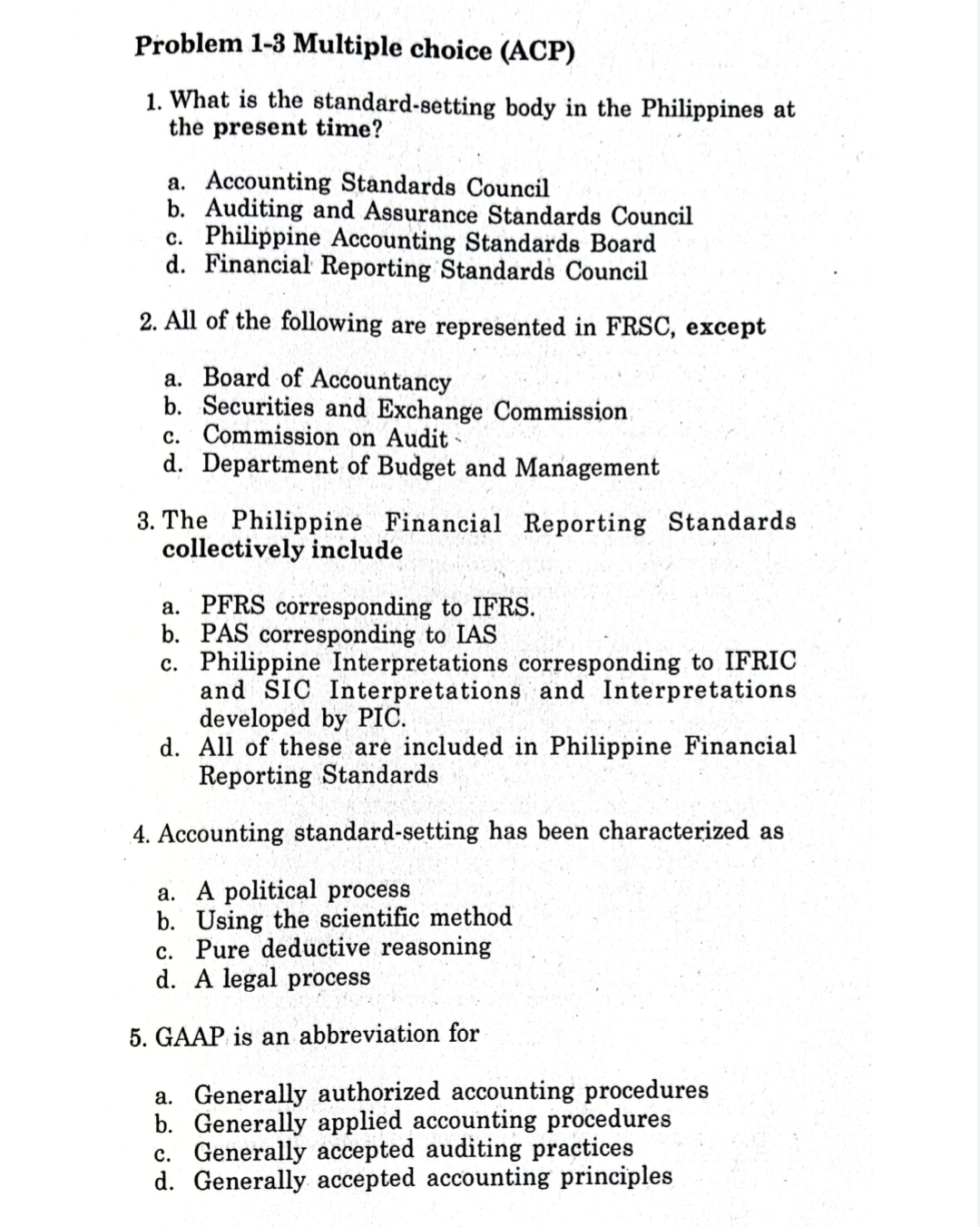
Question: Problem 1-3 Multiple choice (ACP) 1. What is the standard-setting body in the Philippines at the present time? a. Accounting Standards Council b. Auditing and
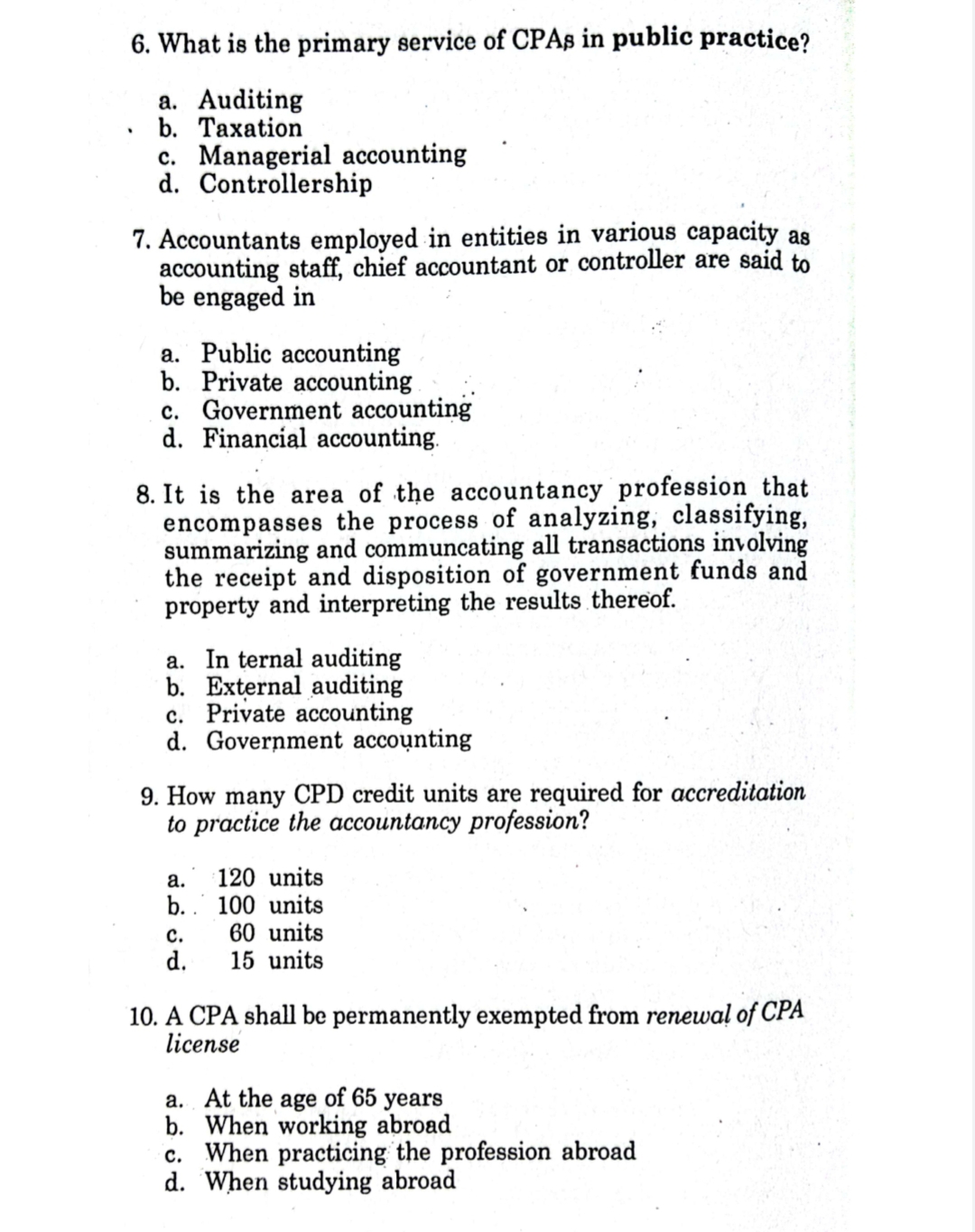
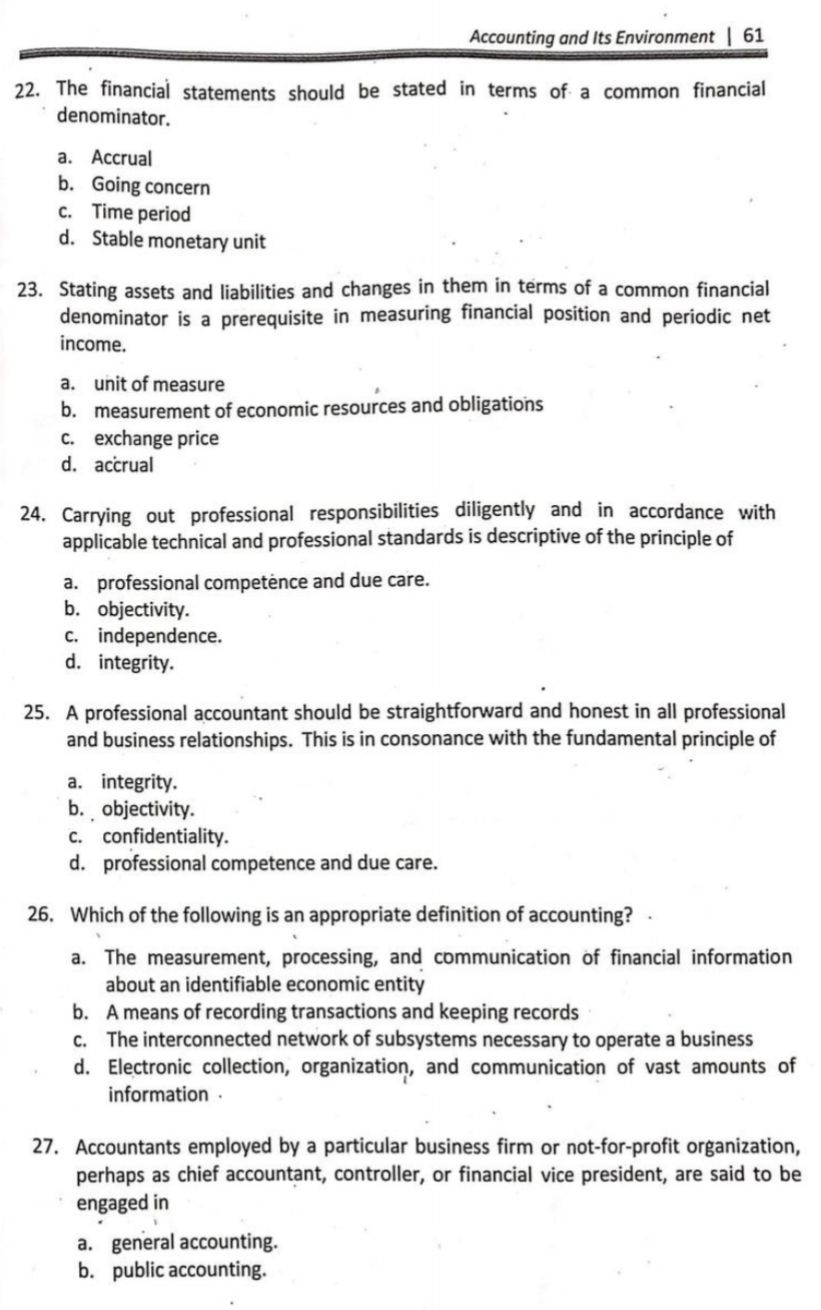
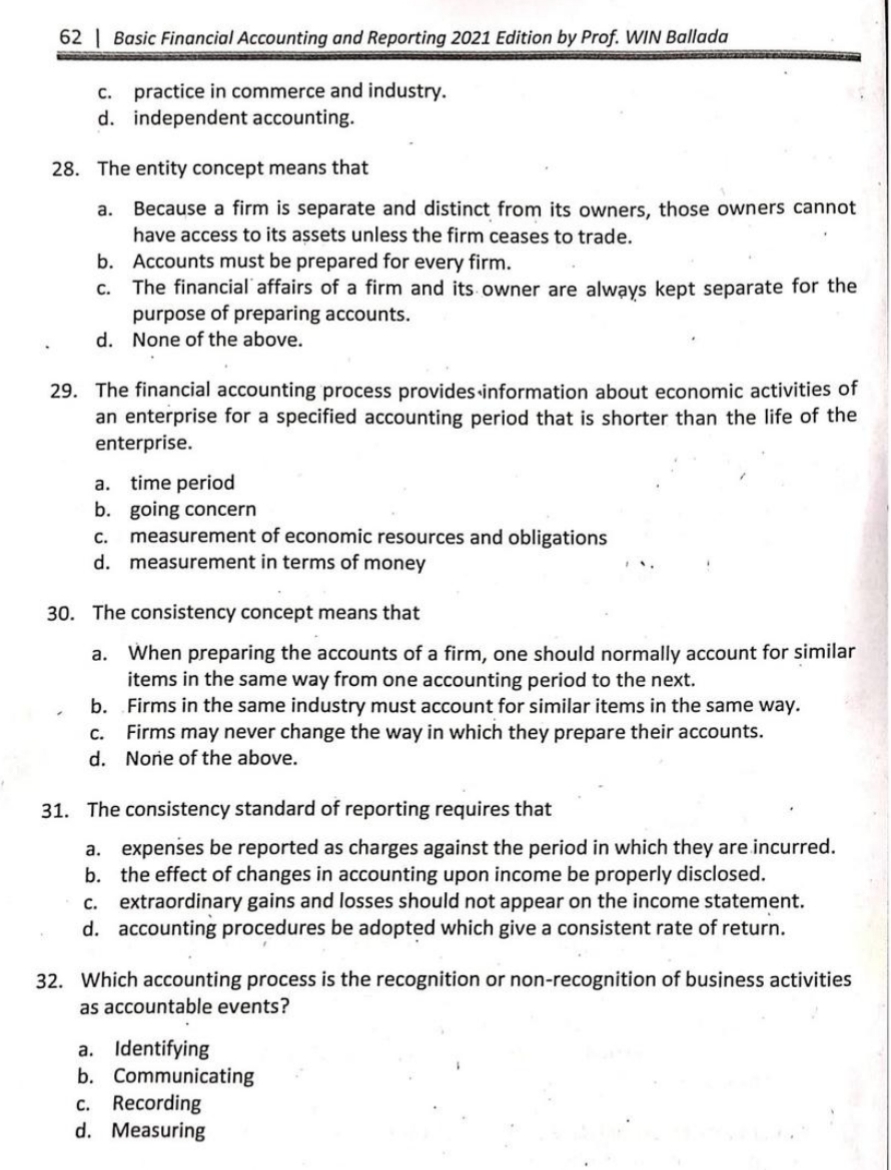
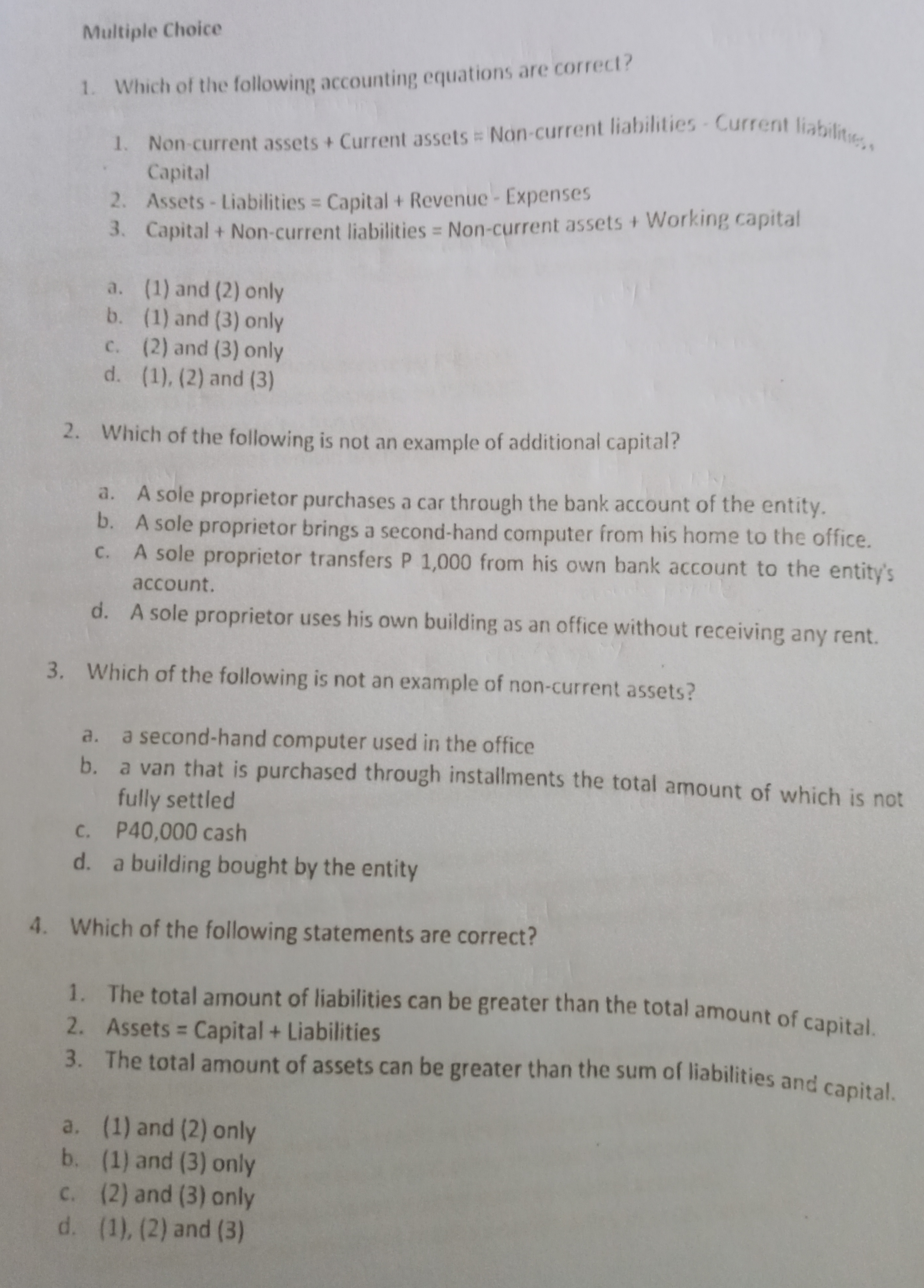
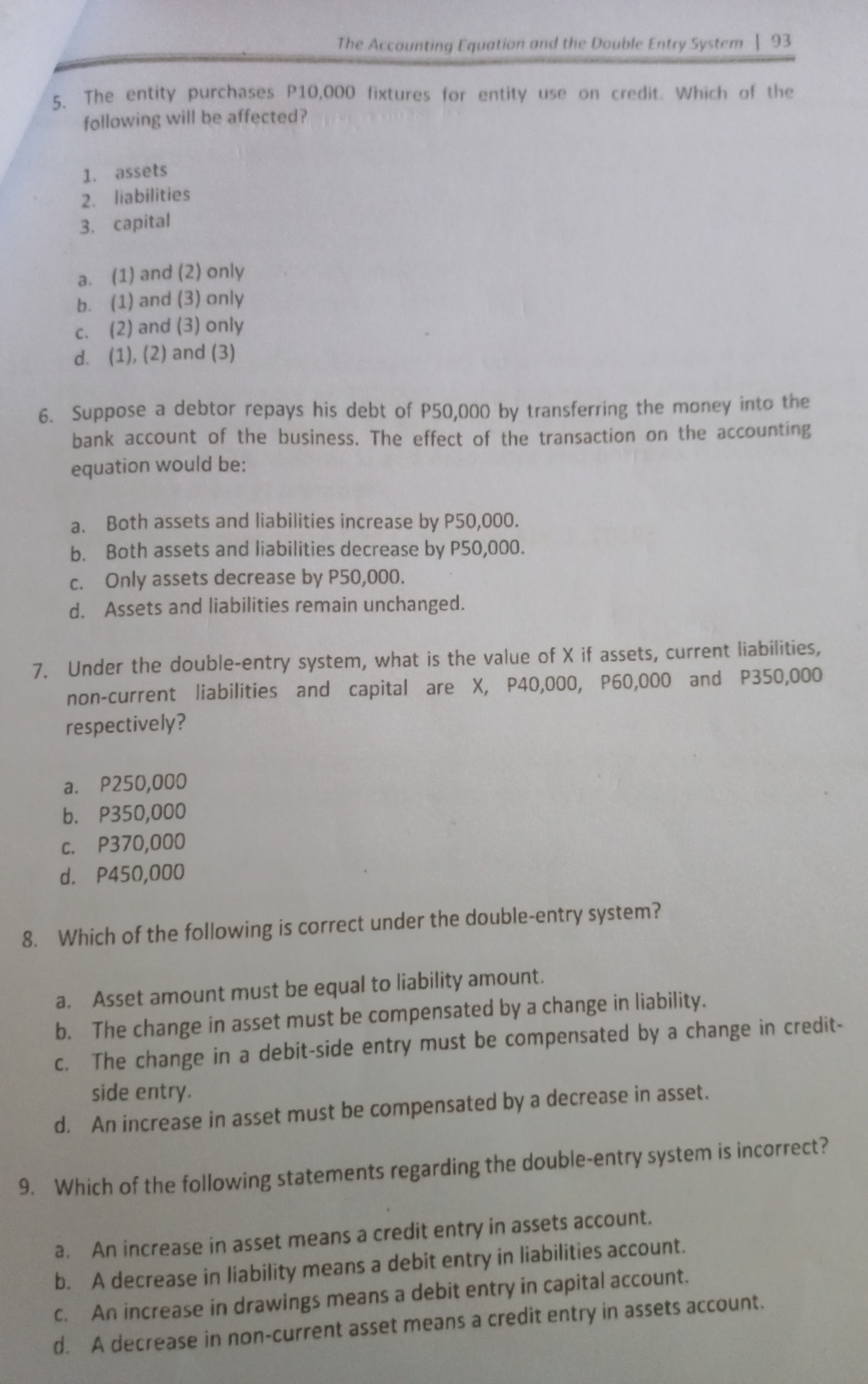
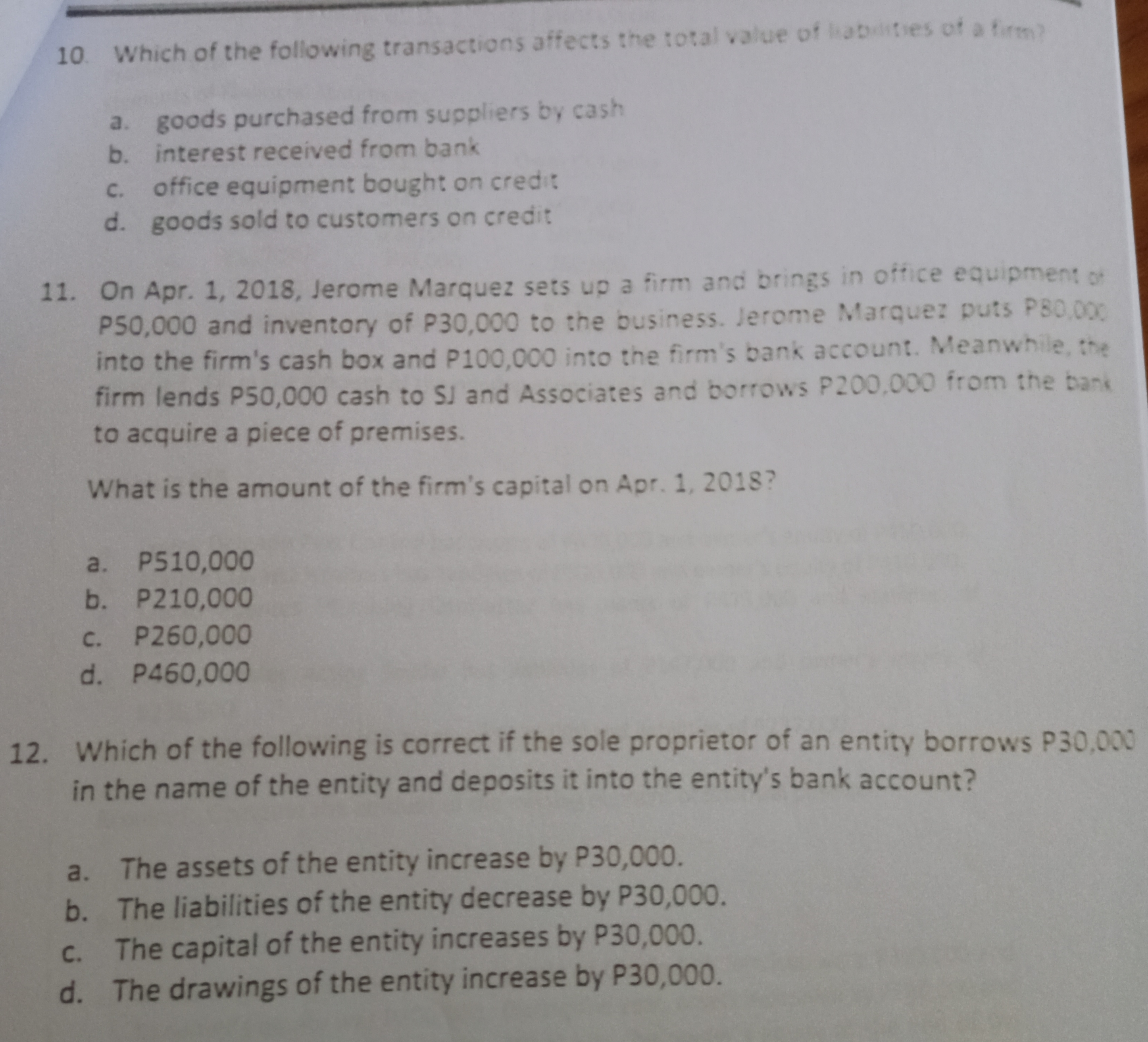
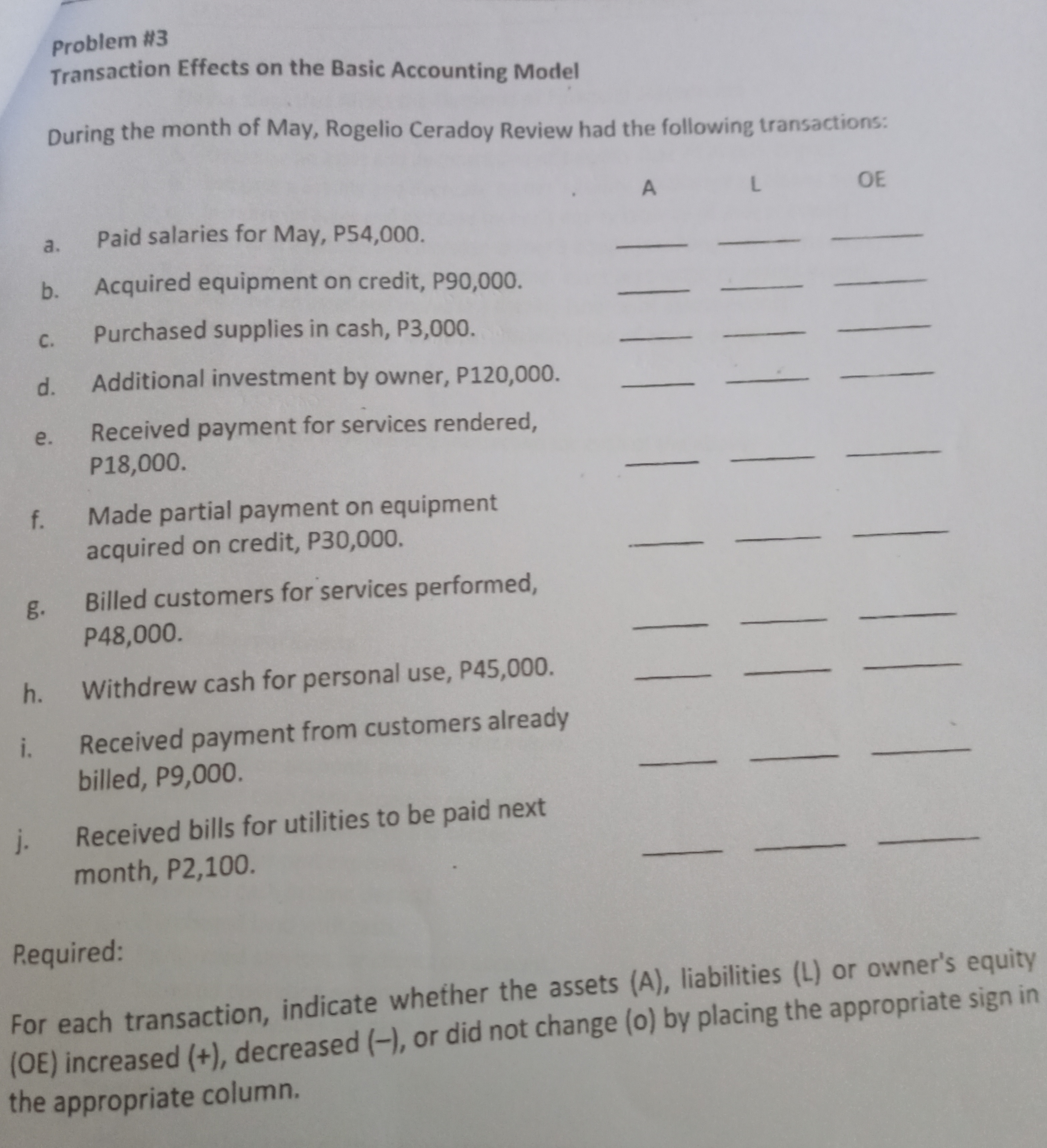
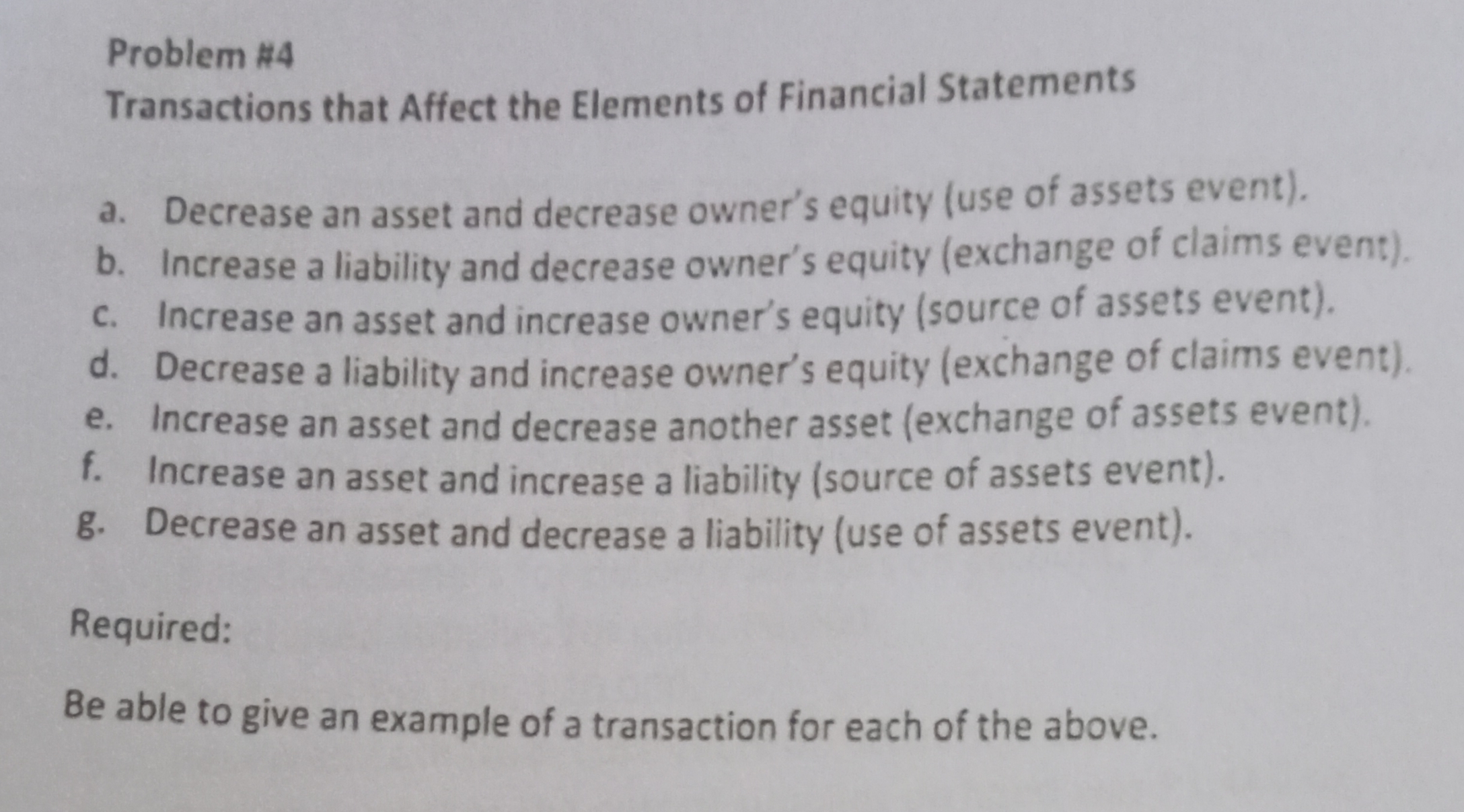
Problem 1-3 Multiple choice (ACP) 1. What is the standard-setting body in the Philippines at the present time? a. Accounting Standards Council b. Auditing and Assurance Standards Council c. Philippine Accounting Standards Board d. Financial Reporting Standards Council 2. All of the following are represented in FRSC, except a. Board of Accountancy b. Securities and Exchange Commission c. Commission on Audit . d. Department of Budget and Management 3. The Philippine Financial Reporting Standards collectively include a. PFRS corresponding to IFRS. b. PAS corresponding to LAS c. Philippine Interpretations corresponding to IFRIC and SIC Interpretations and Interpretations developed by PIC. d. All of these are included in Philippine Financial Reporting Standards 4. Accounting standard-setting has been characterized as a. A political process b. Using the scientific method c. Pure deductive reasoning d. A legal process 5. GAAP is an abbreviation for a. Generally authorized accounting procedures b. Generally applied accounting procedures c. Generally accepted auditing practices d. Generally accepted accounting principles6. What is the primary service of CPAa in public practice? a. Auditing b. Taxation c. Managerial accounting d. Controllership ' 7. Accountants employed in entities in various capacity as accounting staff, chief accountant or controller are said to be engaged in a. Public accounting b. Private accounting .. 0. Government accounting d. Financial accounting. 8.It is the area of the accountancy profession that encompasses the process of analyzing, classifying, summarizing and communcating all transactions in olving the receipt and disposition of government funds and property and interpreting the results thereof. a. In temal auditing b. External auditing c. Private accounting d. Government accounting 9. How many CPD credit units are required for accreditation to practice the accosntancy profession? a. 120 units b. .' 100 units c. 60 units d. 15 units 10. A CPA shall be permanently exempted from renewal of CPA license At the age of 65 years When working abroad When practicing the profession abroad When studying abroad 9'99\"!\" Accounting and Its Environment | 61 22. The financial statements should be stated in terms of a common financial denominator. a. Accrual b. Going concern c. Time period d. Stable monetary unit 23. Stating assets and liabilities and changes in them in terms of a common financial denominator is a prerequisite in measuring financial position and periodic net income. a. unit of measure b. measurement of economic resources and obligations C. exchange price d. accrual 24. Carrying out professional responsibilities diligently and in accordance with applicable technical and professional standards is descriptive of the principle of a. professional competence and due care. b. objectivity. c. independence. d. integrity. 25. A professional accountant should be straightforward and honest in all professional and business relationships. This is in consonance with the fundamental principle of a. integrity. b. objectivity. c. confidentiality. d. professional competence and due care. 26. Which of the following is an appropriate definition of accounting? a. The measurement, processing, and communication of financial information about an identifiable economic entity b. A means of recording transactions and keeping records c. The interconnected network of subsystems necessary to operate a business d. Electronic collection, organization, and communication of vast amounts of information . 27. Accountants employed by a particular business firm or not-for-profit organization, perhaps as chief accountant, controller, or financial vice president, are said to be engaged in a. general accounting. b. public accounting.62 I Basic Financioi Accounting and Reporting 2021 Edition by Prof. WiN Boiiodo c. practice in commerce and industry. d. independent accounting. 28. The entity concept means that a. Because a firm is separate and distinct from its owners, those owners cannot have access to its assets unless the rm ceases to trade. b. Accounts must be prepared for every firm. c. The financial'affairs of a rm and its owner are always kept separate for the purpose of preparing accounts. d. None of the above. 29. The nancial accounting process provides-information about economic activities of an enterprise for a specified accounting period that is shorter than the life of the enterprise. a. time period b. going concern c. measurement of economic resources and obligations d. measurement in terms of money .- ._ 30. The consistency concept means that a. When preparing the accounts of a firm, one should normally account for similar items in the same way from one accounting period to the next. b. Firms in the same industry must account for similar items in the same way. c. Firms may never change the way in which they prepare their accounts. d. None of the above. 31. The consistency standard of mporting requires that a. expenses be reported as charges against the period in which they are incurred. b. the effect of changes in accounting upon income be properly disclosed. c. extraordinary gains and losses should not appear on the income statement. d. accounting procedures be adopted which give a consistent rate of return. 32. Which accounting process is the recognition or non-recognition of business activities as accountable events? 3. Identifying b. Communicating c. Recording d. Measuring Multiple Choice 1. Which of the following accounting equations are correct? 1. Non-current assets + Current assets = Non-current liabilities - Current liabilities Capital 2. Assets - Liabilities = Capital + Revenue - Expenses 3. Capital + Non-current liabilities = Non-current assets + Working capital a. (1) and (2) only b. (1) and (3) only c. (2) and (3) only d. (1), (2) and (3) 2. Which of the following is not an example of additional capital? Ty a. A sole proprietor purchases a car through the bank account of the entity. b. A sole proprietor brings a second-hand computer from his home to the office. c. A sole proprietor transfers P 1,000 from his own bank account to the entity's account. d. A sole proprietor uses his own building as an office without receiving any rent. 3. Which of the following is not an example of non-current assets? a. a second-hand computer used in the office b. a van that is purchased through installments the total amount of which is not fully settled c. P40,000 cash d. a building bought by the entity 4. Which of the following statements are correct? 1. The total amount of liabilities can be greater than the total amount of capital. 2. Assets = Capital + Liabilities 3. The total amount of assets can be greater than the sum of liabilities and capital. a. (1) and (2) only b. (1) and (3) only c. (2) and (3) only d. (1), (2) and (3)The Accounting Equation and the Double Entry System | 93 5. The entity purchases P10,000 fixtures for entity use on credit. Which of the following will be affected? 1. assets 2. liabilities 3. capital a. (1) and (2) only b. (1) and (3) only c. (2) and (3) only d. (1), (2) and (3) 6. Suppose a debtor repays his debt of P50,000 by transferring the money into the bank account of the business. The effect of the transaction on the accounting equation would be: a. Both assets and liabilities increase by P50,000. b. Both assets and liabilities decrease by P50,000. c. Only assets decrease by P50,000. d. Assets and liabilities remain unchanged. 7. Under the double-entry system, what is the value of X if assets, current liabilities, non-current liabilities and capital are X, P40,000, P60,000 and P350,000 respectively? a. P250,000 b. P350,000 C. P370,000 d. P450,000 8. Which of the following is correct under the double-entry system? a. Asset amount must be equal to liability amount. b. The change in asset must be compensated by a change in liability. C. The change in a debit-side entry must be compensated by a change in credit- side entry. d. An increase in asset must be compensated by a decrease in asset. 9. Which of the following statements regarding the double-entry system is incorrect? a. An increase in asset means a credit entry in assets account. b. A decrease in liability means a debit entry in liabilities account. C. An increase in drawings means a debit entry in capital account. d. A decrease in non-current asset means a credit entry in assets account.10. Which of the following transactions affects the total value of habilities of a firm> a. goods purchased from suppliers by cash b. interest received from bank c. office equipment bought on credit d. goods sold to customers on credit 11. On Apr. 1, 2018, Jerome Marquez sets up a firm and brings in office equipment of P50,000 and inventory of P30,000 to the business. Jerome Marquez puts P80,000 into the firm's cash box and P100,000 into the firm's bank account. Meanwhile, the firm lends P50,000 cash to SJ and Associates and borrows P200,000 from the bank to acquire a piece of premises. What is the amount of the firm's capital on Apr. 1, 2018? a. P510,000 b. P210,000 c. P260,000 d. P460,000 12. Which of the following is correct if the sole proprietor of an entity borrows P30,000 in the name of the entity and deposits it into the entity's bank account? a. The assets of the entity increase by P30,000. b. The liabilities of the entity decrease by P30,000. c. The capital of the entity increases by P30,000. d. The drawings of the entity increase by P30,000.Problem #3 Transaction Effects on the Basic Accounting Model During the month of May, Rogelio Ceradoy Review had the following transactions: A OE a. Paid salaries for May, P54,000. b. Acquired equipment on credit, P90,000. C. Purchased supplies in cash, P3,000. d. Additional investment by owner, P120,000. e. Received payment for services rendered, P18,000. f. Made partial payment on equipment acquired on credit, P30,000. 1 1.11 1 1 1 Billed customers for services performed, P48,000. h. Withdrew cash for personal use, P45,000. i. Received payment from customers already billed, P9,000. j. Received bills for utilities to be paid next month, P2,100. Required: For each transaction, indicate whether the assets (A), liabilities (L) or owner's equity (OE) increased (+), decreased (-), or did not change (o) by placing the appropriate sign in the appropriate column.Problem #4 Transactions that Affect the Elements of Financial Statements a. Decrease an asset and decrease owner's equity (use of assets event). b. Increase a liability and decrease owner's equity (exchange of claims event). C. Increase an asset and increase owner's equity (source of assets event). d. Decrease a liability and increase owner's equity (exchange of claims event) e. Increase an asset and decrease another asset (exchange of assets event). f. Increase an asset and increase a liability (source of assets event). g. Decrease an asset and decrease a liability (use of assets event). Required: Be able to give an example of a transaction for each of the above
Step by Step Solution
There are 3 Steps involved in it
1 Expert Approved Answer
Step: 1 Unlock
Question Has Been Solved by an Expert!
Get step-by-step solutions from verified subject matter experts
Step: 2 Unlock
Step: 3 Unlock
Students Have Also Explored These Related Accounting Questions!









 Study Help