







Question: Problem 1.4In Exercise 1.4, we use an artificial data set to study the perceptron learning algorithm. This problem leads you to explore the algorithm further
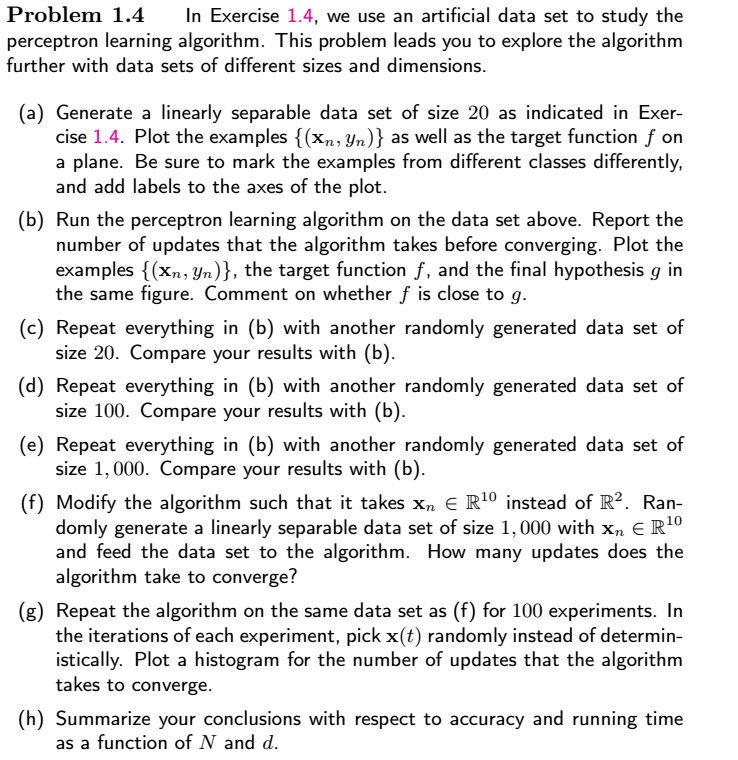
Problem 1.4In Exercise 1.4, we use an artificial data set to study the perceptron learning algorithm. This problem leads you to explore the algorithm further with data sets of different sizes and dimensions (a) Generate a linearly separable data set of size 20 as indicated in Exer cise 1.4. Plot the examples (xn , yn)) as well as the target function f on a plane. Be sure to mark the examples from different classes differently, and add labels to the axes of the plot. (b) Run the perceptron learning algorithm on the data set above. Report the number of updates that the algorithm takes before converging. Plot the examples {(Xn,Yn), the target function f, and the final hypothesis g in the same figure. Comment on whether f is close to g (c) Repeat everything in (b) with another randomly generated data set of (d) Repeat everything in (b) with another randomly generated data set of (e) Repeat everything in (b) with another randomly generated data set of (f) Modify the algorithm such that it takes Rio instead of R2. Ran- size 20. Compare your results with (b) size 100. Compare your results with (b) size 1,000. Compare your results with (b) 10 domly generate a linearly separable data set of size 1,000 with xn R and feed the data set to the algorithm. How many updates does the algorithm take to converge? (g) Repeat the algorithm on the same data set as (f) for 100 experiments. In the iterations of each experiment, pick x(t) randomly instead of determin- istically. Plot a histogram for the number of updates that the algorithm takes to converge (h) Summarize your conclusions with respect to accuracy and running time as a function of N and d Problem 1.4In Exercise 1.4, we use an artificial data set to study the perceptron learning algorithm. This problem leads you to explore the algorithm further with data sets of different sizes and dimensions (a) Generate a linearly separable data set of size 20 as indicated in Exer cise 1.4. Plot the examples (xn , yn)) as well as the target function f on a plane. Be sure to mark the examples from different classes differently, and add labels to the axes of the plot. (b) Run the perceptron learning algorithm on the data set above. Report the number of updates that the algorithm takes before converging. Plot the examples {(Xn,Yn), the target function f, and the final hypothesis g in the same figure. Comment on whether f is close to g (c) Repeat everything in (b) with another randomly generated data set of (d) Repeat everything in (b) with another randomly generated data set of (e) Repeat everything in (b) with another randomly generated data set of (f) Modify the algorithm such that it takes Rio instead of R2. Ran- size 20. Compare your results with (b) size 100. Compare your results with (b) size 1,000. Compare your results with (b) 10 domly generate a linearly separable data set of size 1,000 with xn R and feed the data set to the algorithm. How many updates does the algorithm take to converge? (g) Repeat the algorithm on the same data set as (f) for 100 experiments. In the iterations of each experiment, pick x(t) randomly instead of determin- istically. Plot a histogram for the number of updates that the algorithm takes to converge (h) Summarize your conclusions with respect to accuracy and running time as a function of N and d
Step by Step Solution
There are 3 Steps involved in it

Get step-by-step solutions from verified subject matter experts
 Study Help