







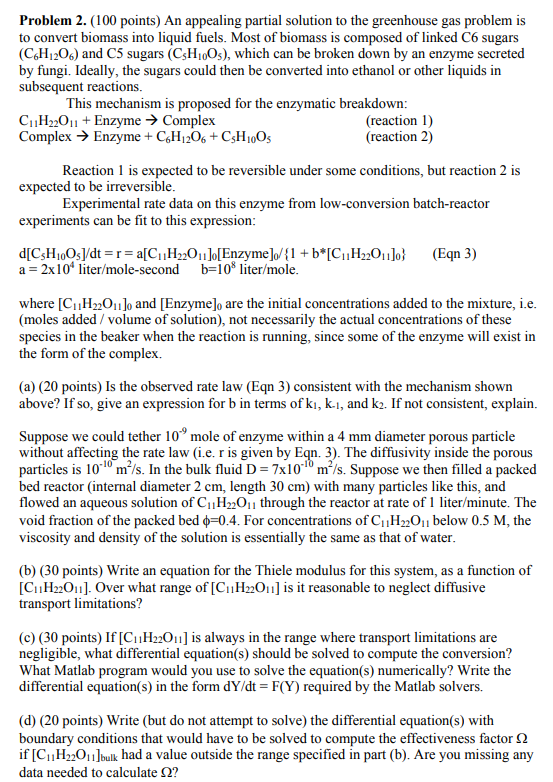
Question: Problem 2 . ( 1 0 0 points ) An appealing partial solution to the greenhouse gas problem is to convert biomass into liquid fuels.
Problem points An appealing partial solution to the greenhouse gas problem is
to convert biomass into liquid fuels. Most of biomass is composed of linked C sugars
and sugars which can be broken down by an enzyme secreted
by fungi. Ideally, the sugars could then be converted into ethanol or other liquids in
subsequent reactions.
This mechanism is proposed for the enzymatic breakdown:
Enzyme Complex reaction
Complex Enzyme reaction
Reaction is expected to be reversible under some conditions, but reaction is
expected to be irreversible.
Experimental rate data on this enzyme from lowconversion batchreactor
experiments can be fit to this expression:
Eqn
liter molesecond liter mole.
where and Enzyme are the initial concentrations added to the mixture, ie
moles added volume of solution not necessarily the actual concentrations of these
species in the beaker when the reaction is running, since some of the enzyme will exist in
the form of the complex.
a points Is the observed rate law Eqn consistent with the mechanism shown
above? If so give an expression for in terms of and If not consistent, explain.
Suppose we could tether mole of enzyme within a diameter porous particle
without affecting the rate law ie is given by Eqn. The diffusivity inside the porous
particles is In the bulk fluid Suppose we then filled a packed
bed reactor internal diameter length with many particles like this, and
flowed an aqueous solution of through the reactor at rate of literminute The
void fraction of the packed bed For concentrations of below the
viscosity and density of the solution is essentially the same as that of water.
b points Write an equation for the Thiele modulus for this system, as a function of
Over what range of is it reasonable to neglect diffusive
transport limitations
c points If is always in the range where transport limitations are
negligible, what differential equations should be solved to compute the conversion?
What Matlab program would you use to solve the equations numerically? Write the
differential equations in the form required by the Matlab solvers.
d points Write but do not attempt to solve the differential equations with
boundary conditions that would have to be solved to compute the effectiveness factor
if had a value outside the range specified in part b Are you missing any
data needed to calculate
Step by Step Solution
There are 3 Steps involved in it
1 Expert Approved Answer
Step: 1 Unlock

Question Has Been Solved by an Expert!
Get step-by-step solutions from verified subject matter experts
Step: 2 Unlock
Step: 3 Unlock
 Study Help