







Question: Problem #2 1. Jill and John Best are contemplating opening a small store in their local community. They are very interested in providing a level
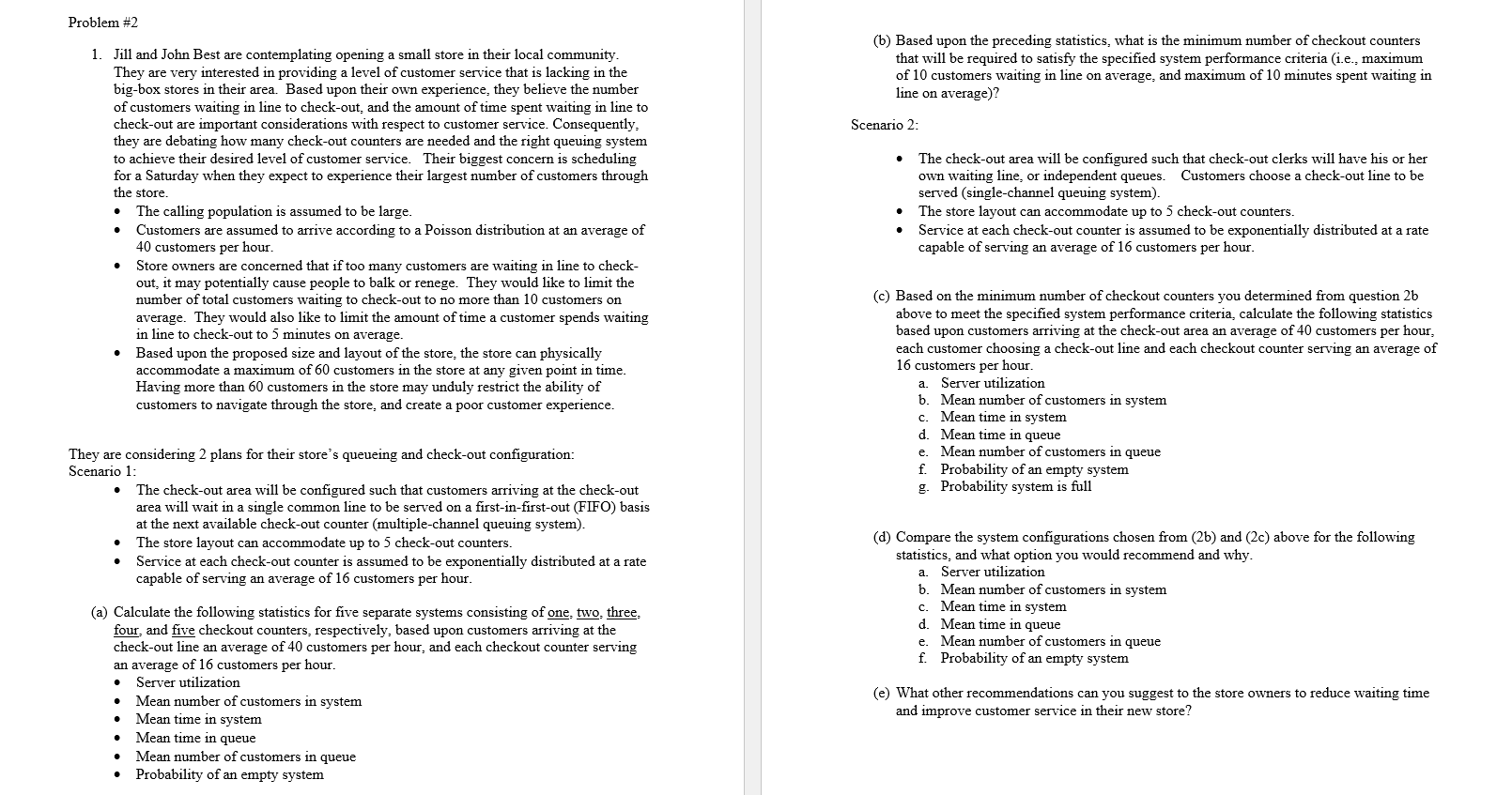
Problem \#2 1. Jill and John Best are contemplating opening a small store in their local community. They are very interested in providing a level of customer service that is lacking in the big-box stores in their area. Based upon their own experience, they believe the number of customers waiting in line to check-out, and the amount of time spent waiting in line to check-out are important considerations with respect to customer service. Consequently, they are debating how many check-out counters are needed and the right queuing system to achieve their desired level of customer service. Their biggest concern is scheduling for a Saturday when they expect to experience their largest number of customers through the store. - The calling population is assumed to be large. - Customers are assumed to arrive according to a Poisson distribution at an average of 40 customers per hour. - Store owners are concerned that if too many customers are waiting in line to checkout, it may potentially cause people to balk or renege. They would like to limit the number of total customers waiting to check-out to no more than 10 customers on average. They would also like to limit the amount of time a customer spends waiting in line to check-out to 5 minutes on average. - Based upon the proposed size and layout of the store, the store can physically accommodate a maximum of 60 customers in the store at any given point in time. Having more than 60 customers in the store may unduly restrict the ability of customers to navigate through the store, and create a poor customer experience. They are considering 2 plans for their store's queueing and check-out configuration: Scenario 1: - The check-out area will be configured such that customers arriving at the check-out area will wait in a single common line to be served on a first-in-first-out (FIFO) basis at the next available check-out counter (multiple-channel queuing system). - The store layout can accommodate up to 5 check-out counters. - Service at each check-out counter is assumed to be exponentially distributed at a rate capable of serving an average of 16 customers per hour. (a) Calculate the following statistics for five separate systems consisting of one, two, three, four, and five checkout counters, respectively, based upon customers arriving at the check-out line an average of 40 customers per hour, and each checkout counter serving an average of 16 customers per hour. - Server utilization - Mean number of customers in system - Mean time in system - Mean time in queue - Mean number of customers in queue - Probability of an empty system (b) Based upon the preceding statistics, what is the minimum number of checkout counters that will be required to satisfy the specified system performance criteria (i.e., maximum of 10 customers waiting in line on average, and maximum of 10 minutes spent waiting in line on average)? Scenario 2: - The check-out area will be configured such that check-out clerks will have his or her own waiting line, or independent queues. Customers choose a check-out line to be served (single-channel queuing system). - The store layout can accommodate up to 5 check-out counters. - Service at each check-out counter is assumed to be exponentially distributed at a rate capable of serving an average of 16 customers per hour. (c) Based on the minimum number of checkout counters you determined from question 2b above to meet the specified system performance criteria, calculate the following statistics based upon customers arriving at the check-out area an average of 40 customers per hour, each customer choosing a check-out line and each checkout counter serving an average of 16 customers per hour. a. Server utilization b. Mean number of customers in system c. Mean time in system d. Mean time in queue e. Mean number of customers in queue f. Probability of an empty system g. Probability system is full (d) Compare the system configurations chosen from (2b) and (2c) above for the following statistics, and what option you would recommend and why. a. Server utilization b. Mean number of customers in system c. Mean time in system d. Mean time in queue e. Mean number of customers in queue f. Probability of an empty system (e) What other recommendations can you suggest to the store owners to reduce waiting time and improve customer service in their new store
Step by Step Solution
There are 3 Steps involved in it

Get step-by-step solutions from verified subject matter experts
 Study Help