Question: Problem 2 (14 pts) Consider the autonomous planar (i.e., n=2) model x1=2x1+x2,x2=x1+(x1+x2)2 (a) (2 pts) Obtain all equilibrium points for this model. (To avoid cluttered

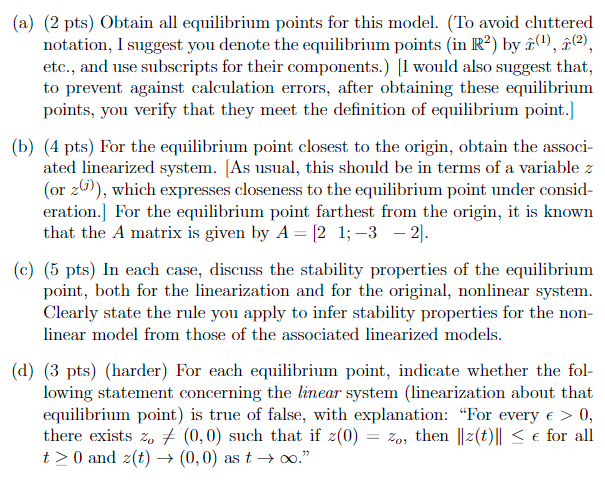
Problem 2 (14 pts) Consider the autonomous planar (i.e., n=2) model x1=2x1+x2,x2=x1+(x1+x2)2 (a) (2 pts) Obtain all equilibrium points for this model. (To avoid cluttered notation, I suggest you denote the equilibrium points (in R2 ) by x^(1),x^(2), etc., and use subscripts for their components.) (I would also suggest that, to prevent against calculation errors, after obtaining these equilibrium points, you verify that they meet the definition of equilibrium point.] (b) (4 pts) For the equilibrium point closest to the origin, obtain the associated linearized system. [As usual, this should be in terms of a variable z (or z(j) ), which expresses closeness to the equilibrium point under consideration.] For the equilibrium point farthest from the origin, it is known that the A matrix is given by A=[21;32]. (c) (5 pts) In each case, discuss the stability properties of the equilibrium point, both for the linearization and for the original, nonlinear system. Clearly state the rule you apply to infer stability properties for the nonlinear model from those of the associated linearized models. (d) (3 pts) (harder) For each equilibrium point, indicate whether the following statement concerning the linear system (linearization about that equilibrium point) is true of false, with explanation: "For every >0, there exists zo=(0,0) such that if z(0)=zo, then z(t) for all t0 and z(t)(0,0) as t." Problem 2 (14 pts) Consider the autonomous planar (i.e., n=2) model x1=2x1+x2,x2=x1+(x1+x2)2 (a) (2 pts) Obtain all equilibrium points for this model. (To avoid cluttered notation, I suggest you denote the equilibrium points (in R2 ) by x^(1),x^(2), etc., and use subscripts for their components.) (I would also suggest that, to prevent against calculation errors, after obtaining these equilibrium points, you verify that they meet the definition of equilibrium point.] (b) (4 pts) For the equilibrium point closest to the origin, obtain the associated linearized system. [As usual, this should be in terms of a variable z (or z(j) ), which expresses closeness to the equilibrium point under consideration.] For the equilibrium point farthest from the origin, it is known that the A matrix is given by A=[21;32]. (c) (5 pts) In each case, discuss the stability properties of the equilibrium point, both for the linearization and for the original, nonlinear system. Clearly state the rule you apply to infer stability properties for the nonlinear model from those of the associated linearized models. (d) (3 pts) (harder) For each equilibrium point, indicate whether the following statement concerning the linear system (linearization about that equilibrium point) is true of false, with explanation: "For every >0, there exists zo=(0,0) such that if z(0)=zo, then z(t) for all t0 and z(t)(0,0) as t









 Study Help