







Question: Problem 2: (15 points) A computer system uses a 10 bit word to represent normalized (regular normalization a:s described in the textbook, not IEEE normalization)
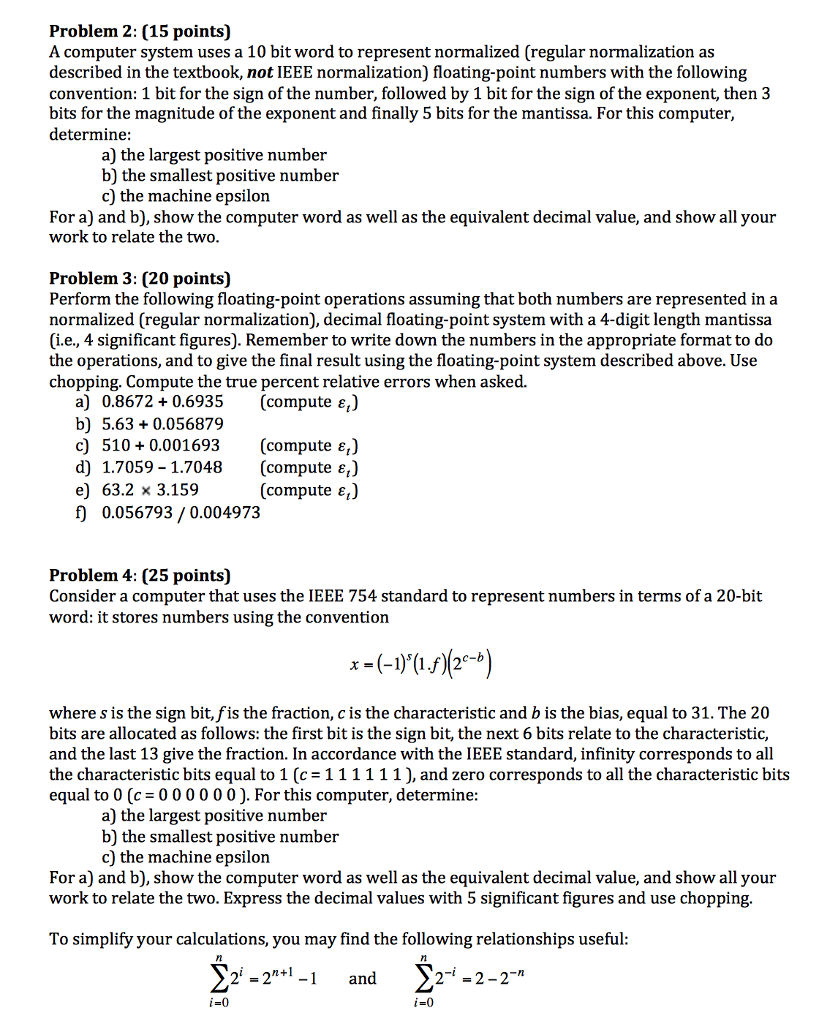
Problem 2: (15 points) A computer system uses a 10 bit word to represent normalized (regular normalization a:s described in the textbook, not IEEE normalization) floating-point numbers with the following convention: 1 bit for the sign of the number, followed by 1 bit for the sign of the exponent, then 3 bits for the magnitude of the exponent and finally 5 bits for the mantissa. For this computer, determine a) the largest positive number b) the smallest positive number c) the machine epsilon For a) and b), show the computer word as well as the equivalent decimal value, and show all your work to relate the two Problem 3: (20 points) Perform the following floating-point operations assuming that both numbers are represented in a normalized (regular normalization), decimal floating-point system with a 4-digit length mantissa (i.e., 4 significant figures). Remember to write down the numbers in the appropriate format to do the operations, and to give the final result using the floating-point system described above. Use chopping. Compute the true percent relative errors when asked. a) 0.8672 + 0.6935 (compute .) b) 5.63 + 0.056879 c) 510 + 0.001693 (compute .) d) 1.7059-1.7048 (compute .) e) 63.23.159 f) 0.056793 / 0.004973 (compute .) Problem 4: (25 points) Consider a computer that uses the IEEE 754 standard to represent numbers in terms of a 20-bit word: it stores numbers using the convention where s is the sign bit, fis the fraction, c is the characteristic and b is the bias, equal to 31. The 20 bits are allocated as follows: the first bit is the sign bit, the next 6 bits relate to the characteristic, and the last 13 give the fraction. In accordance with the IEEE standard, infinity corresponds to all the characteristic bits equal to 1 (c = 1 1 1 1 1 1 ), and zero corresponds to all the characteristic bits equal to 0 (c = 0 0 0 0 0 0 ). For this computer, determine: a) the largest positive number b) the smallest positive number c) the machine epsilon For a) and b), show the computer word as well as the equivalent decimal value, and show all your work to relate the two. Express the decimal values with 5 significant figures and use chopping To simplify your calculations, you may find the following relationships useful 2'-2" -1 and 2-2-2" i-0
Step by Step Solution
There are 3 Steps involved in it

Get step-by-step solutions from verified subject matter experts
 Study Help