





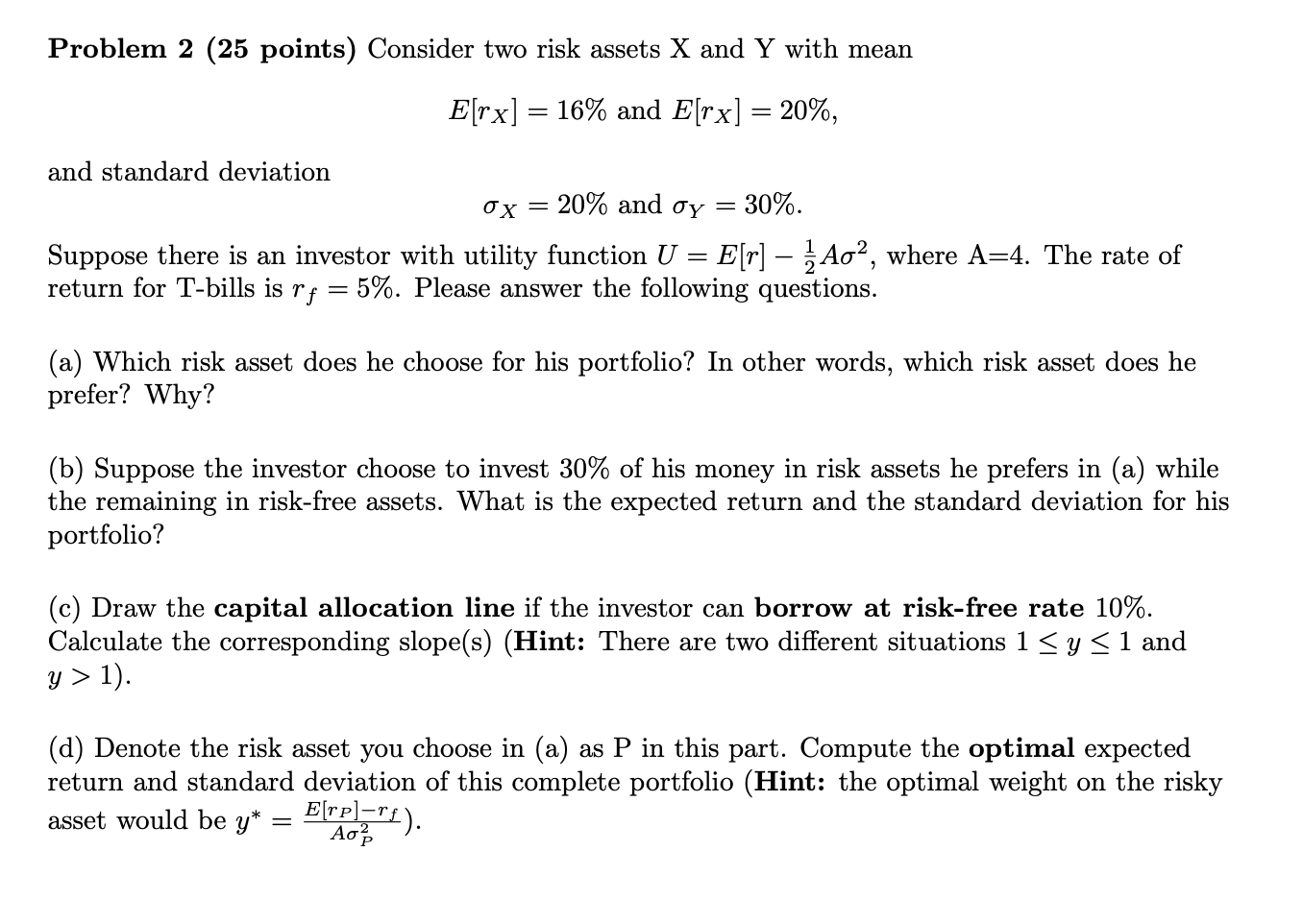
Question: Problem 2 (25 points) Consider two risk assets X and Y with mean E[rx] = 16% and E[rx] = 20%, ox and standard deviation =
 Problem 2 (25 points) Consider two risk assets X and Y

Problem 2 (25 points) Consider two risk assets X and Y with mean E[rx] = 16% and E[rx] = 20%, ox and standard deviation = 20% and oy = 30%. Suppose there is an investor with utility function U = E[r] Ao?, where A=4. The rate of return for T-bills is rf = 5%. Please answer the following questions. (a) Which risk asset does he choose for his portfolio? In other words, which risk asset does he prefer? Why? (b) Suppose the investor choose to invest 30% of his money in risk assets he prefers in (a) while the remaining in risk-free assets. What is the expected return and the standard deviation for his portfolio? (c) Draw the capital allocation line if the investor can borrow at risk-free rate 10%. Calculate the corresponding slope(s) (Hint: There are two different situations 1 1). (d) Denote the risk asset you choose in (a) as P in this part. Compute the optimal expected return and standard deviation of this complete portfolio (Hint: the optimal weight on the risky asset would be y* = ET "L). P Problem 2 (25 points) Consider two risk assets X and Y with mean E[rx] = 16% and E[rx] = 20%, ox and standard deviation = 20% and oy = 30%. Suppose there is an investor with utility function U = E[r] Ao?, where A=4. The rate of return for T-bills is rf = 5%. Please answer the following questions. (a) Which risk asset does he choose for his portfolio? In other words, which risk asset does he prefer? Why? (b) Suppose the investor choose to invest 30% of his money in risk assets he prefers in (a) while the remaining in risk-free assets. What is the expected return and the standard deviation for his portfolio? (c) Draw the capital allocation line if the investor can borrow at risk-free rate 10%. Calculate the corresponding slope(s) (Hint: There are two different situations 1 1). (d) Denote the risk asset you choose in (a) as P in this part. Compute the optimal expected return and standard deviation of this complete portfolio (Hint: the optimal weight on the risky asset would be y* = ET "L). P

Step by Step Solution

There are 3 Steps involved in it

1 Expert Approved Answer
Step: 1 Unlock blur-text-image
Question Has Been Solved by an Expert!

Get step-by-step solutions from verified subject matter experts

Step: 2 Unlock
Step: 3 Unlock

Students Have Also Explored These Related Finance Questions!