







Question: Problem 2 (30 points) A bacterium is to be grown in aerobic batch culture using a molasses medium. Laboratory experiments indicate that a lag phase
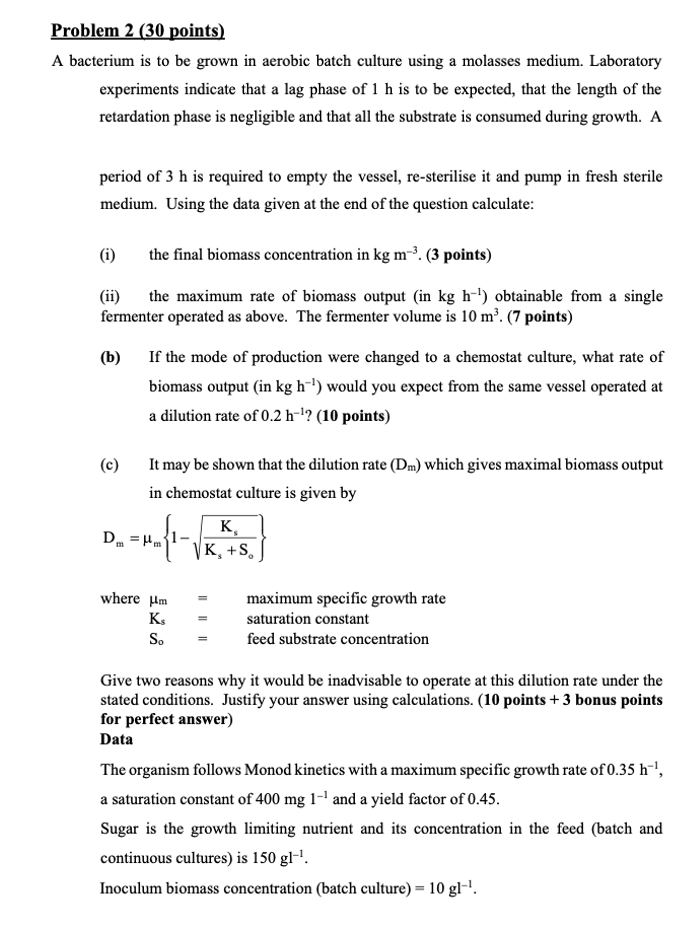
Problem 2 (30 points) A bacterium is to be grown in aerobic batch culture using a molasses medium. Laboratory experiments indicate that a lag phase of 1 h is to be expected, that the length of the retardation phase is negligible and that all the substrate is consumed during growth. A period of 3 h is required to empty the vessel, re-sterilise it and pump in fresh sterile medium. Using the data given at the end of the question calculate: (i) the final biomass concentration in kg m-?. (3 points) (ii) the maximum rate of biomass output (in kg h) obtainable from a single fermenter operated as above. The fermenter volume is 10 m. (7 points) (b) If the mode of production were changed to a chemostat culture, what rate of biomass output (in kg h-!) would you expect from the same vessel operated at a dilution rate of 0.2 h-'? (10 points) (c) It may be shown that the dilution rate (Dm) which gives maximal biomass output in chemostat culture is given by K K+S D = m ----- where um Ks S. maximum specific growth rate saturation constant feed substrate concentration Give two reasons why it would be inadvisable to operate at this dilution rate under the stated conditions. Justify your answer using calculations. (10 points + 3 bonus points for perfect answer) Data The organism follows Monod kinetics with a maximum specific growth rate of 0.35 h-!, a saturation constant of 400 mg 1- and a yield factor of 0.45. Sugar is the growth limiting nutrient and its concentration in the feed (batch and continuous cultures) is 150 gl-!. Inoculum biomass concentration (batch culture) = 10 gl
Step by Step Solution
There are 3 Steps involved in it

Get step-by-step solutions from verified subject matter experts
 Study Help