







Question: Problem 3 (35 points) (a) The parent culture for a bacterial fermentation was grown at 30C in a medium containing 60 g/l glucose, 20 g/l
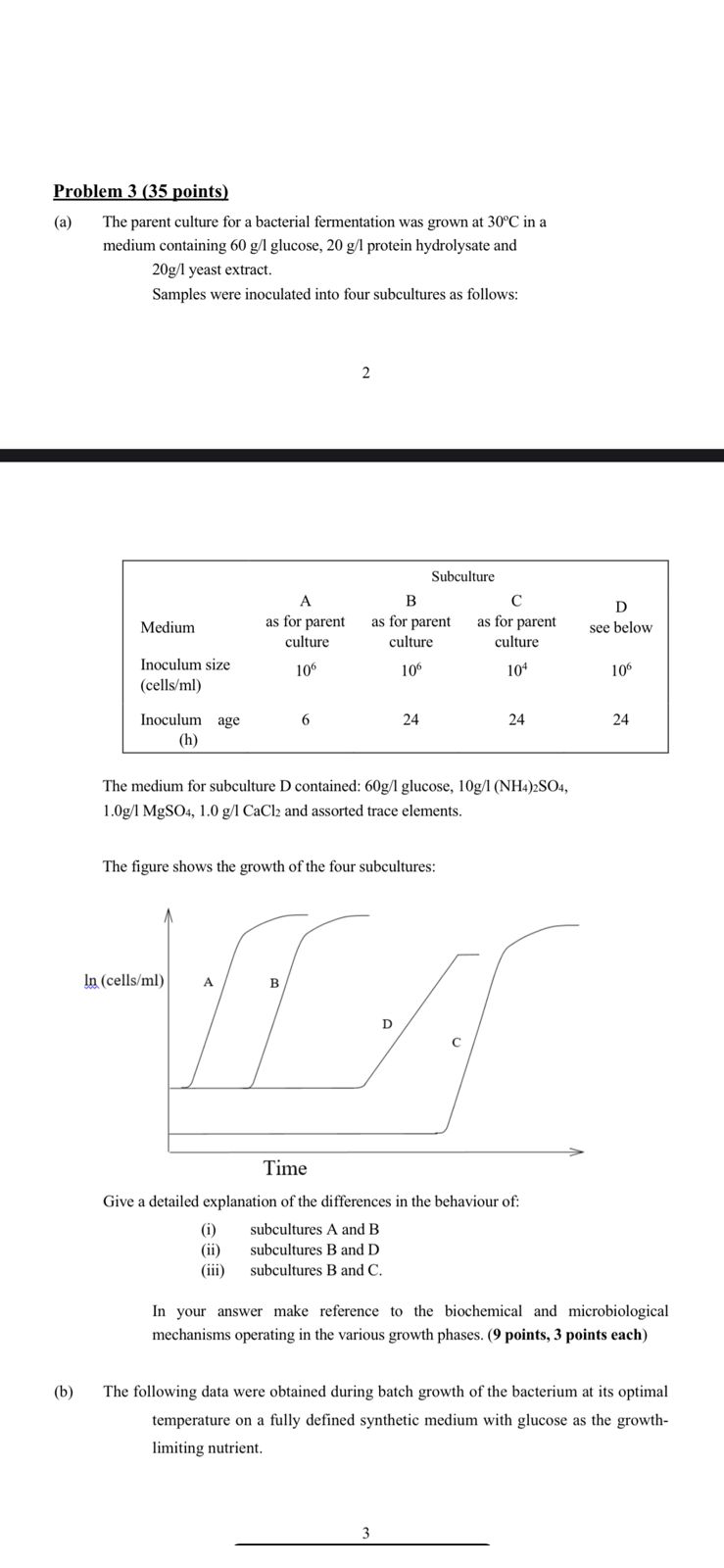
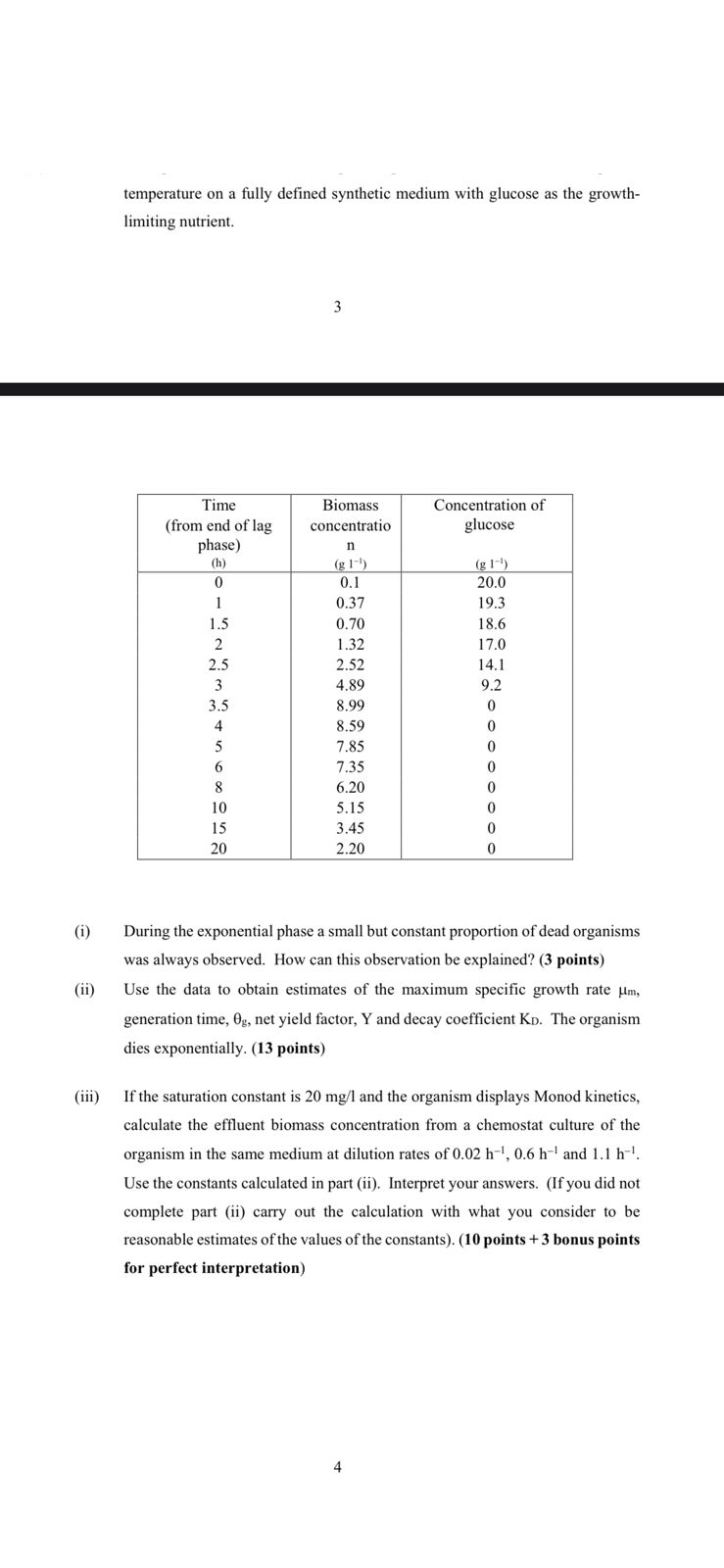
Problem 3 (35 points) (a) The parent culture for a bacterial fermentation was grown at 30C in a medium containing 60 g/l glucose, 20 g/l protein hydrolysate and 20g/1 yeast extract Samples were inoculated into four subcultures as follows: 2 A Medium as for parent Subculture B as for parent as for parent culture culture 106 104 D see below culture Inoculum size (cells/ml) 106 106 6 24 24 Inoculum age (h) h 24 The medium for subculture D contained: 60g/l glucose, 10g/1 (NH4)2SO4, 1.0g/MgSO4, 1.0 g/l CaCl2 and assorted trace elements. The figure shows the growth of the four subcultures: In (cells/ml) A B D Time Give a detailed explanation of the differences in the behaviour of: (i) subcultures A and B (ii) subcultures B and D (iii) subcultures B and C. In your answer make reference to the biochemical and microbiological mechanisms operating in the various growth phases. (9 points, 3 points each) (b) The following data were obtained during batch growth of the bacterium at its optimal temperature on a fully defined synthetic medium with glucose as the growth- limiting nutrient 3 temperature on a fully defined synthetic medium with glucose as the growth- limiting nutrient 3 Concentration of glucose Time (from end of lag phase) (h) ( 0 1 20.0 19.3 1.5 18.6 2 2.5 3 3.5 4 5 5 6 8 8 10 15 20 Biomass concentratio n "') (g1') 0.1 0.37 0.70 1.32 2.52 4.89 8.99 8.59 7.85 7.35 6.20 5.15 3.45 2.20 17.0 14.1 9.2 0 0 0 0 0 0 0 0 (i) (ii) During the exponential phase a small but constant proportion of dead organisms was always observed. How can this observation be explained? (3 points) Use the data to obtain estimates of the maximum specific growth rate um, generation time, 0g, net yield factor, Y and decay coefficient Kp. The organism dies exponentially. (13 points) If the saturation constant is 20 mg/l and the organism displays Monod kinetics, calculate the effluent biomass concentration from a chemostat culture of the organism in the same medium at dilution rates of 0.02 h-!, 0.6 h- and 1.1 h-! Use the constants calculated in part (ii). Interpret your answers. (If you did not complete part (ii) carry out the calculation with what you consider to be reasonable estimates of the values of the constants). (10 points + 3 bonus points for perfect interpretation) 4 Problem 3 (35 points) (a) The parent culture for a bacterial fermentation was grown at 30C in a medium containing 60 g/l glucose, 20 g/l protein hydrolysate and 20g/1 yeast extract Samples were inoculated into four subcultures as follows: 2 A Medium as for parent Subculture B as for parent as for parent culture culture 106 104 D see below culture Inoculum size (cells/ml) 106 106 6 24 24 Inoculum age (h) h 24 The medium for subculture D contained: 60g/l glucose, 10g/1 (NH4)2SO4, 1.0g/MgSO4, 1.0 g/l CaCl2 and assorted trace elements. The figure shows the growth of the four subcultures: In (cells/ml) A B D Time Give a detailed explanation of the differences in the behaviour of: (i) subcultures A and B (ii) subcultures B and D (iii) subcultures B and C. In your answer make reference to the biochemical and microbiological mechanisms operating in the various growth phases. (9 points, 3 points each) (b) The following data were obtained during batch growth of the bacterium at its optimal temperature on a fully defined synthetic medium with glucose as the growth- limiting nutrient 3 temperature on a fully defined synthetic medium with glucose as the growth- limiting nutrient 3 Concentration of glucose Time (from end of lag phase) (h) ( 0 1 20.0 19.3 1.5 18.6 2 2.5 3 3.5 4 5 5 6 8 8 10 15 20 Biomass concentratio n "') (g1') 0.1 0.37 0.70 1.32 2.52 4.89 8.99 8.59 7.85 7.35 6.20 5.15 3.45 2.20 17.0 14.1 9.2 0 0 0 0 0 0 0 0 (i) (ii) During the exponential phase a small but constant proportion of dead organisms was always observed. How can this observation be explained? (3 points) Use the data to obtain estimates of the maximum specific growth rate um, generation time, 0g, net yield factor, Y and decay coefficient Kp. The organism dies exponentially. (13 points) If the saturation constant is 20 mg/l and the organism displays Monod kinetics, calculate the effluent biomass concentration from a chemostat culture of the organism in the same medium at dilution rates of 0.02 h-!, 0.6 h- and 1.1 h-! Use the constants calculated in part (ii). Interpret your answers. (If you did not complete part (ii) carry out the calculation with what you consider to be reasonable estimates of the values of the constants). (10 points + 3 bonus points for perfect interpretation) 4
Step by Step Solution
There are 3 Steps involved in it

Get step-by-step solutions from verified subject matter experts
 Study Help