







Question: Problem 2. (4 points) Remaining time: 73:51 (min:sec) The maximum daily temperature in New Haven, Connecticut, is recorded for 18 different days. These maximum daily
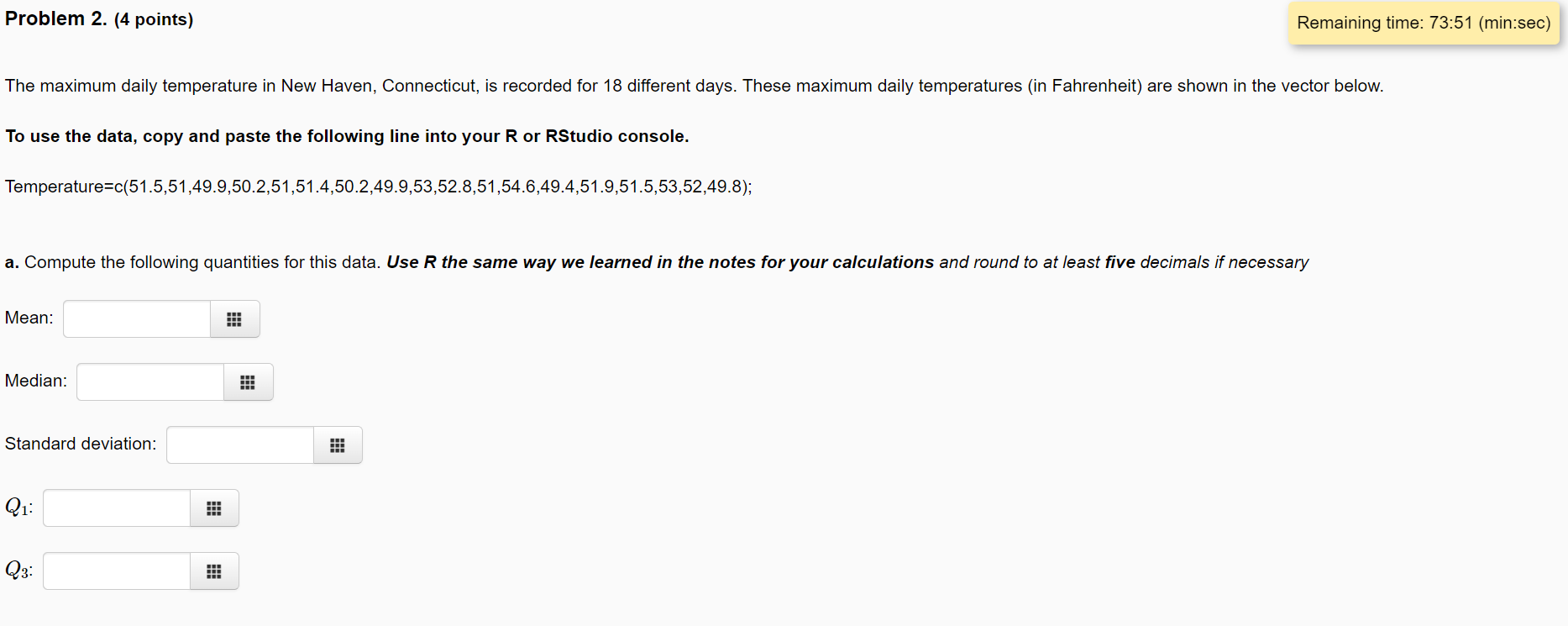
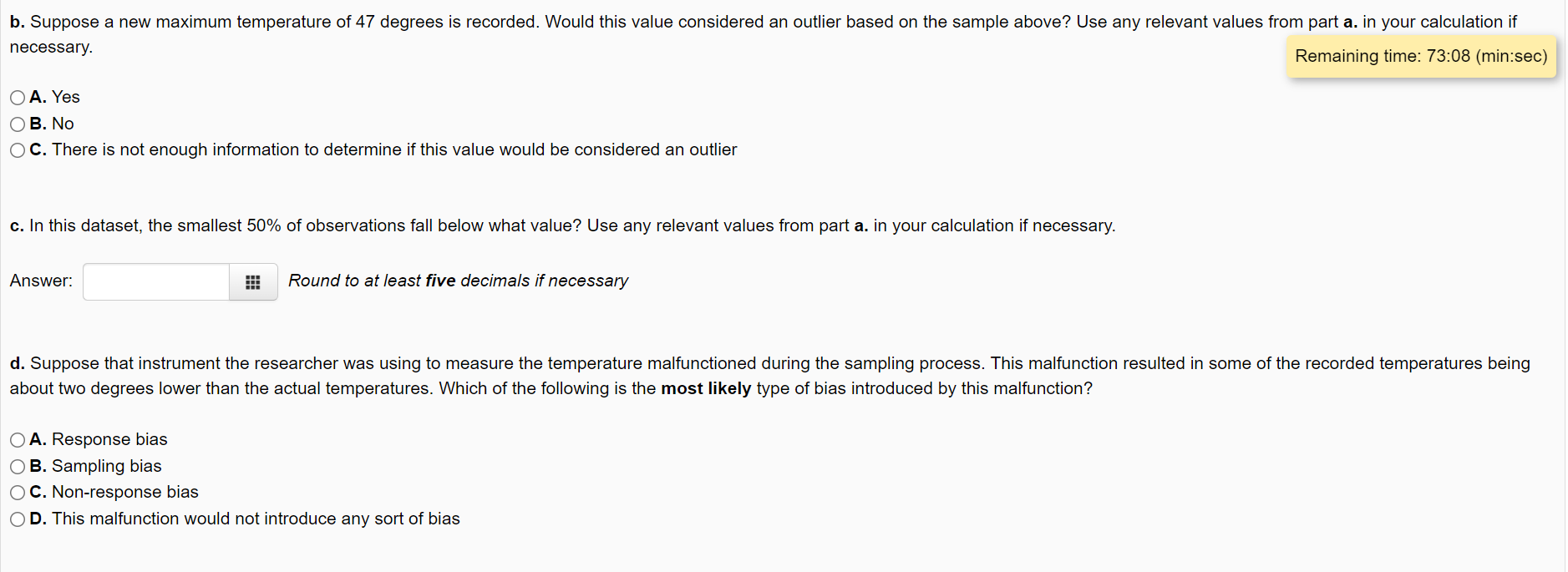
Problem 2. (4 points) Remaining time: 73:51 (min:sec) The maximum daily temperature in New Haven, Connecticut, is recorded for 18 different days. These maximum daily temperatures (in Fahrenheit) are shown in the vector below. To use the data. copy and paste the following line into your R or RStudio console. Temperature=c(51.5,51,49.9,50.2,51,51.4,50.2,49.9,53,52.8,51,54.6,49.4,51.9,51_5,53,52,49.8); a. Compute the following quantities for this data. Use R the same way we learned in the notes for your calculations and round to at least ve decimals if necessary Mean: i Median: i Standard deviation: Q12 Q3: b. Suppose a new maximum temperature of 47 degrees is recorded. Would this value considered an outlier based on the sample above? Use any relevant values from part a. in your calculation if necessary. Remaining time: 73:08 (min:sec) O A. Yes 0 E. No 0 C. There is not enough information to determine if this value would be considered an outlier c. In this dataset, the smallest 50% of observations fall below what value? Use any relevant values from part a. in your calculation if necessary. Answer: Round to at least ve decimals if necessary d. Suppose that instrument the researcher was using to measure the temperature malfunctioned during the sampling process. This malfunction resulted in some of the recorded temperatures being about two degrees lower than the actual temperatures. Which of the following is the most likely type of bias introduced by this malfunction? O A. Response bias OB. Sampling bias 0 C. Nonresponse bias 0 D. This malfunction would not introduce any sort of bias
Step by Step Solution
There are 3 Steps involved in it

Get step-by-step solutions from verified subject matter experts
 Study Help