







Question: Problem 2 (50 points) In this problem, we will model a flyball governor - a timeless piece of engineering - which is used to
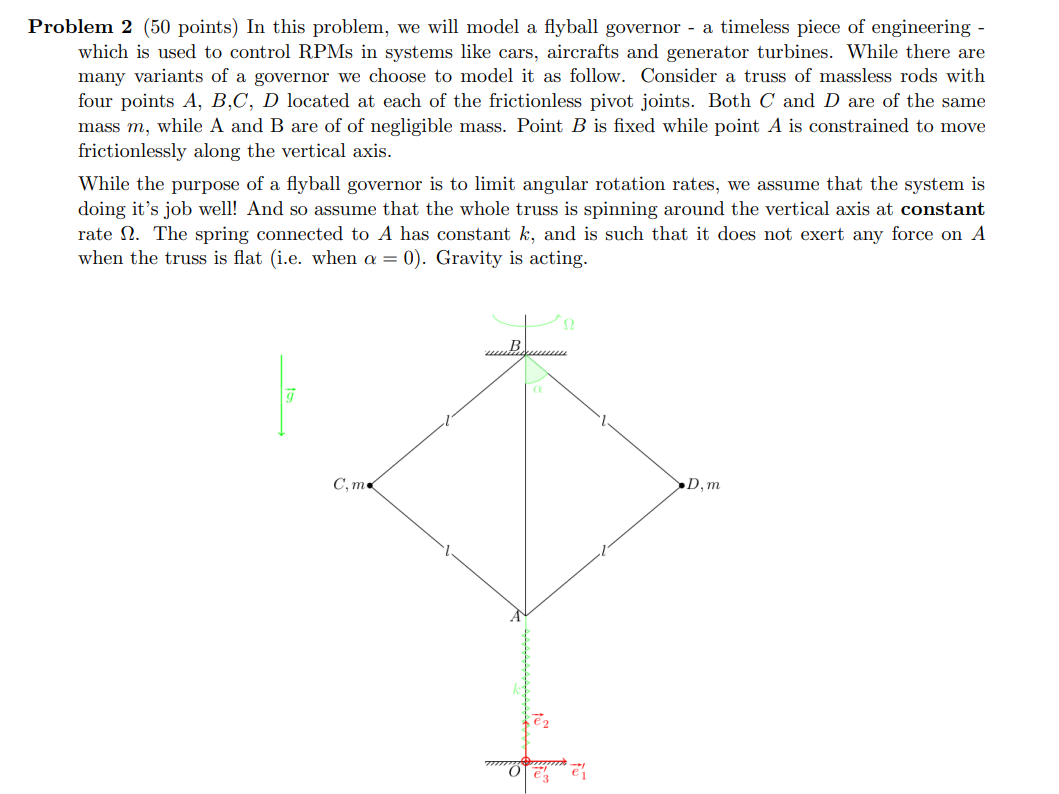
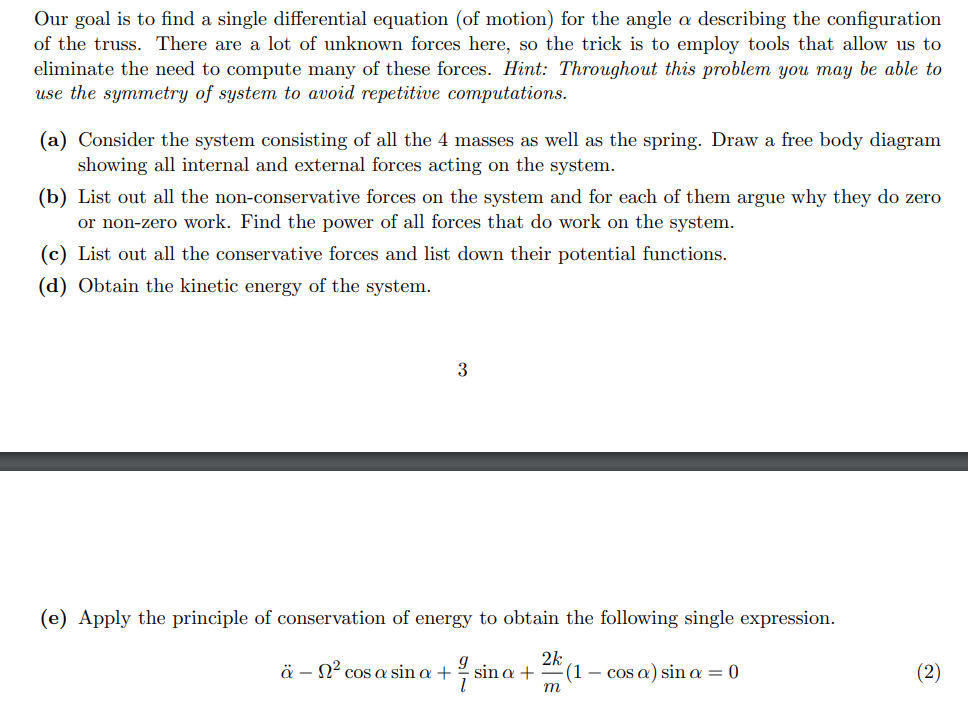
Problem 2 (50 points) In this problem, we will model a flyball governor - a timeless piece of engineering - which is used to control RPMs in systems like cars, aircrafts and generator turbines. While there are many variants of a governor we choose to model it as follow. Consider a truss of massless rods with four points A, B,C, D located at each of the frictionless pivot joints. Both C and D are of the same mass m, while A and B are of of negligible mass. Point B is fixed while point A is constrained to move frictionlessly along the vertical axis. While the purpose of a flyball governor is to limit angular rotation rates, we assume that the system is doing it's job well! And so assume that the whole truss is spinning around the vertical axis at constant rate . The spring connected to A has constant k, and is such that it does not exert any force on A when the truss is flat (i.e. when a = 0). Gravity is acting. C, m uiting wwwwww O 3 1 D, m Our goal is to find a single differential equation (of motion) for the angle a describing the configuration of the truss. There are a lot of unknown forces here, so the trick is to employ tools that allow us to eliminate the need to compute many of these forces. Hint: Throughout this problem you may be able to use the symmetry of system to avoid repetitive computations. (a) Consider the system consisting of all the 4 masses as well as the spring. Draw a free body diagram showing all internal and external forces acting on the system. (b) List out all the non-conservative forces on the system and for each of them argue why they do zero or non-zero work. Find the power of all forces that do work on the system. (c) List out all the conservative forces and list down their potential functions. (d) Obtain the kinetic energy of the system. 3 (e) Apply the principle of conservation of energy to obtain the following single expression. 2k - cos a sin a + sin sin a + m (1 - cos a) sin a = 0 (2)
Step by Step Solution
There are 3 Steps involved in it

Get step-by-step solutions from verified subject matter experts
 Study Help