







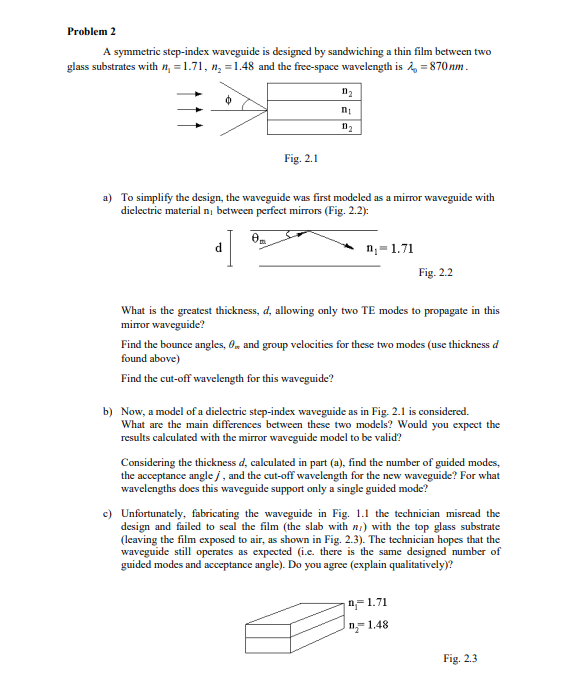
Question: Problem 2 A symmetric step - index waveguide is designed by sandwiching a thin film between two glass substrates with ( n _ {
Problem
A symmetric stepindex waveguide is designed by sandwiching a thin film between two glass substrates with n n and the freespace wavelength is lambdamathrm~nm
a To simplify the design, the waveguide was first modeled as a mirror waveguide with dielectric material mathrmn between perfect mirrors Fig:
What is the greatest thickness, d allowing only two TE modes to propagate in this mirror waveguide?
Find the bounce angles, thetamathrmm and group velocities for these two modes use thickness d found above
Find the cutoff wavelength for this waveguide?
b Now, a model of a dielectric stepindex waveguide as in Fig. is considered. What are the main differences between these two models? Would you expect the results calculated with the mirror waveguide model to be valid?
Considering the thickness d calculated in part a find the number of guided modes, the acceptance angle j and the cutoff wavelength for the new waveguide? For what wavelengths does this waveguide support only a single guided mode?
c Unfortunately, fabricating the waveguide in Fig. the technician misread the design and failed to seal the film the slab with nl with the top glass substrate leaving the film exposed to air, as shown in Fig. The technician hopes that the waveguide still operates as expected ie there is the same designed number of guided modes and acceptance angle Do you agree explain qualitatively
Step by Step Solution
There are 3 Steps involved in it
1 Expert Approved Answer
Step: 1 Unlock

Question Has Been Solved by an Expert!
Get step-by-step solutions from verified subject matter experts
Step: 2 Unlock
Step: 3 Unlock
 Study Help