



Question: Problem 2: Assume that a system B is comprised of 8 particles, each located at the corner of a cube. Each of the particles
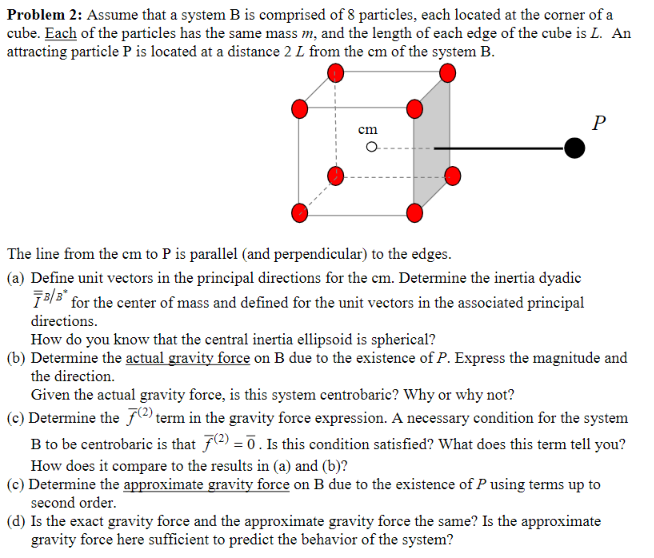
Problem 2: Assume that a system B is comprised of 8 particles, each located at the corner of a cube. Each of the particles has the same mass m, and the length of each edge of the cube is L. An attracting particle P is located at a distance 2 Z from the cm of the system B. cm P The line from the cm to P is parallel (and perpendicular) to the edges. (a) Define unit vectors in the principal directions for the cm. Determine the inertia dyadic 73/3 for the center of mass and defined for the unit vectors in the associated principal directions. How do you know that the central inertia ellipsoid is spherical? (b) Determine the actual gravity force on B due to the existence of P. Express the magnitude and the direction. Given the actual gravity force, is this system centrobaric? Why or why not? (c) Determine the F(2) term in the gravity force expression. A necessary condition for the system B to be centrobaric is that F(2) = 0. Is this condition satisfied? What does this term tell you? How does it compare to the results in (a) and (b)? (c) Determine the approximate gravity force on B due to the existence of P using terms up to second order. (d) Is the exact gravity force and the approximate gravity force the same? Is the approximate gravity force here sufficient to predict the behavior of the system?
Step by Step Solution
There are 3 Steps involved in it
Lets address the problem step by step a Define unit vectors in the principal directions for the cm Determine the inertia dyadic j s for the center of ... View full answer

Get step-by-step solutions from verified subject matter experts