







Question: Question 16 (2 points) A 5.00 cm object is placed 10.0 cm from a concave (diverging) lens. The image is one-fifth the size of
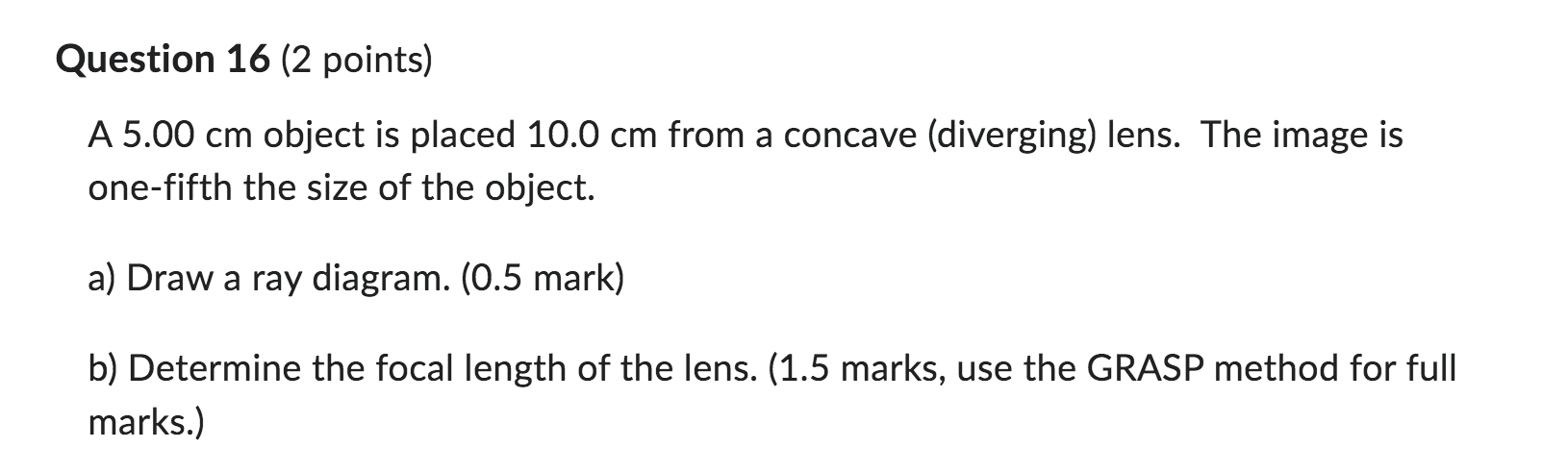
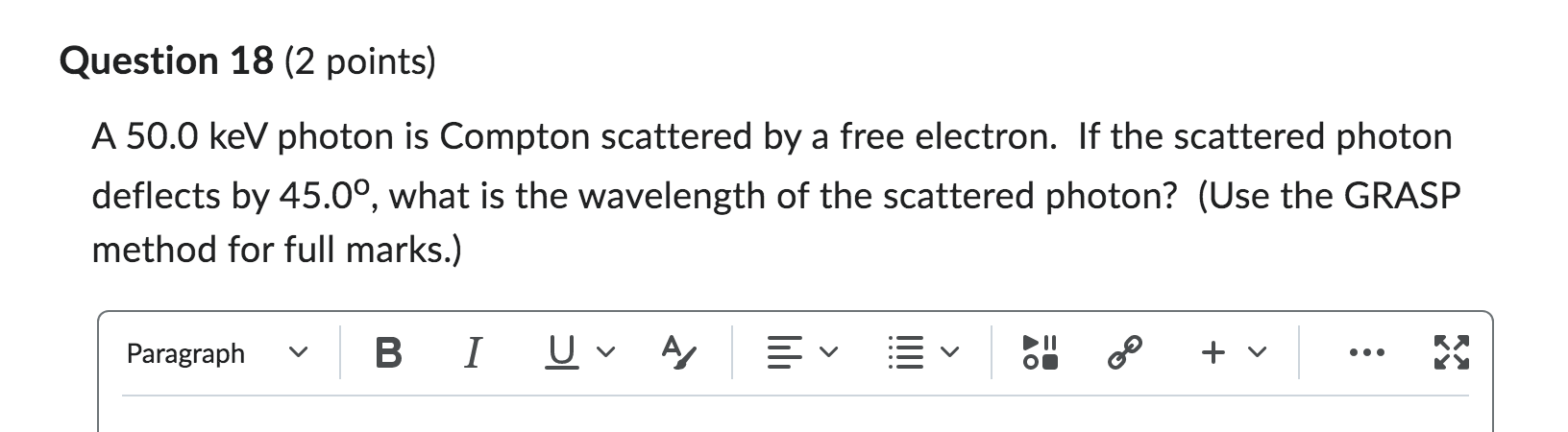
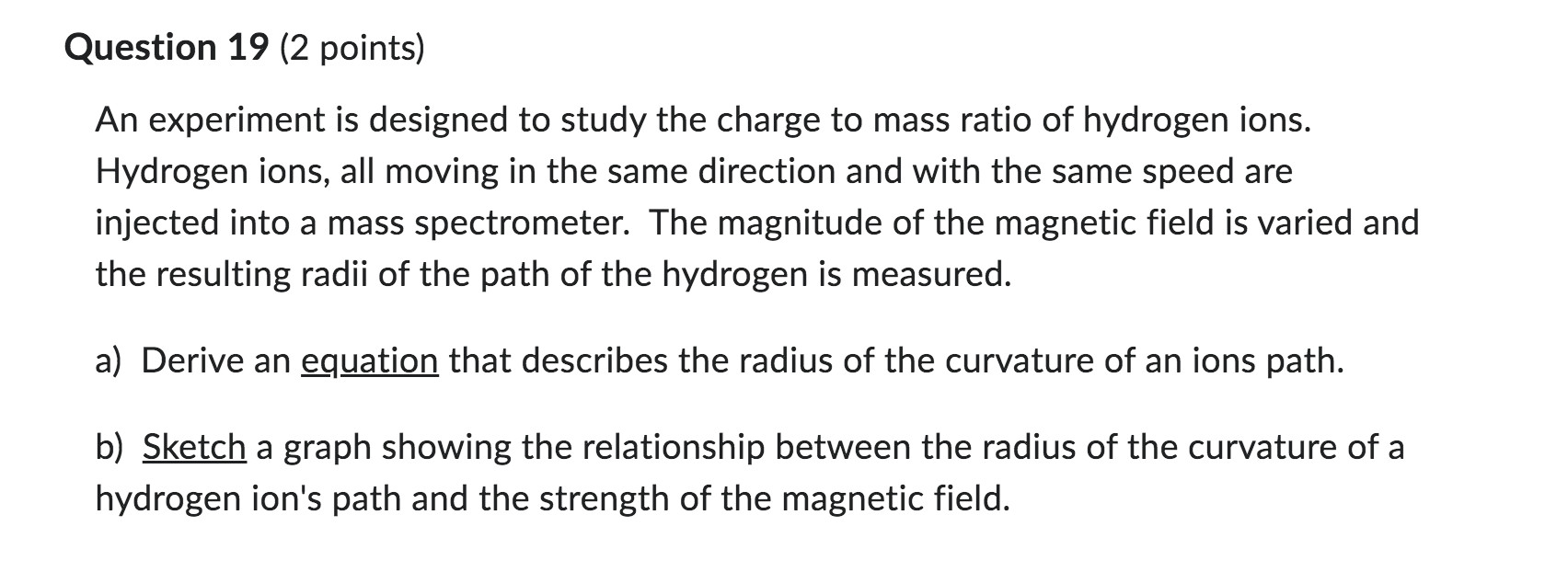
Question 16 (2 points) A 5.00 cm object is placed 10.0 cm from a concave (diverging) lens. The image is one-fifth the size of the object. a) Draw a ray diagram. (0.5 mark) b) Determine the focal length of the lens. (1.5 marks, use the GRASP method for full marks.) Question 18 (2 points) A 50.0 keV photon is Compton scattered by a free electron. If the scattered photon deflects by 45.0, what is the wavelength of the scattered photon? (Use the GRASP method for full marks.) Paragraph B I U A Question 19 (2 points) An experiment is designed to study the charge to mass ratio of hydrogen ions. Hydrogen ions, all moving in the same direction and with the same speed are injected into a mass spectrometer. The magnitude of the magnetic field is varied and the resulting radii of the path of the hydrogen is measured. a) Derive an equation that describes the radius of the curvature of an ions path. b) Sketch a graph showing the relationship between the radius of the curvature of a hydrogen ion's path and the strength of the magnetic field.
Step by Step Solution
There are 3 Steps involved in it
Given Object distance u 100 cm Image is virtual and on the same side as the object for a concave lens Magnification m 15 02 image is onefifth the size of the object Relationship Well use the lens equa... View full answer

Get step-by-step solutions from verified subject matter experts
 Study Help