







Question: Problem 2. Based on a previous midterm exam problem. This problem asks you to analyze the effect of using a bumpless feedback control implementation
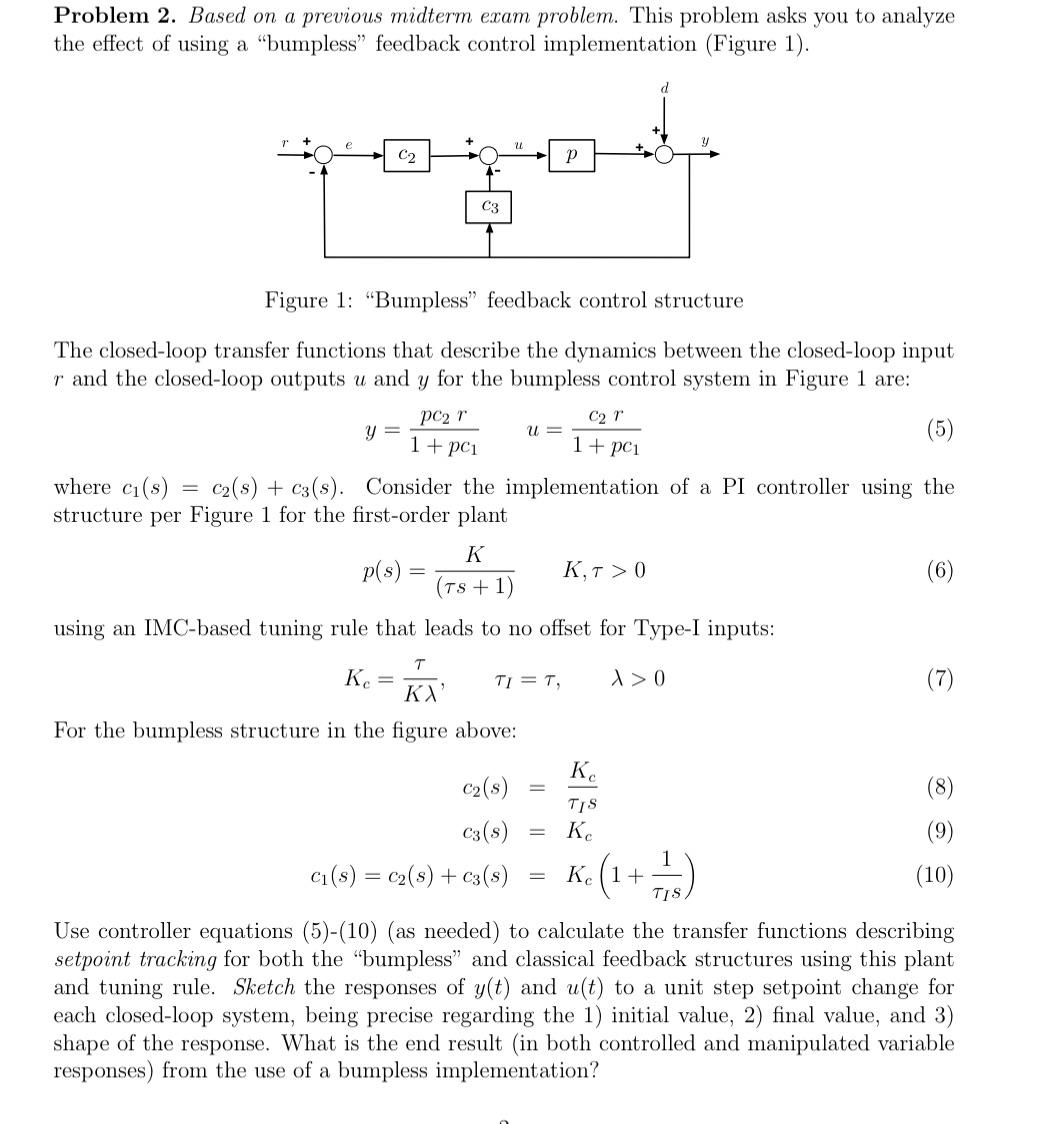
Problem 2. Based on a previous midterm exam problem. This problem asks you to analyze the effect of using a "bumpless" feedback control implementation (Figure 1). C2 + A- C3 Figure 1: "Bumpless" feedback control structure The closed-loop transfer functions that describe the dynamics between the closed-loop input r and the closed-loop outputs u and y for the bumpless control system in Figure 1 are: y = pc2 r 1+pc1 u = C2 T 1+pc1 (5) where c(s) = C2(s) C3(s). Consider the implementation of a PI controller using the structure per Figure 1 for the first-order plant K p(s) = K, TO (TS+1) using an IMC-based tuning rule that leads to no offset for Type-I inputs: T = TI = T, A> O KX' For the bumpless structure in the figure above: C2(8) C3(8) = TIS = C1(s) = c2(s) + C3(s) = Ke 1+ TIS (6) (7) (8) (9) (10) Use controller equations (5)-(10) (as needed) to calculate the transfer functions describing setpoint tracking for both the "bumpless" and classical feedback structures using this plant and tuning rule. Sketch the responses of y(t) and u(t) to a unit step setpoint change for each closed-loop system, being precise regarding the 1) initial value, 2) final value, and 3) shape of the response. What is the end result (in both controlled and manipulated variable responses) from the use of a bumpless implementation?
Step by Step Solution
There are 3 Steps involved in it

Get step-by-step solutions from verified subject matter experts
 Study Help