







Question: Problem 2 Consider a competitive economy. There is one consumer, whose utility function is given by u(x, 1) = In c + In where c
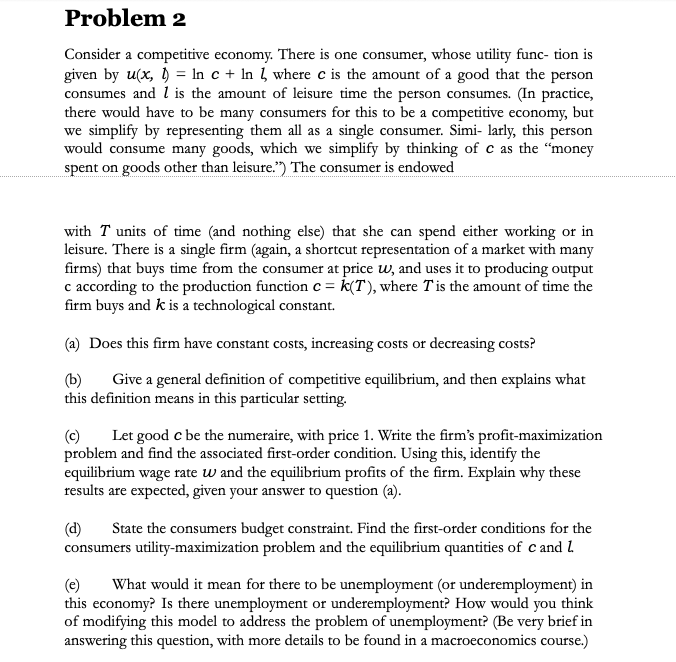
Problem 2 Consider a competitive economy. There is one consumer, whose utility function is given by u(x, 1) = In c + In where c is the amount of a good that the person consumes and 1 is the amount of leisure time the person consumes. (In practice, there would have to be many consumers for this to be a competitive economy, but we simplify by representing them all as a single consumer. Simi- larly, this person would consume many goods, which we simplify by thinking of c as the money spent on goods other than leisure.') The consumer is endowed with T units of time and nothing else) that she can spend either working or in leisure. There is a single firm (again, a shortcut representation of a market with many firms) that buys time from the consumer at price w, and uses it to producing output c according to the production function c = "(T), where T is the amount of time the firm buys and k is a technological constant. (a) Does this firm have constant costs, increasing costs or decreasing costs? (b) Give a general definition of competitive equilibrium, and then explains what this definition means in this particular setting. (c) Let good c be the numeraire, with price 1. Write the firm's profit-maximization problem and find the associated first-order condition. Using this, identify the equilibrium wage rate w and the equilibrium profits of the firm. Explain why these results are expected, given your answer to question (a). d) State the consumers budget constraint. Find the first-order conditions for the consumers utility-maximization problem and the equilibrium quantities of C and 1 What would it mean for there to be unemployment (or underemployment) in this economy? Is there unemployment or underemployment? How would you think of modifying this model to address the problem of unemployment? (Be very brief in answering this question, with more details to be found in a macroeconomics course.) Problem 2 Consider a competitive economy. There is one consumer, whose utility function is given by u(x, 1) = In c + In where c is the amount of a good that the person consumes and 1 is the amount of leisure time the person consumes. (In practice, there would have to be many consumers for this to be a competitive economy, but we simplify by representing them all as a single consumer. Simi- larly, this person would consume many goods, which we simplify by thinking of c as the money spent on goods other than leisure.') The consumer is endowed with T units of time and nothing else) that she can spend either working or in leisure. There is a single firm (again, a shortcut representation of a market with many firms) that buys time from the consumer at price w, and uses it to producing output c according to the production function c = "(T), where T is the amount of time the firm buys and k is a technological constant. (a) Does this firm have constant costs, increasing costs or decreasing costs? (b) Give a general definition of competitive equilibrium, and then explains what this definition means in this particular setting. (c) Let good c be the numeraire, with price 1. Write the firm's profit-maximization problem and find the associated first-order condition. Using this, identify the equilibrium wage rate w and the equilibrium profits of the firm. Explain why these results are expected, given your answer to question (a). d) State the consumers budget constraint. Find the first-order conditions for the consumers utility-maximization problem and the equilibrium quantities of C and 1 What would it mean for there to be unemployment (or underemployment) in this economy? Is there unemployment or underemployment? How would you think of modifying this model to address the problem of unemployment? (Be very brief in answering this question, with more details to be found in a macroeconomics course.)
Step by Step Solution
There are 3 Steps involved in it

Get step-by-step solutions from verified subject matter experts
 Study Help