







Question: Problem 2 : Consider a CT - LTI system described by: ( dy ( t ) ) / ( dt ) + 2 y (
Problem : Consider a CTLTI system described by:
dytdtytdxtdtxt
where the system input is xt and the output is yt We also consider two related subsystems:
system and In particular, system is described by
dytdtytzt
where zt is system input and yt is its output. System is described by:
ztdxtdtxt
where xt is input, and zt is output.
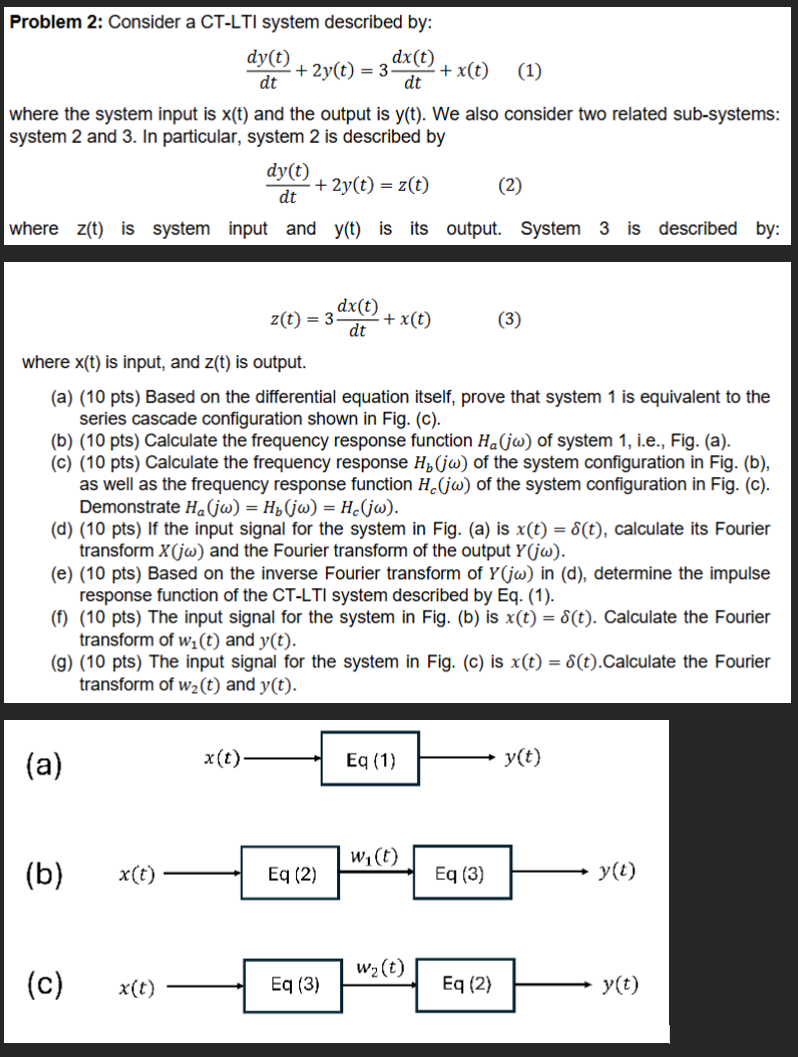
a pts Based on the differential equation itself, prove that system is equivalent to the
series cascade configuration shown in Fig. c
b pts Calculate the frequency response function Hajomega of system ie Fig. a
c pts Calculate the frequency response Hbjomega of the system configuration in Fig. b
as well as the frequency response function Hcjomega of the system configuration in Fig. c
Demonstrate Hajomega Hbjomega Hcjomega
dpts If the input signal for the system in Fig. a is xtdelta t calculate its Fourier
transform xjomega and the Fourier transform of the output Yjomega
e pts Based on the inverse Fourier transform of xtdelta t Calculate the Fourier
transform of wt and yt
gpts The input signal for the system in Fig. c is xtdelta tCalculate the Fourier
transform of wt and yt
Step by Step Solution
There are 3 Steps involved in it
1 Expert Approved Answer
Step: 1 Unlock

Question Has Been Solved by an Expert!
Get step-by-step solutions from verified subject matter experts
Step: 2 Unlock
Step: 3 Unlock
 Study Help