







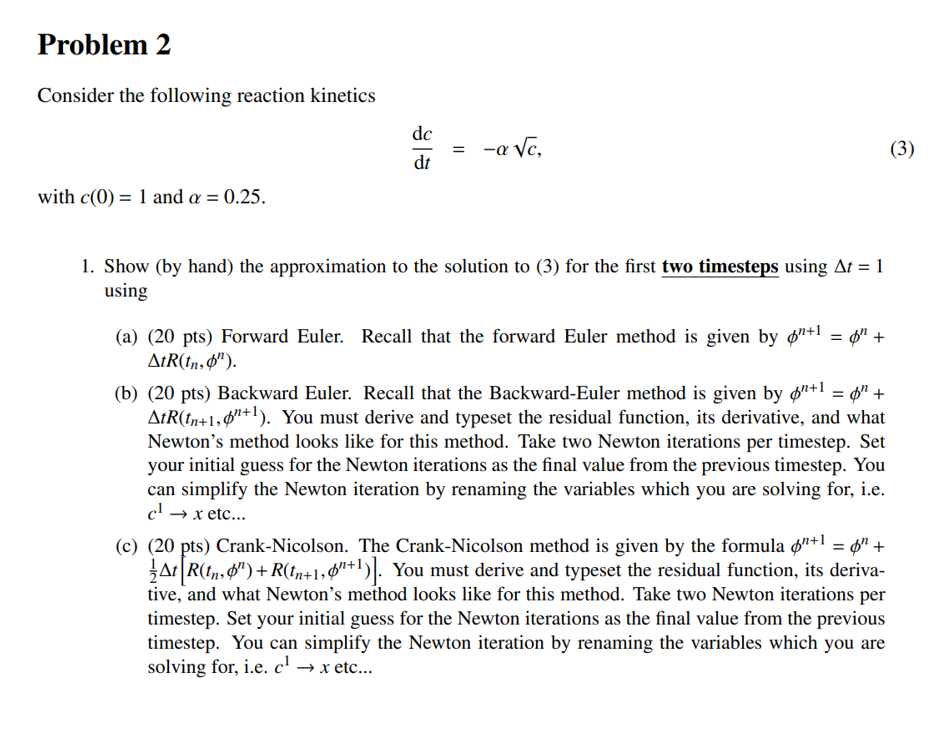
Question: Problem 2 Consider the following reaction kinetics d c ( d ) t = - c 2 , with c ( 0 ) = 1
Problem
Consider the following reaction kinetics
with and
Show by hand the approximation to the solution to for the first two timesteps using
using
a pts Forward Euler. Recall that the forward Euler method is given by
b pts Backward Euler. Recall that the BackwardEuler method is given by
You must derive and typeset the residual function, its derivative, and what
Newton's method looks like for this method. Take two Newton iterations per timestep. Set
your initial guess for the Newton iterations as the final value from the previous timestep. You
can simplify the Newton iteration by renaming the variables which you are solving for, ie
etc...
c pts CrankNicolson. The CrankNicolson method is given by the formula
You must derive and typeset the residual function, its deriva
tive, and what Newton's method looks like for this method. Take two Newton iterations per
timestep. Set your initial guess for the Newton iterations as the final value from the previous
timestep. You can simplify the Newton iteration by renaming the variables which you are
solving for, ie etc...
Step by Step Solution
There are 3 Steps involved in it
1 Expert Approved Answer
Step: 1 Unlock

Question Has Been Solved by an Expert!
Get step-by-step solutions from verified subject matter experts
Step: 2 Unlock
Step: 3 Unlock
 Study Help