



Question: Problem 2 : Employer - Bias Model In class, we saw how the personal prejudice model of discrimination could lead to differences in employment and
Problem : EmployerBias Model
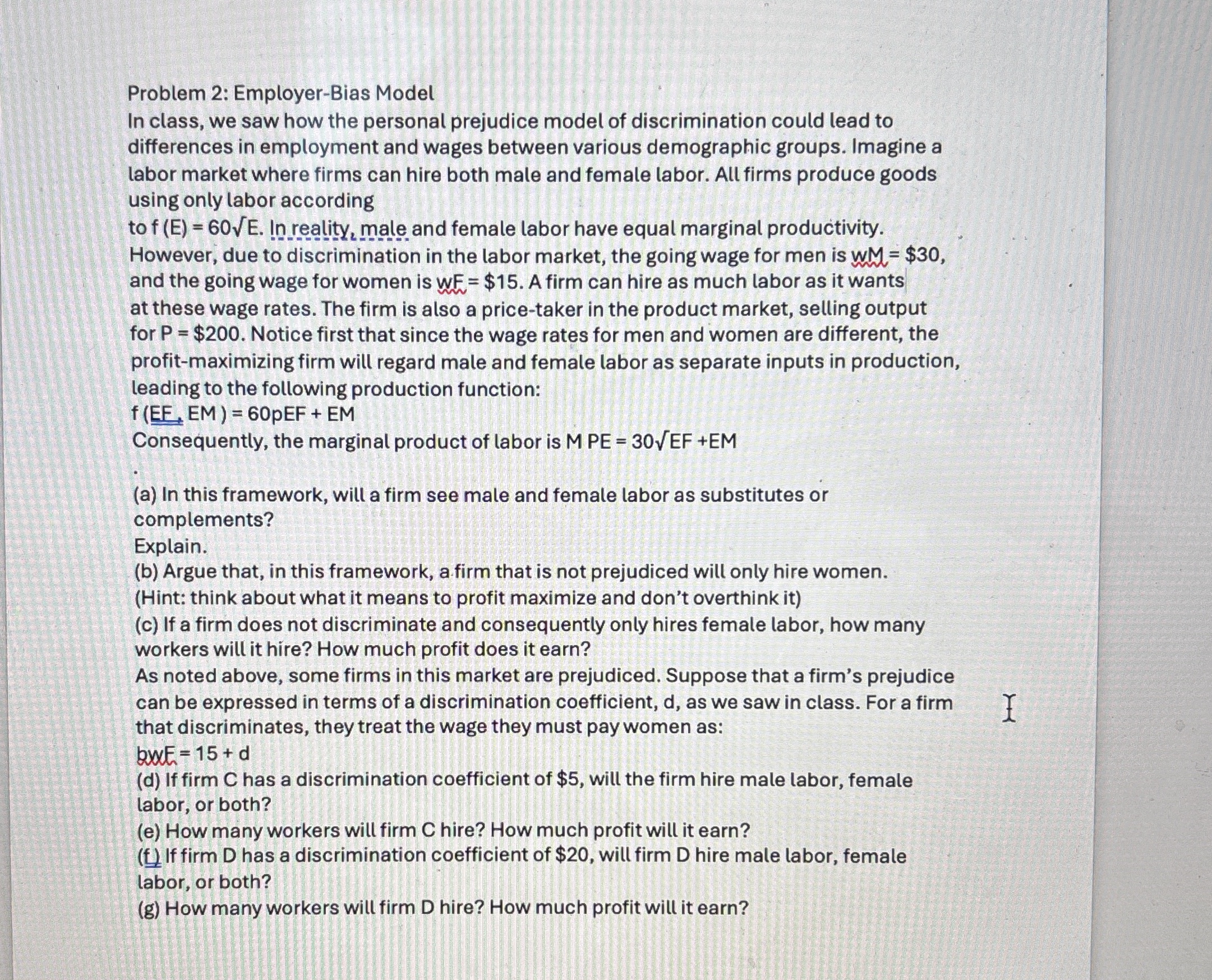
In class, we saw how the personal prejudice model of discrimination could lead to differences in employment and wages between various demographic groups. Imagine a labor market where firms can hire both male and female labor. All firms produce goods using only labor according to In reality, male and female labor have equal marginal productivity. However, due to discrimination in the labor market, the going wage for men is $ and the going wage for women is $ A firm can hire as much labor as it wants at these wage rates. The firm is also a pricetaker in the product market, selling output for $ Notice first that since the wage rates for men and women are different, the profitmaximizing firm will regard male and female labor as separate inputs in production, leading to the following production function:
pEF
Consequently, the marginal product of labor is MPE
a In this framework, will a firm see male and female labor as substitutes or complements?
Explain.
b Argue that, in this framework, a firm that is not prejudiced will only hire women.
Hint: think about what it means to profit maximize and don't overthink it
c If a firm does not discriminate and consequently only hires female labor, how many workers will it hire? How much profit does it earn?
As noted above, some firms in this market are prejudiced. Suppose that a firm's prejudice can be expressed in terms of a discrimination coefficient, as we saw in class. For a firm that discriminates, they treat the wage they must pay women as:
bwE
d If firm C has a discrimination coefficient of $ will the firm hire male labor, female labor, or both?
e How many workers will firm C hire? How much profit will it earn?
f If firm D has a discrimination coefficient of $ will firm D hire male labor, female labor, or both?
g How many workers will firm D hire? How much profit will it earn?
Step by Step Solution
There are 3 Steps involved in it
1 Expert Approved Answer
Step: 1 Unlock

Question Has Been Solved by an Expert!
Get step-by-step solutions from verified subject matter experts
Step: 2 Unlock
Step: 3 Unlock