







Question: Problem 2: End-to-end Delay and Throughput. Consider a path with k + 1 nodes: a source host, a destination host and k - 1 intermediate
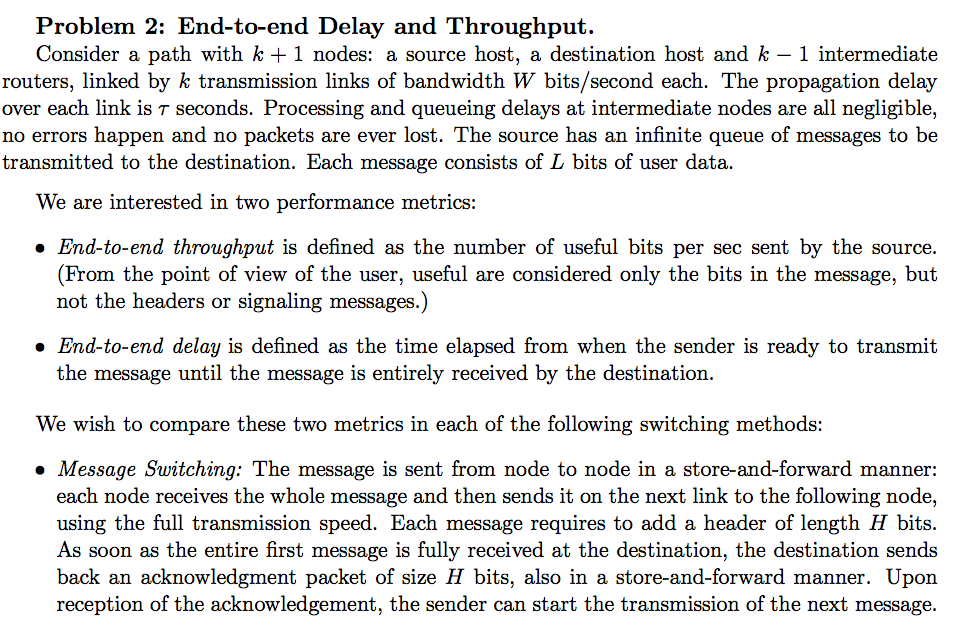
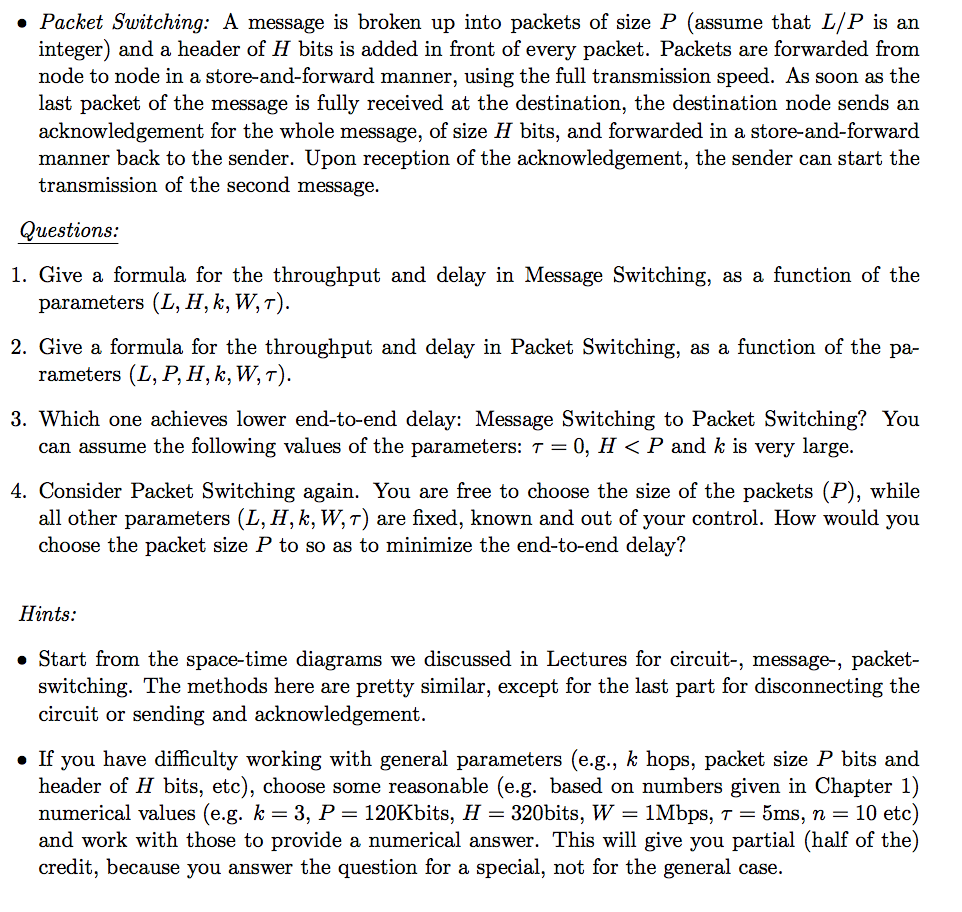
Problem 2: End-to-end Delay and Throughput. Consider a path with k + 1 nodes: a source host, a destination host and k - 1 intermediate routers, linked by k transmission links of bandwidth W bits/second each. The propagation delay over each link is T seconds. Processing and queueing delays at intermediate nodes are all negligible, no errors happen and no packets are ever lost. The source has an infinite queue of messages to be transmitted to the destination. Each message consists of L bits of user data. We are interested in two performance metrics End-to-end throughput is defined as the number of useful bits per sec sent by the source From the point of view of the user, useful are considered only the bits in the message, but not the headers or signaling messages End-to-end delay is defined as the time elapsed from when the sender is ready to transmit the message until the message is entirely received by the destination. We wish to compare these two metrics in each of the following switching methods: Message Switching: The message is sent from node to node in a store-and-forward manner: each node receives the whole message and then sends it on the next link to the following node, using the full transmission speed. Each message requires to add a header of length H bits. As soon as the entire first message is fully received at the destination, the destination sends back an acknowledgment packet of size H bits, also in a store-and-forward manner. Upon reception of the acknowledgement, the sender can start the transmission of the next message
Step by Step Solution
There are 3 Steps involved in it

Get step-by-step solutions from verified subject matter experts
 Study Help