







Question: Consider a path with k + 1 nodes: a source host, a destination host and k - 1 intermediate routers, linked by k transmission

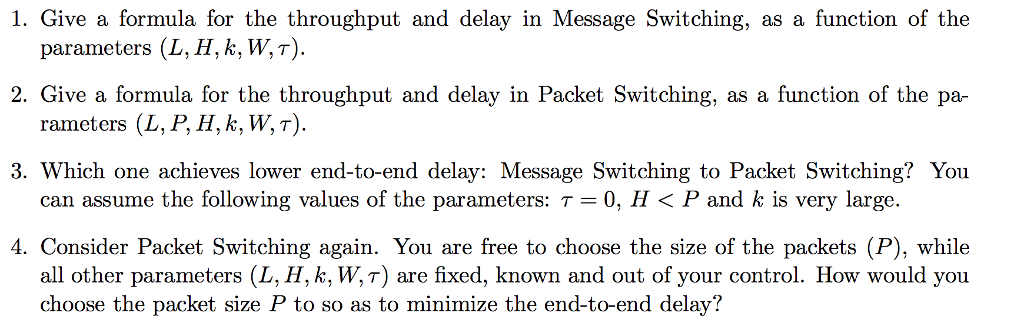
Consider a path with k + 1 nodes: a source host, a destination host and k - 1 intermediate routers, linked by k transmission links of bandwidth W bits/second each. The propagation delay over each link is 7 seconds. Processing and queueing delays at intermediate nodes are all negligible, no errors happen and no packets are ever lost. The source has an infinite queue of messages to be transmitted to the destination. Each message consists of L bits of user data. 1. Give a formula for the throughput and delay in Message Switching, as a function of the parameters (L, H, k, W, 7). 2. Give a formula for the throughput and delay in Packet Switching, as a function of the pa- rameters (L, P, H, k, W, T). 3. Which one achieves lower end-to-end delay: Message Switching to Packet Switching? You can assume the following values of the parameters: 7 = 0, H < P and k is very large. 4. Consider Packet Switching again. You are free to choose the size of the packets (P), while all other parameters (L, H, k, W, 7) are fixed, known and out of your control. How would you choose the packet size P to so as to minimize the end-to-end delay?
Step by Step Solution
3.49 Rating (152 Votes )
There are 3 Steps involved in it
Lets tackle each part of the question step by step 1 Message Switching Throughput The throughput in message switching is determined by the bandwidth W ... View full answer

Get step-by-step solutions from verified subject matter experts
 Study Help