







Question: Problem 2: Estimating Likelihood from Data Suppose we are given a dataset D = {1, ..., n} Rd. We would like to model the
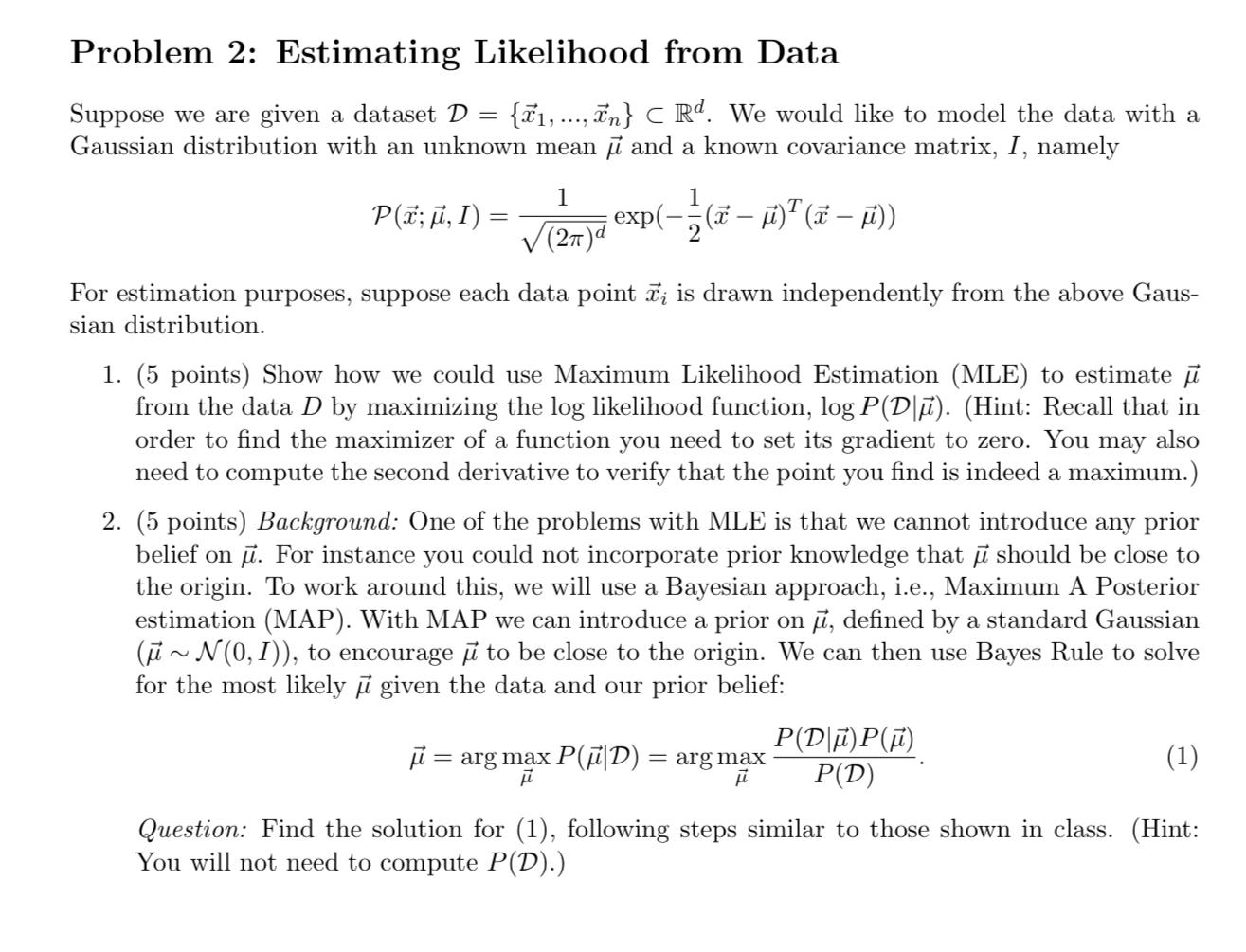
Problem 2: Estimating Likelihood from Data Suppose we are given a dataset D = {1, ..., n} Rd. We would like to model the data with a Gaussian distribution with an unknown mean and a known covariance matrix, I, namely P(x; , I) = 1 (27) exp(-(x-1) (x - )) exp(-1/2)()) For estimation purposes, suppose each data point is drawn independently from the above Gaus- sian distribution. 1. (5 points) Show how we could use Maximum Likelihood Estimation (MLE) to estimate from the data D by maximizing the log likelihood function, log P(D|). (Hint: Recall that in order to find the maximizer of a function you need to set its gradient to zero. You may also need to compute the second derivative to verify that the point you find is indeed a maximum.) 2. (5 points) Background: One of the problems with MLE is that we cannot introduce any prior belief on . For instance you could not incorporate prior knowledge that should be close to the origin. To work around this, we will use a Bayesian approach, i.e., Maximum A Posterior estimation (MAP). With MAP we can introduce a prior on , defined by a standard Gaussian (~N(0,1)), to encourage to be close to the origin. We can then use Bayes Rule to solve for the most likely given the data and our prior belief: = arg max P(D) = arg max P(D|)P() P(D) (1) Question: Find the solution for (1), following steps similar to those shown in class. (Hint: You will not need to compute P(D).)
Step by Step Solution
There are 3 Steps involved in it

Get step-by-step solutions from verified subject matter experts
 Study Help