







Question: Problem 2 Explain how a maximum flow problem for a network with several sources and sinks can be transformed into an equivalent problem maximum flow
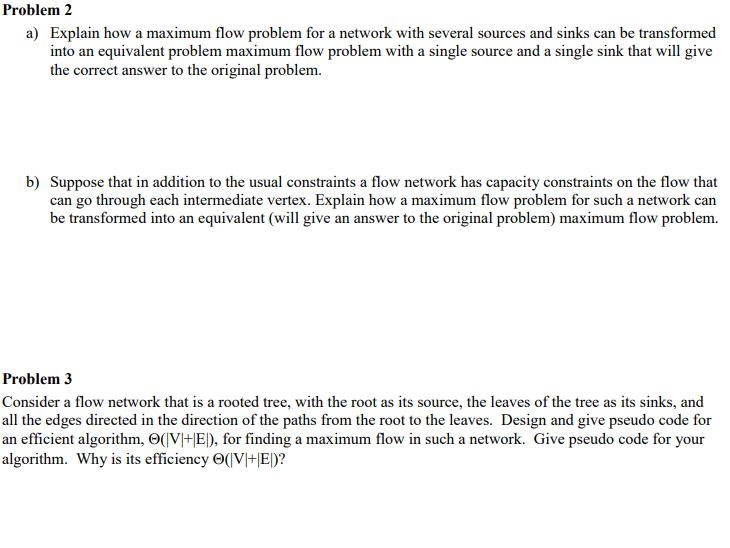
Problem 2 Explain how a maximum flow problem for a network with several sources and sinks can be transformed into an equivalent problem maximum flow problem with a single source and a single sink that will give the correct answer to the original problem. a) b) Suppose that in addition to the usual constraints a flow network has capacity constraints on the flow that can go through each intermediate vertex. Explain how a maximum flow problem for such a network can be transformed into an equivalent (will give an answer to the original problem) maximum flow problem. Problem 3 Consider a flow network that is a rooted tree, with the root as its source, the leaves of the tree as its sinks, and all the edges directed in the direction of the paths from the root to the leaves. Design and give pseudo code for an efficient algorithm, e(VHED, for finding a maximum flow in such a network. Give pseudo code for your algorithm. Why is its efficiency (NIHE)? Problem 2 Explain how a maximum flow problem for a network with several sources and sinks can be transformed into an equivalent problem maximum flow problem with a single source and a single sink that will give the correct answer to the original problem. a) b) Suppose that in addition to the usual constraints a flow network has capacity constraints on the flow that can go through each intermediate vertex. Explain how a maximum flow problem for such a network can be transformed into an equivalent (will give an answer to the original problem) maximum flow problem. Problem 3 Consider a flow network that is a rooted tree, with the root as its source, the leaves of the tree as its sinks, and all the edges directed in the direction of the paths from the root to the leaves. Design and give pseudo code for an efficient algorithm, e(VHED, for finding a maximum flow in such a network. Give pseudo code for your algorithm. Why is its efficiency (NIHE)
Step by Step Solution
There are 3 Steps involved in it

Get step-by-step solutions from verified subject matter experts
 Study Help