







Question: Problem 2. Explicit methods. In the Black-Scholes model, the price v(t, s) of a European option with payoff satisfies the Black-Scholes PDE: 082 vt(t,
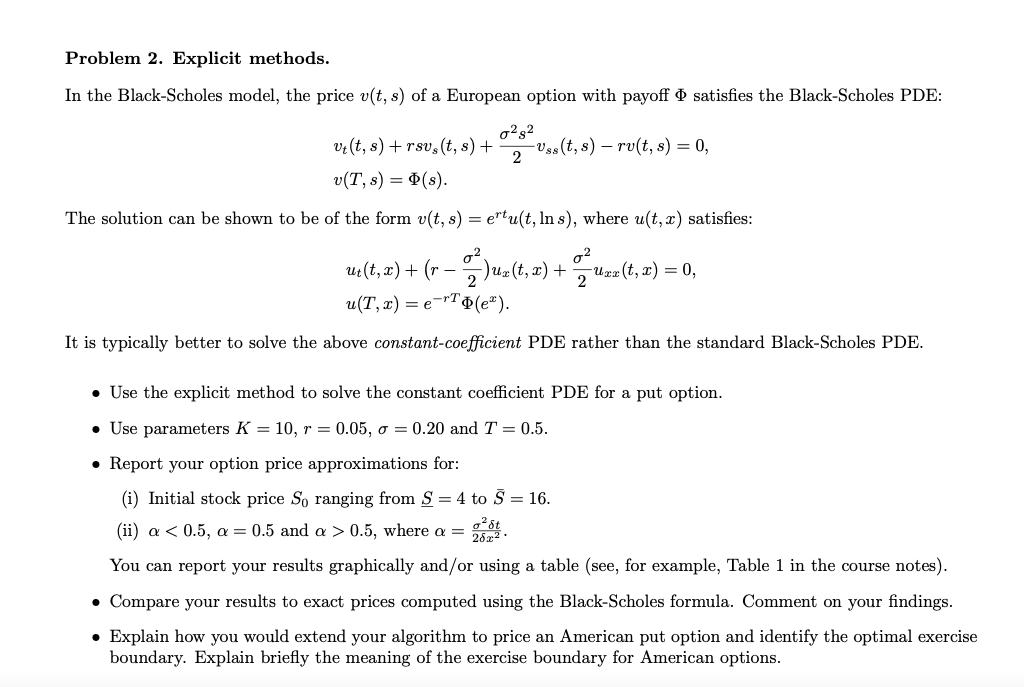
Problem 2. Explicit methods. In the Black-Scholes model, the price v(t, s) of a European option with payoff satisfies the Black-Scholes PDE: 082 vt(t, s) +rsvs (t, s) + -Uss(t,s) - rv(t, s) = 0, 2 v(T, s) = (s). The solution can be shown to be of the form v(t, s) = ertu(t, lns), where u(t, x) satisfies: 0 2 ut(t, x) + (r- )u(t, x) + u(T, x) = e-To(e). It is typically better to solve the above constant-coefficient PDE rather than the standard Black-Scholes PDE. -Uxx (t, x) = 0, Use the explicit method to solve the constant coefficient PDE for a put option. Use parameters K = 10, r= 0.05, o= 0.20 and T = 0.5. Report your option price approximations for: (i) Initial stock price So ranging from S = 4 to 5 = 16. (ii) a < 0.5, a = 0.5 and a > 0.5, where a = You can report your results graphically and/or using a table (see, for example, Table 1 in the course notes). Compare your results to exact prices computed using the Black-Scholes formula. Comment on your findings. Explain how you would extend your algorithm to price an American put option and identify the optimal exercise boundary. Explain briefly the meaning of the exercise boundary for American options.
Step by Step Solution
3.39 Rating (165 Votes )
There are 3 Steps involved in it
To solve the constant coefficient PDE for a put option using the explicit method we can discretize the time and stock price domains and iteratively ca... View full answer

Get step-by-step solutions from verified subject matter experts
 Study Help