





Question: Problem 2: Filters (10 points) Our work with transfer functions taught us that a filter can be represented by a complex function of frequency which
Problem 2: Filters (10 points) Our work with
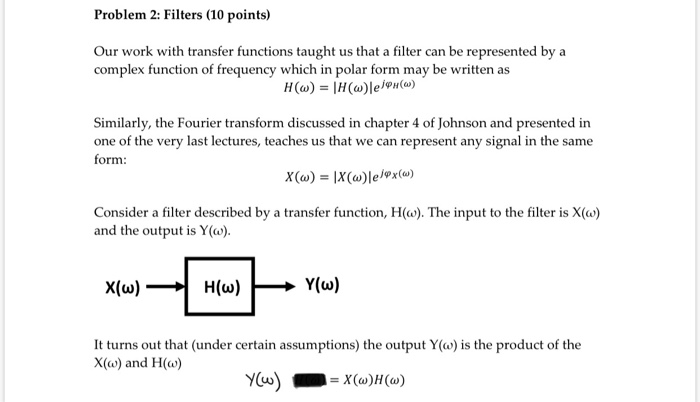
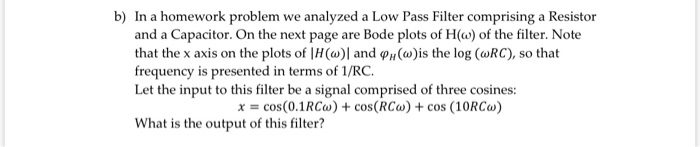
Problem 2: Filters (10 points) Our work with transfer functions taught us that a filter can be represented by a complex function of frequency which in polar form may be written as H(W) = \H(wlew) Similarly, the Fourier transform discussed in chapter 4 of Johnson and presented in one of the very last lectures, teaches us that we can represent any signal in the same form: X(w) = X(w) elx(w) Consider a filter described by a transfer function, HW). The input to the filter is X(w) and the output is Y(w). X(w) - H(w) Yw) It turns out that (under certain assumptions) the output (W) is the product of the X(w) and H(W) Y(w) = x(w)H(w) b) In a homework problem we analyzed a Low Pass Filter comprising a Resistor and a Capacitor. On the next page are Bode plots of H(w) of the filter. Note that the x axis on the plots of H(w) and (w)is the log (WRC), so that frequency is presented in terms of 1/RC. Let the input to this filter be a signal comprised of three cosines: x = cos(0.1RCW) + cos(RCW) + cos (10RCW) What is the output of this filter

Step by Step Solution

There are 3 Steps involved in it

1 Expert Approved Answer
Step: 1 Unlock blur-text-image

Question Has Been Solved by an Expert!

Get step-by-step solutions from verified subject matter experts

Step: 2 Unlock
Step: 3 Unlock

Students Have Also Explored These Related General Management Questions!