







Question: Problem 2 In this problem we study the homogeneous linear 2 nd order equation y(t)+ty(t)+y(t)=0 where is some arbitrary but fixed constant. Let us start
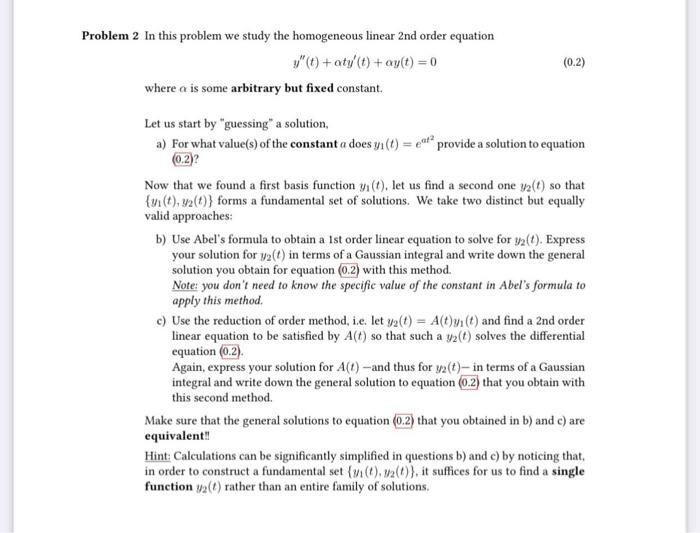
Problem 2 In this problem we study the homogeneous linear 2 nd order equation y(t)+ty(t)+y(t)=0 where is some arbitrary but fixed constant. Let us start by "guessing" a solution, a) For what value(s) of the constant a does y1(t)=eat2 provide a solution to equation (0.2)? Now that we found a first basis function y1(t), let us find a second one y2(t) so that {y1(t),y2(t)} forms a fundamental set of solutions. We take two distinct but equally valid approaches: b) Use Abel's formula to obtain a 1st order linear equation to solve for y2(t). Express your solution for y2(t) in terms of a Gaussian integral and write down the general solution you obtain for equation (0.2) with this method. Note: you don't need to know the specific value of the constant in Abel's formula to apply this method. c) Use the reduction of order method, i.e. let y2(t)=A(t)y1(t) and find a 2 nd order linear equation to be satisfied by A(t) so that such a y2(t) solves the differential equation (0.2). Again, express your solution for A(t) - and thus for y2(t) - in terms of a Gaussian integral and write down the general solution to equation (0.2) that you obtain with this second method. Make sure that the general solutions to equation (0.2) that you obtained in b) and c) are equivalent!! Hint: Calculations can be significantly simplified in questions b) and c) by noticing that, in order to construct a fundamental set {y1(t),y2(t)}, it suffices for us to find a single function y2(t) rather than an entire family of solutions
Step by Step Solution
There are 3 Steps involved in it

Get step-by-step solutions from verified subject matter experts
 Study Help