







Question: Problem 2 In this problem, we will investigate the implied timing of ASMD charts. Recall that any datapath effects from the active path take effect
Problem
In this problem, we will investigate the implied timing of ASMD charts. Recall that any datapath effects from the active path take effect when you EXIT the state.
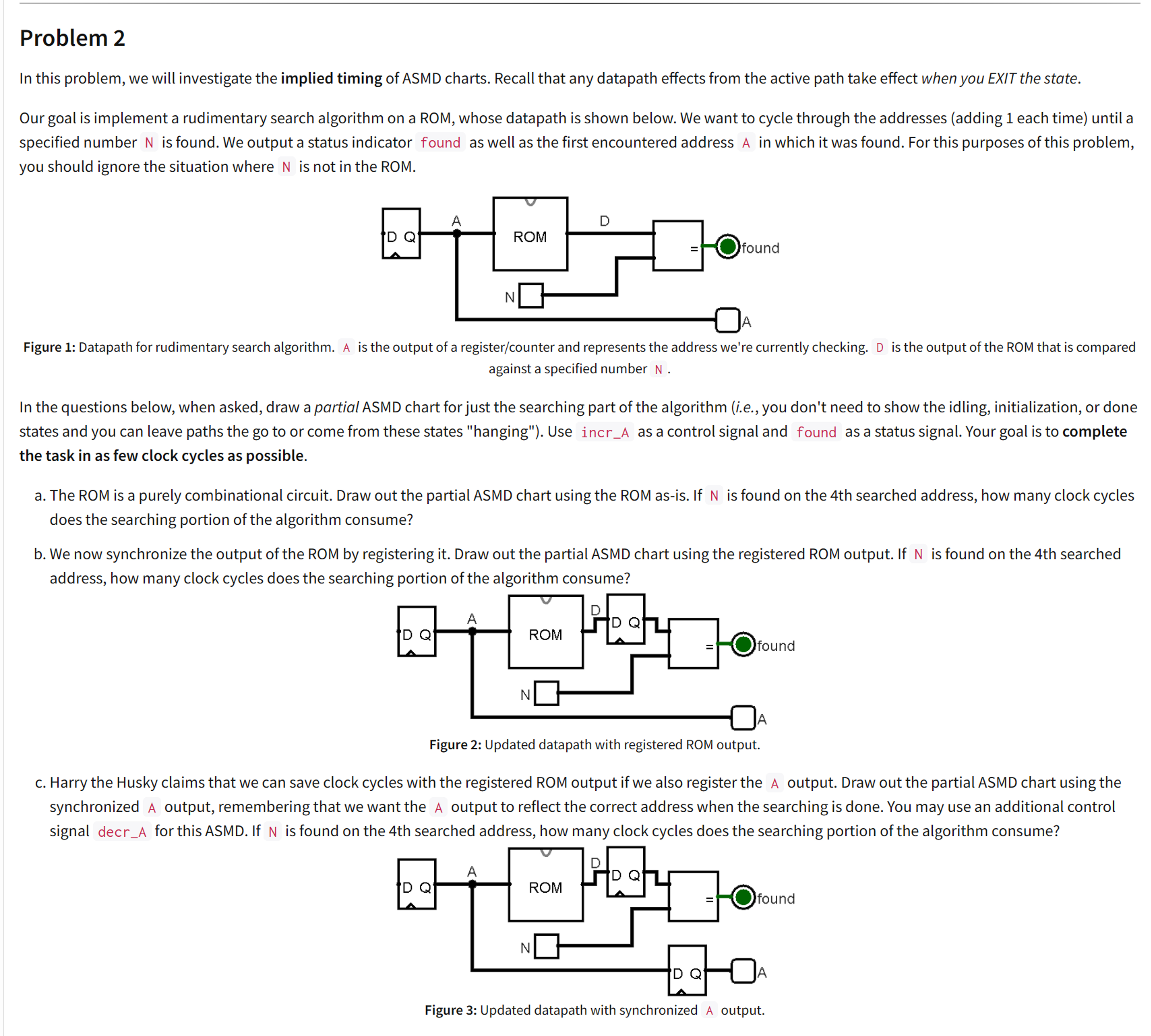
Our goal is implement a rudimentary search algorithm on a ROM, whose datapath is shown below. We want to cycle through the addresses adding each time until a
specified number is found. We output a status indicator found as well as the first encountered address in which it was found. For this purposes of this problem,
you should ignore the situation where is not in the ROM.
Figure : Datapath for rudimentary search algorithm. A is the output of a registercounter and represents the address we're currently checking. D is the output of the ROM that is compared
against a specified number
In the questions below, when asked, draw a partial ASMD chart for just the searching part of the algorithm ie you don't need to show the idling, initialization, or done
states and you can leave paths the go to or come from these states "hanging" Use incrA as a control signal and found as a status signal. Your goal is to complete
the task in as few clock cycles as possible.
a The ROM is a purely combinational circuit. Draw out the partial ASMD chart using the ROM asis If is found on the th searched address, how many clock cycles
does the searching portion of the algorithm consume?
b We now synchronize the output of the ROM by registering it Draw out the partial ASMD chart using the registered ROM output. If is found on the th searched
address, how many clock cycles does the searc'
c Harry the Husky claims that we can save clock cycles with the registered ROM output if we also register the A output. Draw out the partial ASMD chart using the
synchronized A output, remembering that we want the A output to reflect the correct address when the searching is done. You may use an additional control
signal decrA for this ASMD. If is found on the th cearrhed addresc hnw manv rlnck svelec dnec the cearrhino portion of the algorithm consume?
Step by Step Solution
There are 3 Steps involved in it
1 Expert Approved Answer
Step: 1 Unlock

Question Has Been Solved by an Expert!
Get step-by-step solutions from verified subject matter experts
Step: 2 Unlock
Step: 3 Unlock
 Study Help