







Question: Problem 2. Mass transfer from a rotating disk A spinning disk is designed as a mass transfer device. The Soluble film solid disk rotates about
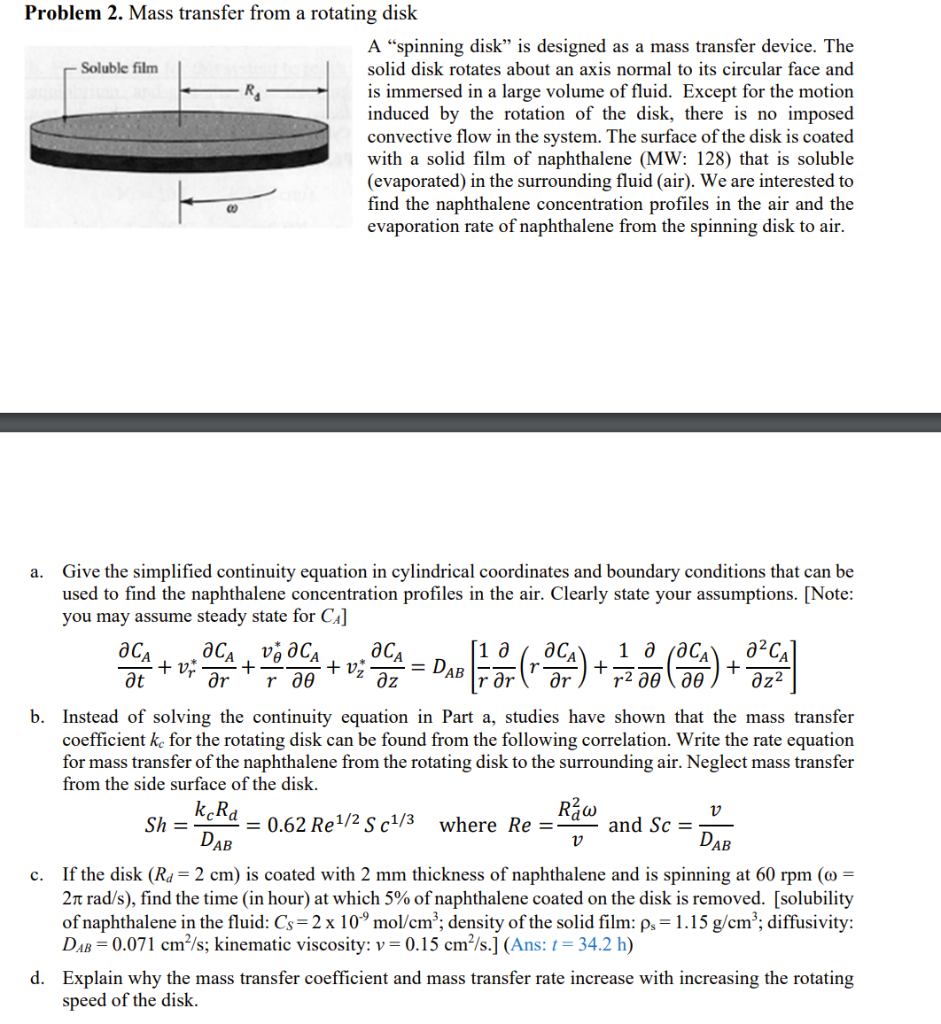
Problem 2. Mass transfer from a rotating disk A spinning disk is designed as a mass transfer device. The Soluble film solid disk rotates about an axis normal to its circular face and is immersed in a large volume of fluid. Except for the motion induced by the rotation of the disk, there is no imposed convective flow in the system. The surface of the disk is coated with a solid film of naphthalene (MW: 128) that is soluble (evaporated) in the surrounding fluid (air). We are interested to find the naphthalene concentration profiles in the air and the evaporation rate of naphthalene from the spinning disk to air. a. OCA .= DAB Devi Gee)+70 ) + Give the simplified continuity equation in cylindrical coordinates and boundary conditions that can be used to find the naphthalene concentration profiles in the air. Clearly state your assumptions. [Note: you may assume steady state for CA] OCA VOCA aca 1 a OCA 1 a CA OPCA] + V + + v. at ar ran az ar ar r2 \ az2 b. Instead of solving the continuity equation in Part a, studies have shown that the mass transfer coefficient ke for the rotating disk can be found from the following correlation. Write the rate equation for mass transfer of the naphthalene from the rotating disk to the surrounding air. Neglect mass transfer from the side surface of the disk. keRa Raw V Sh = = 0.62 Re1/2 S c1/3 where Re = and Sc= DAB V DAB If the disk (Rd = 2 cm) is coated with 2 mm thickness of naphthalene and is spinning at 60 rpm (o = 2t rad/s), find the time in hour) at which 5% of naphthalene coated on the disk is removed. [solubility of naphthalene in the fluid: Cs=2 x 10⁻⁹ mol/cm; density of the solid film: Ps= 1.15 g/cm; diffusivity: DAB = 0.071 cm-/s; kinematic viscosity: v = 0.15 cm/s.] (Ans: t = 34.2 h) d. Explain why the mass transfer coefficient and mass transfer rate increase with increasing the rotating speed of the disk. c. Problem 2. Mass transfer from a rotating disk A spinning disk is designed as a mass transfer device. The Soluble film solid disk rotates about an axis normal to its circular face and is immersed in a large volume of fluid. Except for the motion induced by the rotation of the disk, there is no imposed convective flow in the system. The surface of the disk is coated with a solid film of naphthalene (MW: 128) that is soluble (evaporated) in the surrounding fluid (air). We are interested to find the naphthalene concentration profiles in the air and the evaporation rate of naphthalene from the spinning disk to air. a. OCA .= DAB Devi Gee)+70 ) + Give the simplified continuity equation in cylindrical coordinates and boundary conditions that can be used to find the naphthalene concentration profiles in the air. Clearly state your assumptions. [Note: you may assume steady state for CA] OCA VOCA aca 1 a OCA 1 a CA OPCA] + V + + v. at ar ran az ar ar r2 \ az2 b. Instead of solving the continuity equation in Part a, studies have shown that the mass transfer coefficient ke for the rotating disk can be found from the following correlation. Write the rate equation for mass transfer of the naphthalene from the rotating disk to the surrounding air. Neglect mass transfer from the side surface of the disk. keRa Raw V Sh = = 0.62 Re1/2 S c1/3 where Re = and Sc= DAB V DAB If the disk (Rd = 2 cm) is coated with 2 mm thickness of naphthalene and is spinning at 60 rpm (o = 2t rad/s), find the time in hour) at which 5% of naphthalene coated on the disk is removed. [solubility of naphthalene in the fluid: Cs=2 x 10⁻⁹ mol/cm; density of the solid film: Ps= 1.15 g/cm; diffusivity: DAB = 0.071 cm-/s; kinematic viscosity: v = 0.15 cm/s.] (Ans: t = 34.2 h) d. Explain why the mass transfer coefficient and mass transfer rate increase with increasing the rotating speed of the disk. c
Step by Step Solution
There are 3 Steps involved in it

Get step-by-step solutions from verified subject matter experts
 Study Help