



Question: Problem 2. One challenge in the creation of DCF models is the estimation of growth rates and tying them into the model. How is growth
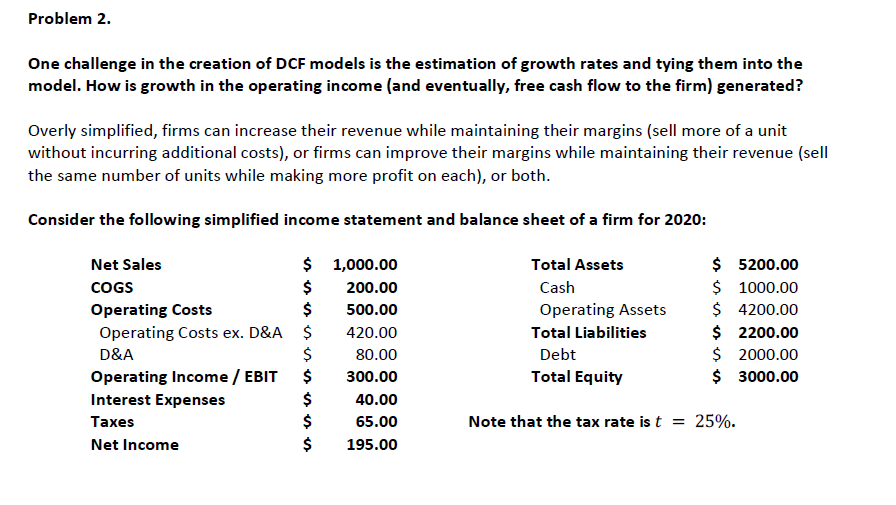
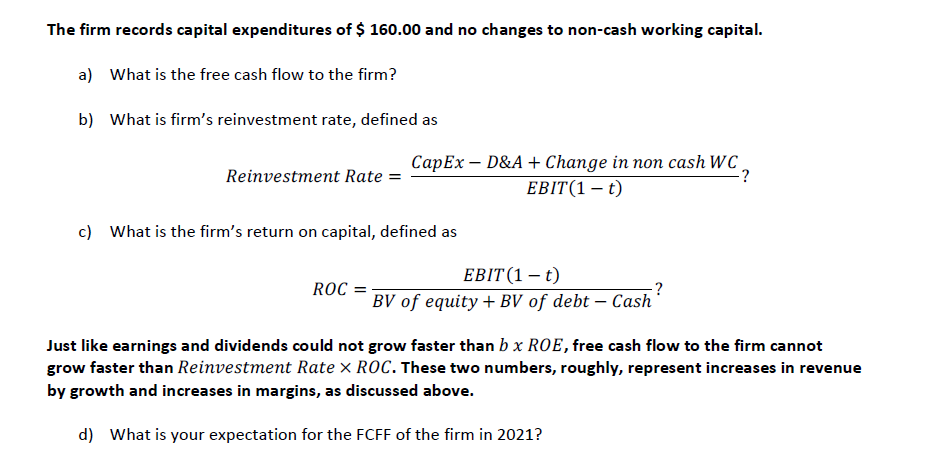
Problem 2. One challenge in the creation of DCF models is the estimation of growth rates and tying them into the model. How is growth in the operating income (and eventually, free cash flow to the firm) generated? Overly simplified, firms can increase their revenue while maintaining their margins (sell more of a unit without incurring additional costs), or firms can improve their margins while maintaining their revenue (sell the same number of units while making more profit on each), or both. Consider the following simplified income statement and balance sheet of a firm for 2020: Net Sales $ 1,000.00 COGS $ 200.00 Operating costs $ 500.00 Operating Costs ex. D&A $ 420.00 D&A $ 80.00 Operating Income / EBIT $ 300.00 Interest Expenses $ 40.00 Taxes $ 65.00 Net Income $ 195.00 Total Assets Cash Operating Assets Total Liabilities Debt Total Equity $ 5200.00 $ 1000.00 $ 4200.00 $ 2200.00 $ 2000.00 $ 3000.00 Note that the tax rate is t = 25%. The firm records capital expenditures of $ 160.00 and no changes to non-cash working capital. a) What is the free cash flow to the firm? b) What is firm's reinvestment rate, defined as CapEx D&A + Change in non cash WC Reinvestment Rate = ? EBIT(1 t) c) What is the firm's return on capital, defined as EBIT(1 t) ROC = - ? BV of equity + BV of debt - Cash Just like earnings and dividends could not grow faster than b x ROE, free cash flow to the firm cannot grow faster than Reinvestment Rate x ROC. These two numbers, roughly, represent increases in revenue by growth and increases in margins, as discussed above. d) What is your expectation for the FCFF of the firm in 2021
Step by Step Solution
There are 3 Steps involved in it

Get step-by-step solutions from verified subject matter experts