







Question: Many villages in the developing world lack access to electricity. One proposed solution is the Free Electric bicycle, which is a stationary bike hooked up
Many villages in the developing world lack access to electricity. One proposed solution is the ‘Free Electric’ bicycle, which is a stationary bike hooked up to a generator and battery. Pedaling the bike powers the generator, which creates electricity that is stored in the battery. The inventor claims that 1 hour on the bike can produce a whole day of electricity. Let’s put it to the test!
Assume the following: ? The human body is 25% efficient in converting food to mechanical kinetic energy. ? An adult can maintain a mechanical power output of 125 W sustained over an hour of biking.
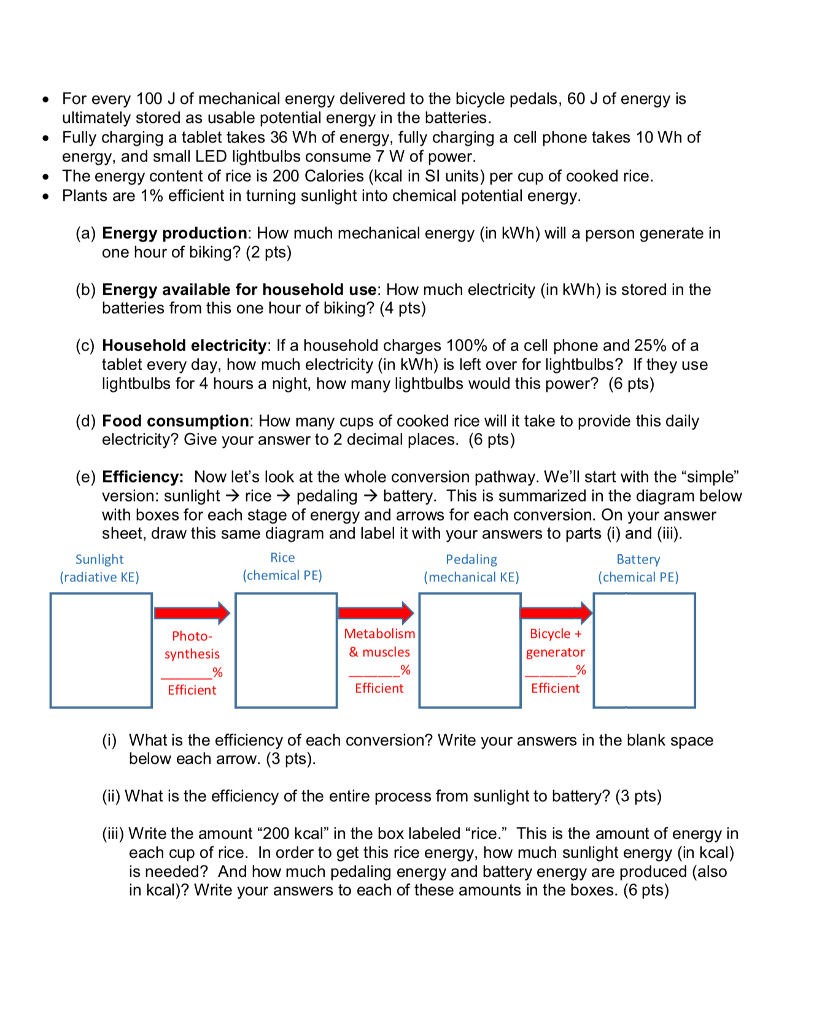
. For every 100 J of mechanical energy delivered to the bicycle pedals, 60 J of energy is ultimately stored as usable potential energy in the batteries. Fully charging a tablet takes 36 Wh of energy, fully charging a cell phone takes 10 Wh of energy, and small LED lightbulbs consume 7 W of power. The energy content of rice is 200 Calories (kcal in SI units) per cup of cooked rice. Plants are 1% efficient in turning sunlight into chemical potential energy. (a) Energy production: How much mechanical energy (in kWh) will a person generate in one hour of biking? (2 pts) (b) Energy available for household use: How much electricity (in kWh) is stored in the batteries from this one hour of biking? (4 pts) (c) Household electricity: If a household charges 100% of a cell phone and 25% of a tablet every day, how much electricity (in kWh) is left over for lightbulbs? If they use lightbulbs for 4 hours a night, how many lightbulbs would this power? (6 pts) (d) Food consumption: How many cups of cooked rice will it take to provide this daily electricity? Give your answer to 2 decimal places. (6 pts) (e) Efficiency: Now let's look at the whole conversion pathway. We'll start with the "simple" version: sunlight rice pedaling battery. This is summarized in the diagram below with boxes for each stage of energy and arrows for each conversion. On your answer sheet, draw this same diagram and label it with your answers to parts (i) and (iii). Rice (chemical PE) Sunlight (radiative KE) Photo- synthesis. _% Efficient Metabolism & muscles % Efficient Pedaling (mechanical KE) Bicycle + generator _% Efficient Battery (chemical PE) (i) What is the efficiency of each conversion? Write your answers in the blank space below each arrow. (3 pts). (ii) What is the efficiency of the entire process from sunlight to battery? (3 pts) (iii) Write the amount "200 kcal" in the box labeled "rice." This is the amount of energy in each cup of rice. In order to get this rice energy, how much sunlight energy (in kcal) is needed? And how much pedaling energy and battery hergy are produced (also in kcal)? Write your answers to each of these amounts in the boxes. (6 pts)
Step by Step Solution
There are 3 Steps involved in it
Lets tackle each part of the question step by step a Energy production If an adult can maintain a mechanical power output of 125 W sustained over an hour we can find the mechanical energy produced in ... View full answer

Get step-by-step solutions from verified subject matter experts
 Study Help