







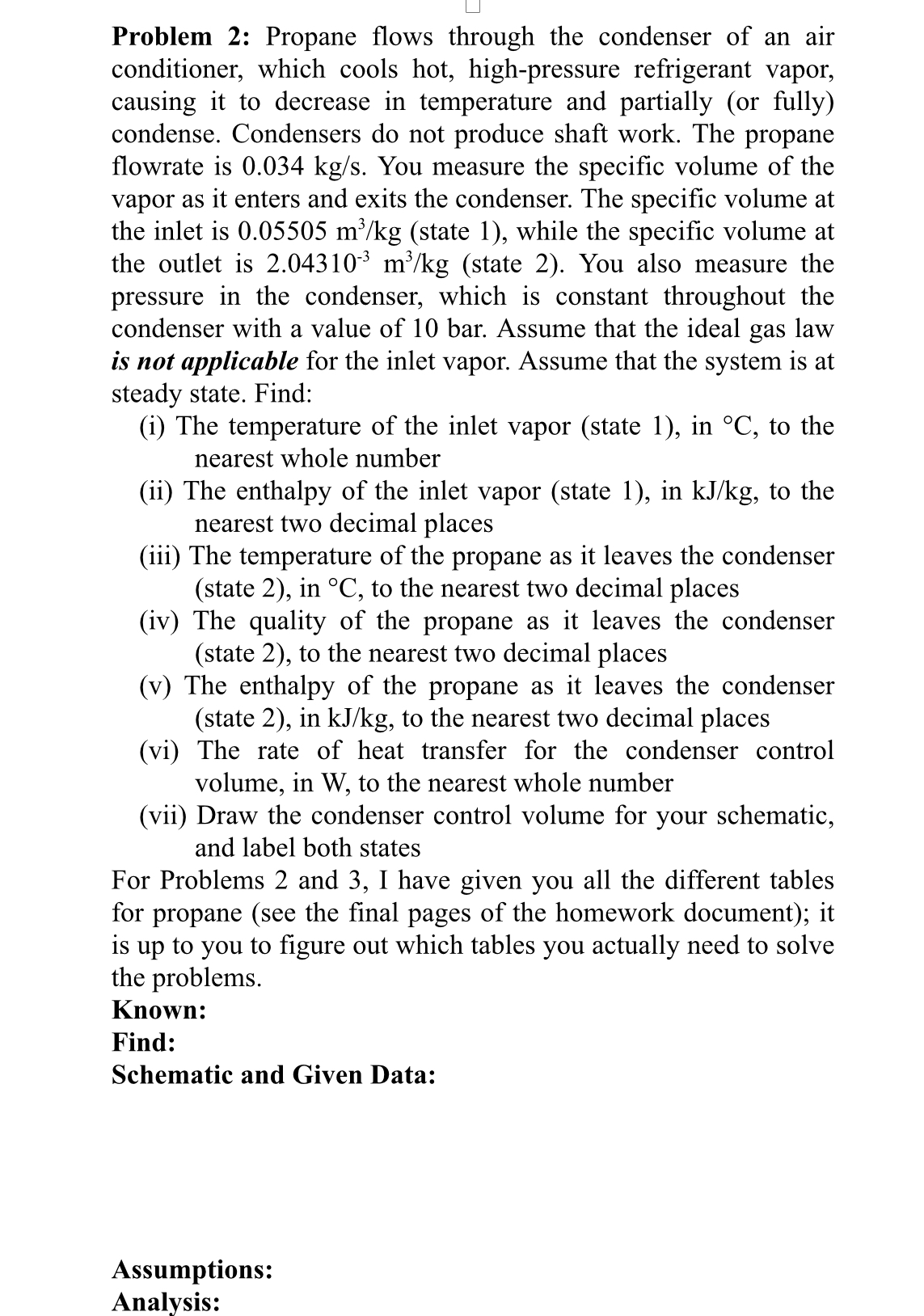
Question: Problem 2 : Propane flows through the condenser of an air conditioner, which cools hot, high - pressure refrigerant vapor, causing it to decrease in
Problem : Propane flows through the condenser of an air
conditioner, which cools hot, highpressure refrigerant vapor,
causing it to decrease in temperature and partially or fully
condense. Condensers do not produce shaft work. The propane
flowrate is You measure the specific volume of the
vapor as it enters and exits the condenser. The specific volume at
the inlet is state while the specific volume at
the outlet is state You also measure the
pressure in the condenser, which is constant throughout the
condenser with a value of bar. Assume that the ideal gas law
is not applicable for the inlet vapor. Assume that the system is at
steady state. Find:
i The temperature of the inlet vapor state in to the
nearest whole number
ii The enthalpy of the inlet vapor state in to the
nearest two decimal places
iii The temperature of the propane as it leaves the condenser
state in to the nearest two decimal places
iv The quality of the propane as it leaves the condenser
state to the nearest two decimal places
v The enthalpy of the propane as it leaves the condenser
state in to the nearest two decimal places
vi The rate of heat transfer for the condenser control
volume, in W to the nearest whole number
vii Draw the condenser control volume for your schematic,
and label both states
For Problems and I have given you all the different tables
for propane see the final pages of the homework document; it
is up to you to figure out which tables you actually need to solve
the problems.
Known:
Find:
Schematic and Given Data:
Assumptions:
Analysis:
Step by Step Solution
There are 3 Steps involved in it
1 Expert Approved Answer
Step: 1 Unlock

Question Has Been Solved by an Expert!
Get step-by-step solutions from verified subject matter experts
Step: 2 Unlock
Step: 3 Unlock
 Study Help