



Question: Problem 2 Public Transit. Pricing: Charlie is a typical New Yorker who rides the subway system. Each month, Charlie spllds $90 on transportation costs' including
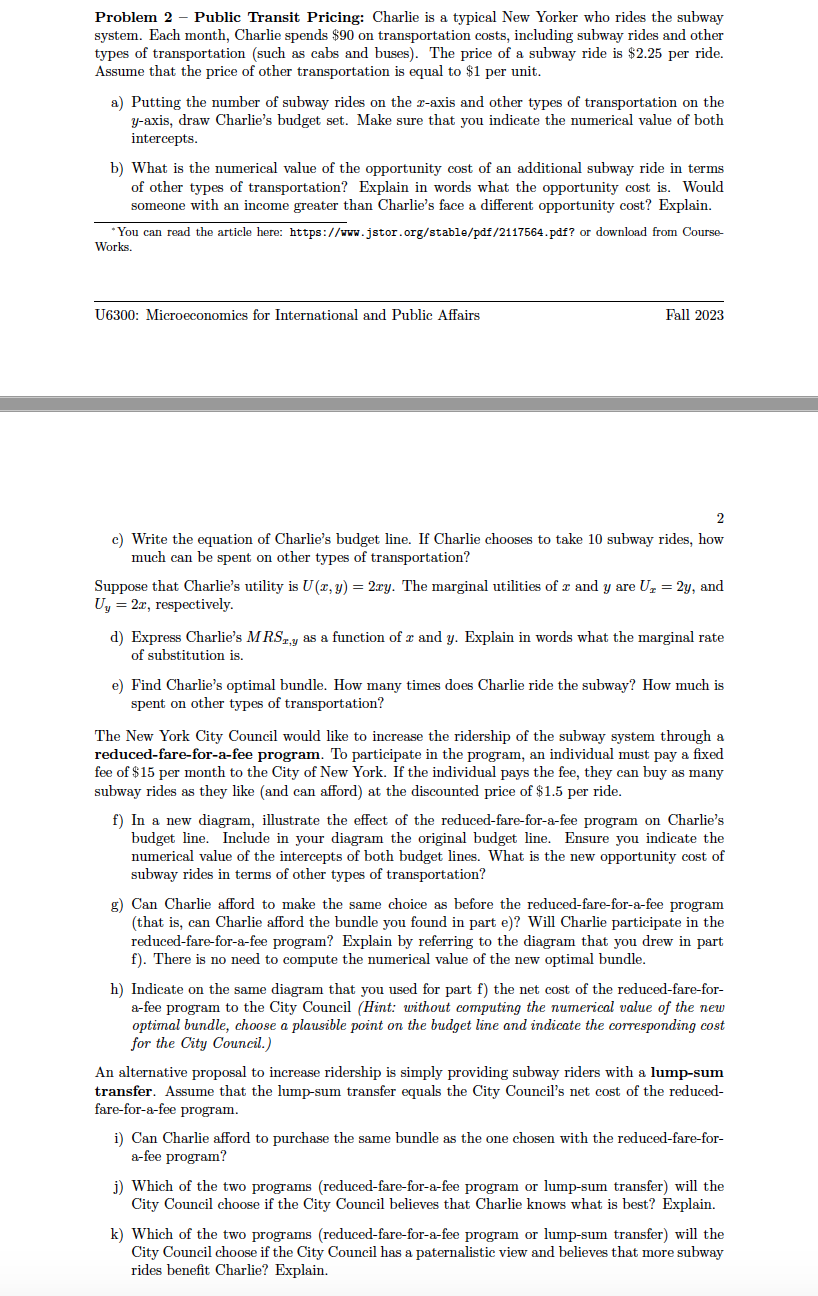
Problem 2 Public Transit. Pricing: Charlie is a typical New Yorker who rides the subway system. Each month, Charlie spllds $90 on transportation costs' including subway rides and other types of transportation (such as cabs and buses}. The price of a subway ride is $2.25 per ride. Assume that the price of other transportation is equal to $1 per unit. a} Putting the number of subway rides on the xaxis and other types of transportation on the yaxis' draw Charlie's budget set. Make sure that you indicate the numerical value of both intercepts. b} What is the numerical value of the opportunity cost of an additional subway ride in terms of other types of transportation? Explain in words what the opportunity cost is. Would someone with an income greater than Charlie's face a dierent opportunity cost? Explain. 'You can read the article here: https:Hmjstor.orgfstahlefpdflzu'fsq.put? or download from Course- Works. UESDD: hiicroeconomics for International and Public Affairs Fall 2023 2 c} Write the equation of Charlie's budget line. If Charlie chooses to take 10 subway rides, how much can be spent on other types of transportation? Suppose that Charlie's utility is U (I, y) = 231;. The marginal utilities of :r and y are U, 2 2y, and Us! = 23, respectively. d} Express Charlie's .i'lri'lltzizlgr as a function of r and 3;. Explain in words what the marginal rate of substitution is. e} Find Charlie's optimal bundle. How many times does Charlie ride the subway? How much is spent on other types of transportation? The New York City Council would like to increase the ridership of the subway system through a reduced-fare-for-afee program. To participate in the program, an individual must pay a xed fee of$15 per month to the City of New York. If the individual pays the fee, they can buy as many subway rides as they like (and can afford} at the discounted price of $1.5 per ride. f} In a new diagram, illustrate the eect of the reducedfareforafee program on Charlie's budget line. Include in your diagram the ori'nal budget line. Ensure you indicate the numerical value of the intercepts of both budget lines. \"'hat is the new opportunity cost of subway rides in terms of other types of transportation? g} Can Charlie afford to make the same choice as before the reducedfareforafee program (that. is' can Charlie afford the bundle you found in part e}? \"Till Charlie participate in the reducedfareforafee program? Explain by referring to the diagram that you drew in part f}. There is no need to compute the numerical value of the new optimal bundle. h} Indicate on the same diagram that you used for part f} the net cost of the reducedfarefor afee program to the City Council (Hint: without computing the numerical value of the new optiincilI bundle, choose a. plausible point on the budget line and indicate the corresponding cost for the City Council.) An alternative proposal to increase ridership is simply providing subway riders with a lurup-surn transfer. Assume that the lumpsum transfer equals the City Council's net cost of the reduced fareforafee program. i} Can Charlie aord to purchase the same bundle as the one chosen with the reduced-farefor afee program? j} Which of the two programs (reduced-fareforafee program or lump-sum transfer} will the City Council choose if the City Council believes that Charlie knows what is best? Ebcplain. k} Which of the two programs (reduced-fareforafee program or lump-sum transfer} will the City Council choose if the City Council has a paternalistic view and believes that more subway rides benet Charlie? Explain
Step by Step Solution
There are 3 Steps involved in it

Get step-by-step solutions from verified subject matter experts