







Question: Problem 2 - Stacked Boxes Box B rests on a horizontal, frictionless floor andlbox A sits on top of box B. The boxes are not
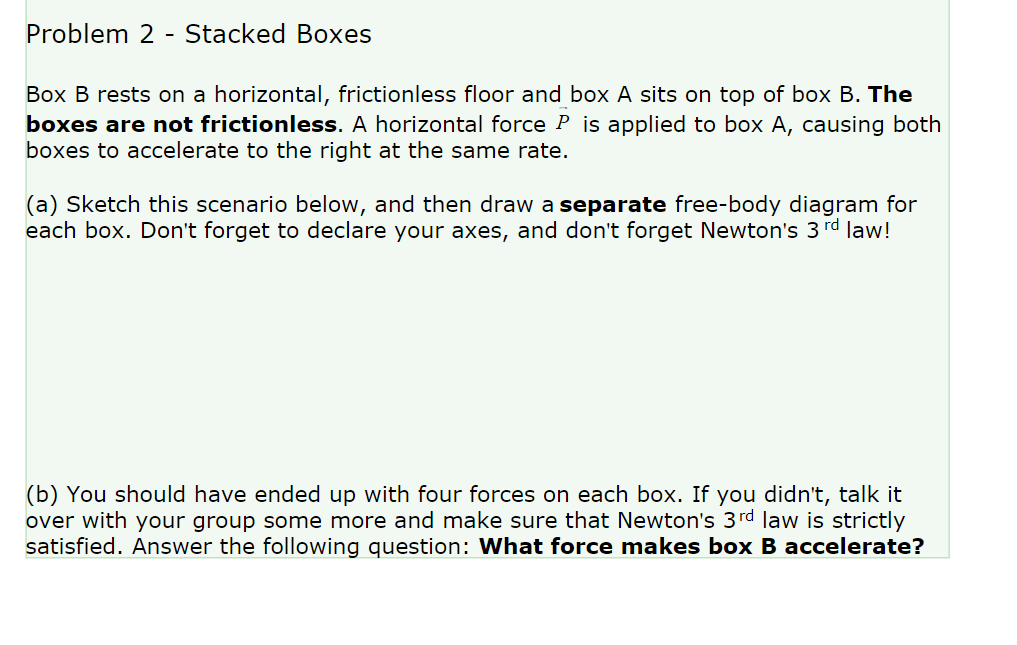
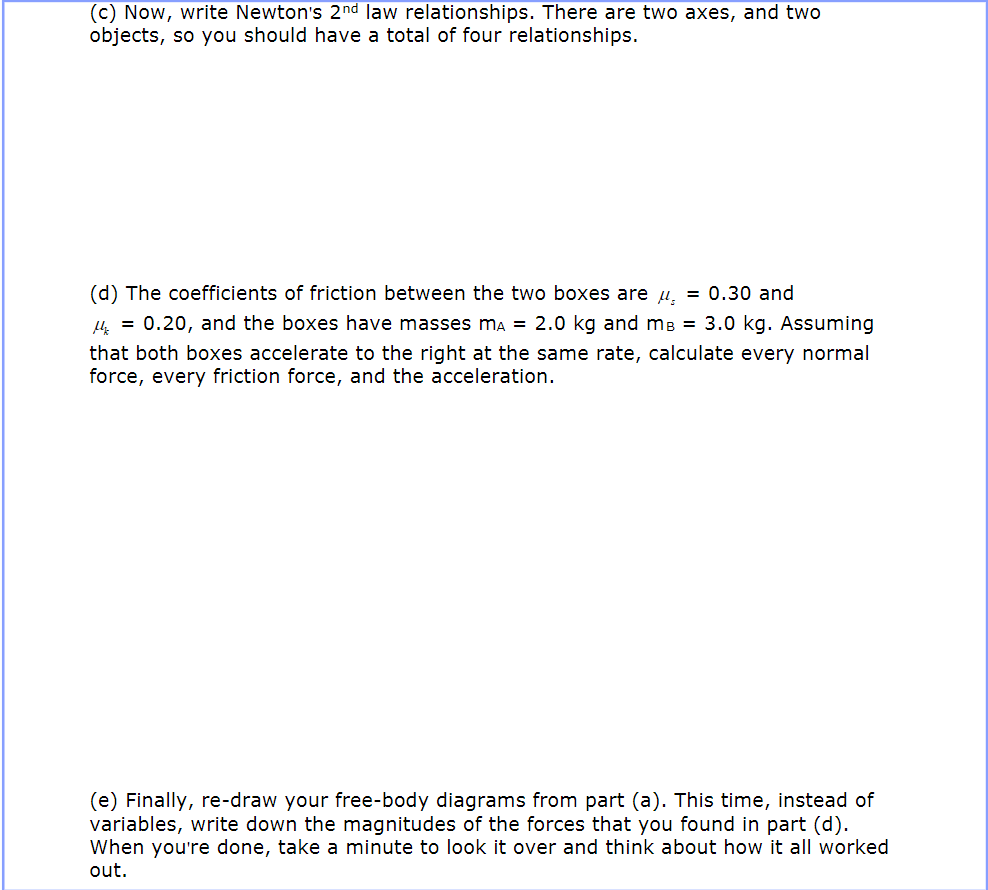
Problem 2 - Stacked Boxes Box B rests on a horizontal, frictionless floor andlbox A sits on top of box B. The boxes are not frictionless. A horizontal force P is applied to box A, causing both boxes to accelerate to the right at the same rate. (a) Sketch this scenario below, and then draw a separate free-body diagram for each box. Don't forget to declare your axes, and don't forget Newton's 3 rd law! (b) You should have ended up with four forces on each box. If you didn't, talk it over with your group some more and make sure that Newton's 3"d law is strictly satisfied. Answer the following question: What force makes box B accelerate? (c) Now, write Newton's 2nd lawr relationships. There are two axes, and two objects, so you should have a total of four relationships. (d) The coefficients of friction between the two boxes are u: = 0.30 and = 0.20, and the boxes have masses mix = 2.0 kg and ma = 3.0 kg. Assuming that both boxes accelerate to the right at the same rate, calculate every normal force, every friction force, and the acceleration. (e) Finally, re-draw your free-body diagrams from part (a). This time, instead of variables, write down the magnitudes of the forces that you found in part (d). When you're done, take a minute to look it over and think about how it all worked out
Step by Step Solution
There are 3 Steps involved in it

Get step-by-step solutions from verified subject matter experts
 Study Help