







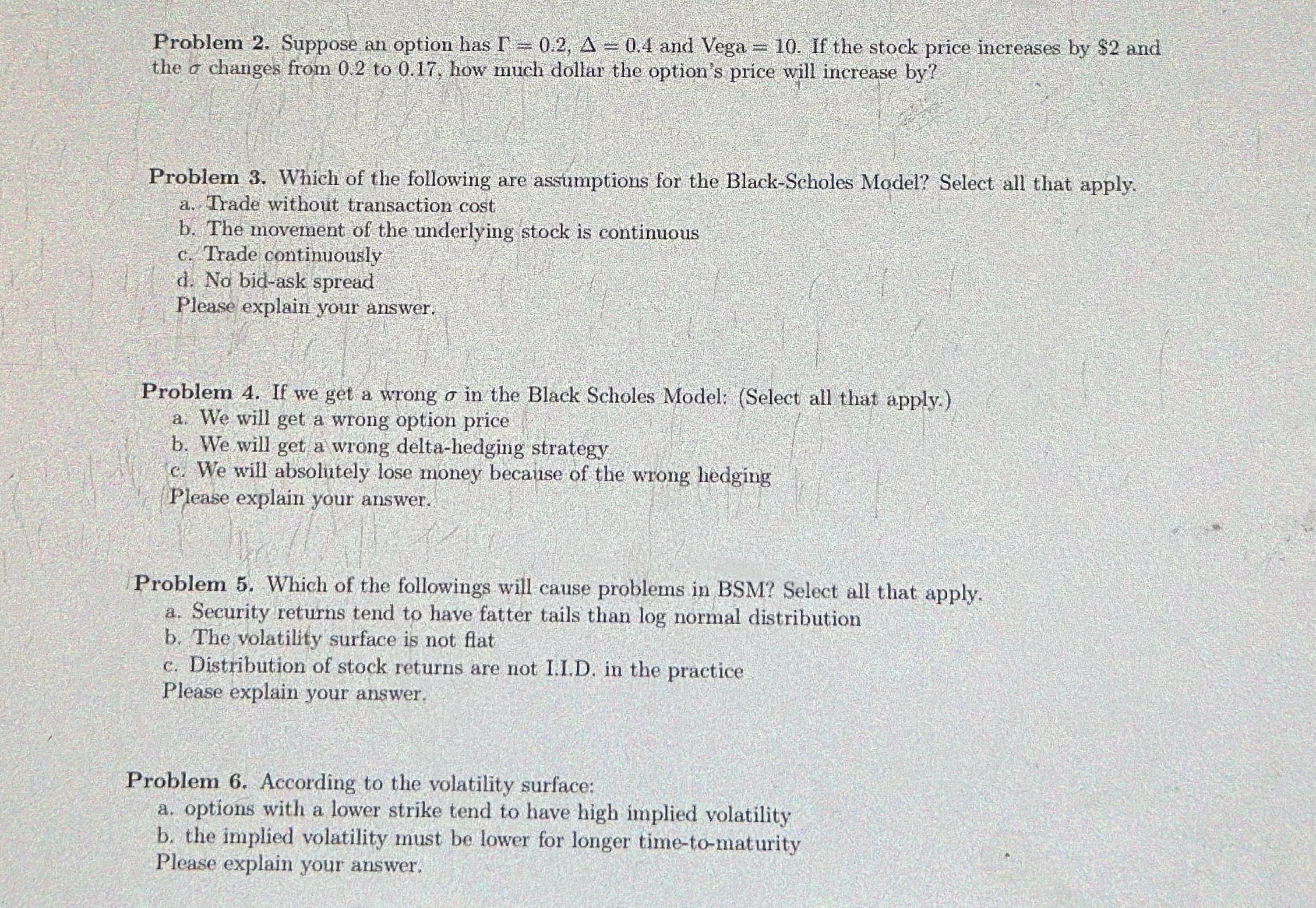
Question: Problem 2 . Suppose an option has = 0 . 2 , = 0 . 4 and Vega = 1 0 . If the stock
Problem Suppose an option has and Vega If the stock price increases by $ and the changes from to how much dollar the option's price will increase by
Problem Which of the following are assumptions for the BlackScholes Model? Select all that apply.
a Trade without transaction cost
b The movement of the underlying stock is continuous
c Trade continuously
d No bidask spread
Please explain your answer.
Problem If we get a wrong in the Black Scholes Model: Select all that apply.
a We will get a wrong option price
b We will get a wrong deltahedging strategy
c We will absolutely lose money because of the wrong hedging
Please explain your answer.
Problem Which of the followings will cause problems in BSM Select all that apply.
a Security returns tend to have fatter tails than normal distribution
b The volatility surface is not flat
c Distribution of stock returns are not I.I.D in the practice
Please explain your answer.
Problem According to the volatility surface:
a options with a lower strike tend to have high implied volatility
b the implied volatility must be lower for longer timetomaturity
Please explain your answer.
Step by Step Solution
There are 3 Steps involved in it
1 Expert Approved Answer
Step: 1 Unlock

Question Has Been Solved by an Expert!
Get step-by-step solutions from verified subject matter experts
Step: 2 Unlock
Step: 3 Unlock
 Study Help