



Question: Problem 2. Suppose we are interested in investigating the relationship between high salt intake and death from cardiovascular disease (CVD). One possible study design is
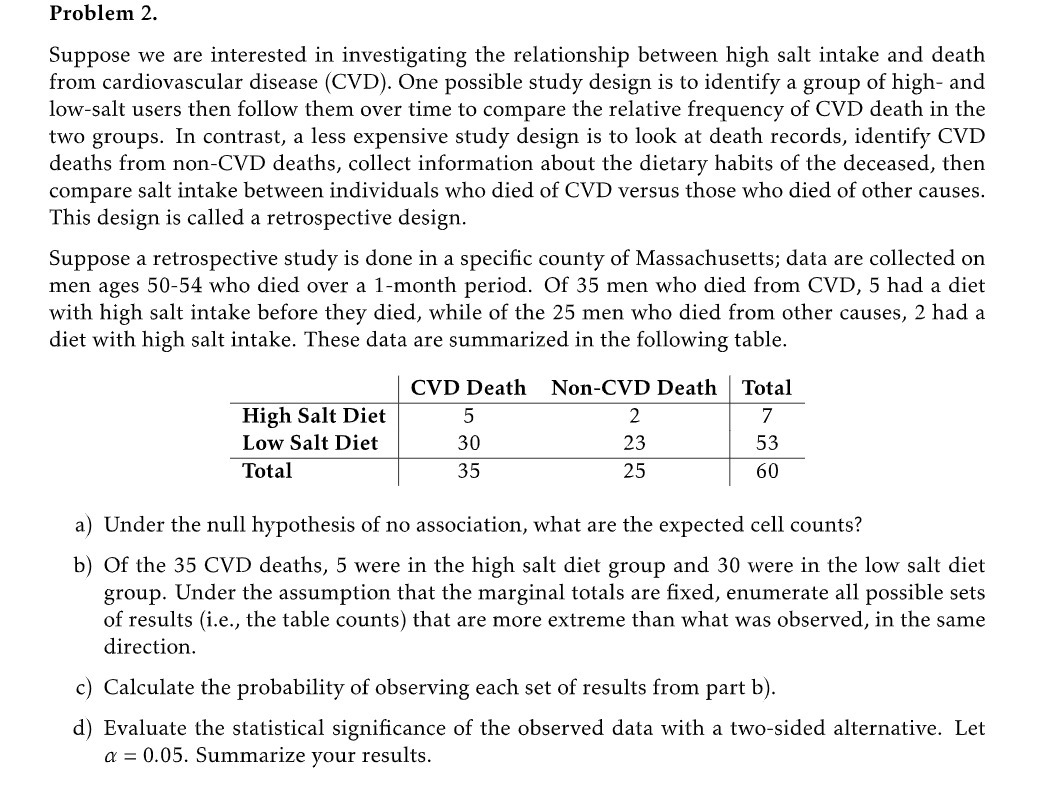
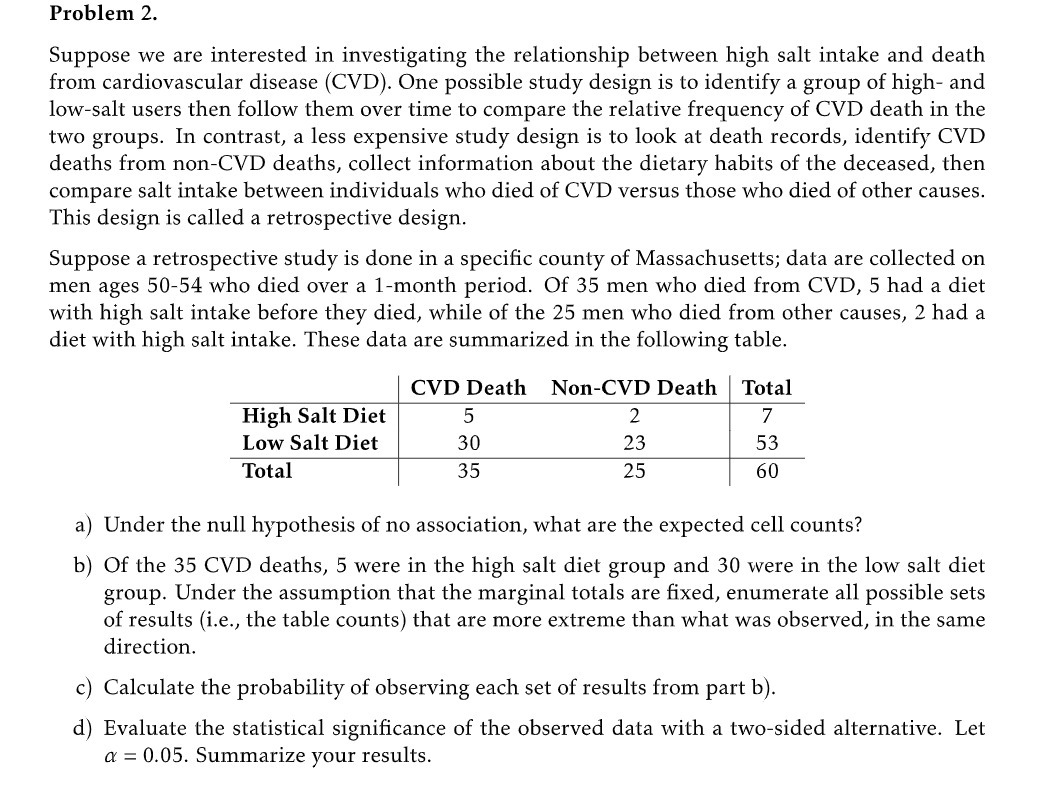
Problem 2. Suppose we are interested in investigating the relationship between high salt intake and death from cardiovascular disease (CVD). One possible study design is to identify a group of high- and lowsalt users then follow them over time to compare the relative frequency of CVD death in the two groups. In contrast, a less expensive study design is to look at death records, identify CVD deaths from nonCVD deaths, collect information about the dietary habits of the deceased, then compare salt intake between individuals who died of CVD versus those who died of other causes. This design is called a retrospective design. Suppose a retrospective study is done in a specic county of Massachusetts; data are collected on men ages 5054: who died over a 1month period. Of 35 men who died from CVD, 5 had a diet with high salt intake before they died, while of the 25 men who died from other causes, 2 had a diet with high salt intake. These data are summarized in the following table. cvo Death Non-CVD Death \\ Total High Salt Diet 5 2 7 Low Salt Diet 30 23 53 Total 35 25 l 60 a) Under the null hypothesis of no association, What are the expected cell counts? b) Of the 35 CVD deaths, 5 were in the high salt diet group and 30 were in the low salt diet group. Under the assumption that the marginal totals are fixed, enumerate all possible sets of results (i.e., the table counts) that are more extreme than what was observed, in the same direction. c) Calculate the probability of observing each set of results from part b). d] Evaluate the statistical signicance of the observed data with a twosided alternative. Let a: = 0.05. Summarize your results
Step by Step Solution
There are 3 Steps involved in it

Get step-by-step solutions from verified subject matter experts