



Question: Problem 2 Suppose you obtain data on a sample of working adult individuals in the U.S. (indexed by i = 1, ..., N), who selfreported
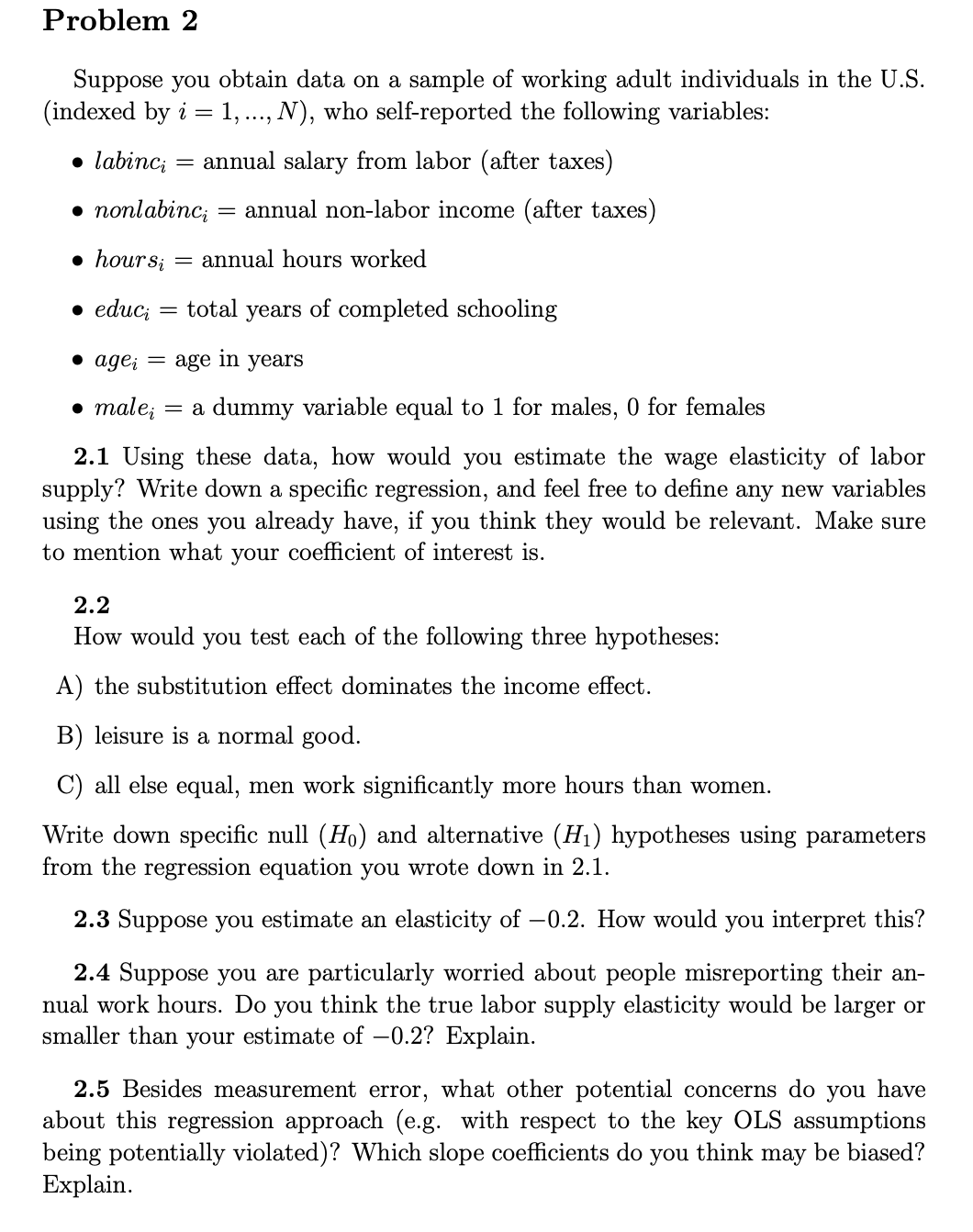
Problem 2 Suppose you obtain data on a sample of working adult individuals in the U.S. (indexed by i = 1, ..., N), who selfreported the following variables: 0 labinc, = annual salary from labor (after taxes) 0 nonlebt'nq = annual nonlabor income (after taxes) 0 hours,- = annual hours worked 0 educ; = total years of completed schooling 0 age,- = age in years 0 mole,- = a dummy variable equal to 1 for males, 0 for females 2.1 Using these data, how would you estimate the wage elasticity of labor supply? Write down a specic regression, and feel free to dene any new variables using the ones you already have, if you think they would be relevant. Make sure to mention what your coefcient of interest is. 2.2 How would you test each of the following three hypotheses: A) the substitution effect dominates the income effect. B) leisure is a normal good. 0) all else equal, men work signicantly more hours than women. Write down specic null (H0) and alternative (H 1) hypotheses using parameters from the regression equation you wrote down in 2.1. 2.3 Suppose you estimate an elasticity of 0.2. How would you interpret this? 2.4 Suppose you are particularly worried about people misreporting their an- nual work hours. Do you think the true labor supply elasticity would be larger or smaller than your estimate of 0.2? Explain. 2.5 Besides measurement error, what other potential concerns do you have about this regression approach (e.g. with respect to the key OLS assumptions being potentially violated)? Which slope coefcients do you think may be biased? Explain
Step by Step Solution
There are 3 Steps involved in it

Get step-by-step solutions from verified subject matter experts