







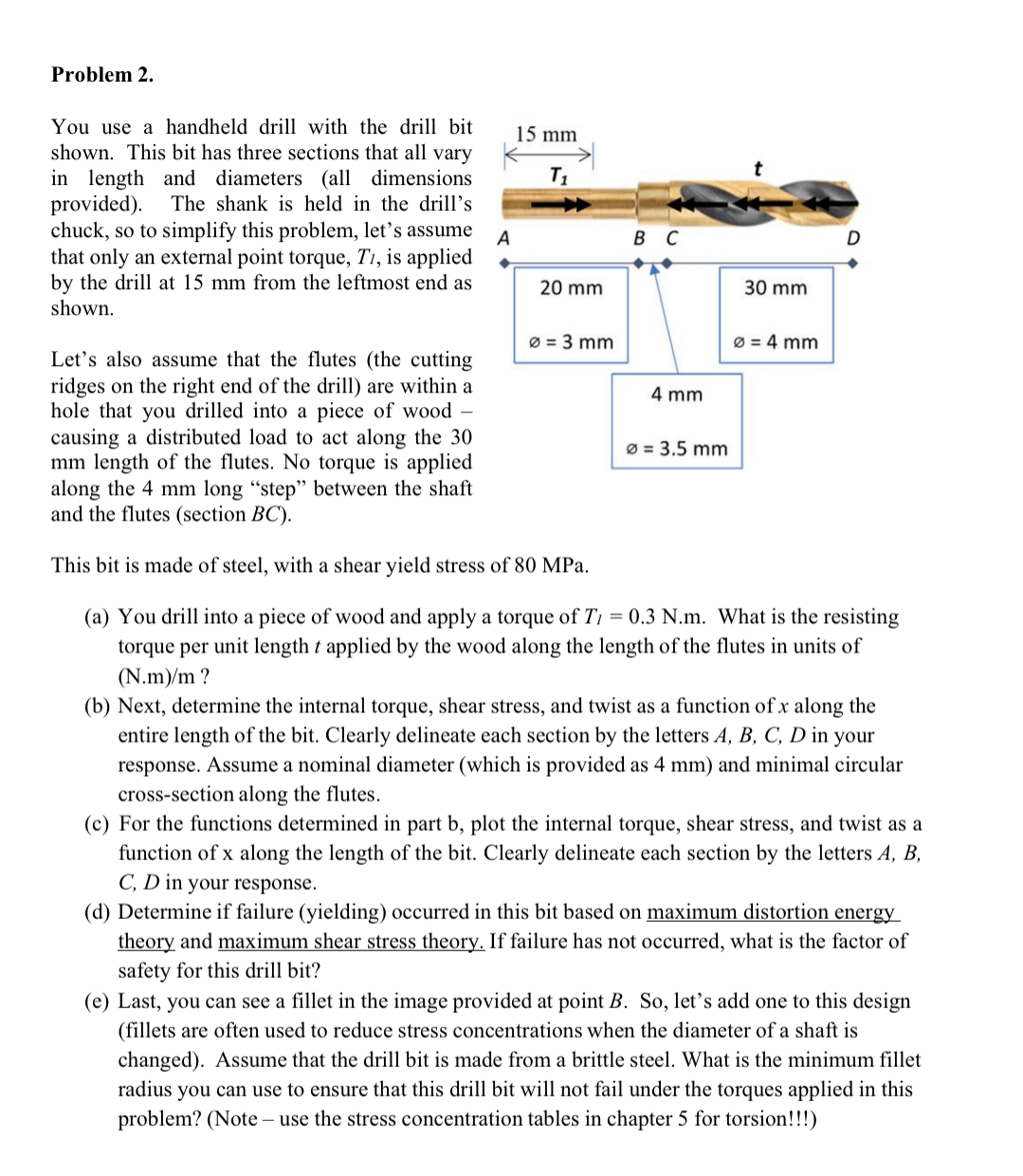
Question: Problem 2 . You use a handheld drill with the drill bit shown. This bit has three sections that all vary in length and diameters
Problem
You use a handheld drill with the drill bit shown. This bit has three sections that all vary in length and diameters all dimensions provided The shank is held in the drill's chuck, so to simplify this problem, let's assume that only an external point torque, Tl is applied by the drill at mm from the leftmost end as shown.
Let's also assume that the flutes the cutting ridges on the right end of the drill are within a hole that you drilled into a piece of wood causing a distributed load to act along the mm length of the flutes. No torque is applied along the mm long "step" between the shaft and the flutes section B C
This bit is made of steel, with a shear yield stress of MPa
a You drill into a piece of wood and apply a torque of Tl Nm What is the resisting torque per unit length t applied by the wood along the length of the flutes in units of Nmm
b Next, determine the internal torque, shear stress, and twist as a function of x along the entire length of the bit. Clearly delineate each section by the letters A B C D in your response. Assume a nominal diameter which is provided as mm and minimal circular crosssection along the flutes.
c For the functions determined in part b plot the internal torque, shear stress, and twist as a function of x along the length of the bit. Clearly delineate each section by the letters A B C D in your response.
d Determine if failure yielding occurred in this bit based on maximum distortion energy theory and maximum shear stress theory. If failure has not occurred, what is the factor of safety for this drill bit?
e Last, you can see a fillet in the image provided at point B So let's add one to this design fillets are often used to reduce stress concentrations when the diameter of a shaft is changed Assume that the drill bit is made from a brittle steel. What is the minimum fillet radius you can use to ensure that this drill bit will not fail under the torques applied in this problem? Note use the stress concentration tables in chapter for torsion!!!
Can you please just do C
Step by Step Solution
There are 3 Steps involved in it
1 Expert Approved Answer
Step: 1 Unlock

Question Has Been Solved by an Expert!
Get step-by-step solutions from verified subject matter experts
Step: 2 Unlock
Step: 3 Unlock
 Study Help