







Question: Problem 3. (10 pts) (7-segment display): Write an ARM program as follows. A commonly used output device in digital systems is a seven-segment display, depicted
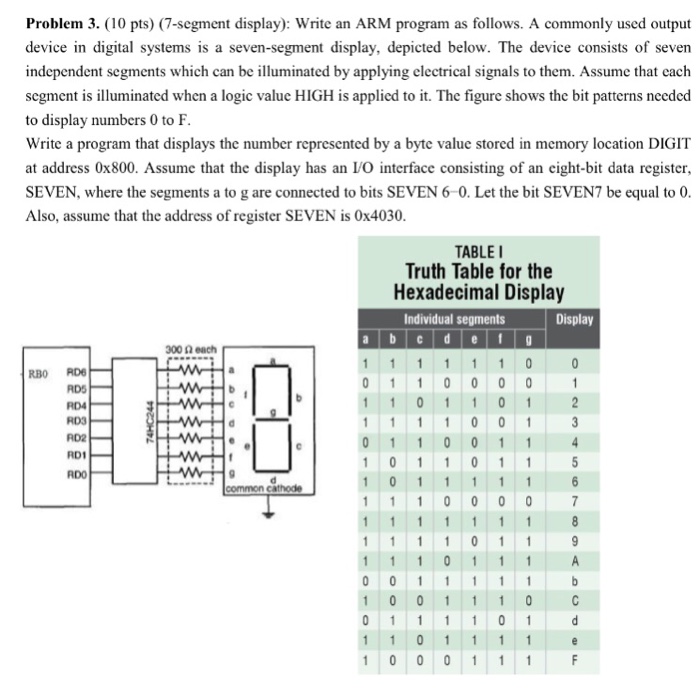
Problem 3. (10 pts) (7-segment display): Write an ARM program as follows. A commonly used output device in digital systems is a seven-segment display, depicted below. The device consists of seven independent segments which can be illuminated by applying electrical signals to them. Assume that cach segment is illuminated when a logic value HIGH is applied to it. The figure shows the bit patterns needed to display numbers 0 to F. Write a program that displays the number represented by a byte value stored in memory location DIGIT at address 0x800. Assume that the display has an IO interface consisting of an cight-bi data register, SEVEN, where the segments a to g are connected to bits SEVEN 6 0. Let the bit SEVEN7 be equal to 0 Also, assume that the address of register SEVEN is 0x4030 TABLEI Truth Table for the Hexadecimal Display Individual segments Display 300 n each RBO RDS RD4 RD3 RD2 RDI RDO common cathode Problem 3. (10 pts) (7-segment display): Write an ARM program as follows. A commonly used output device in digital systems is a seven-segment display, depicted below. The device consists of seven independent segments which can be illuminated by applying electrical signals to them. Assume that cach segment is illuminated when a logic value HIGH is applied to it. The figure shows the bit patterns needed to display numbers 0 to F. Write a program that displays the number represented by a byte value stored in memory location DIGIT at address 0x800. Assume that the display has an IO interface consisting of an cight-bi data register, SEVEN, where the segments a to g are connected to bits SEVEN 6 0. Let the bit SEVEN7 be equal to 0 Also, assume that the address of register SEVEN is 0x4030 TABLEI Truth Table for the Hexadecimal Display Individual segments Display 300 n each RBO RDS RD4 RD3 RD2 RDI RDO common cathode
Step by Step Solution
There are 3 Steps involved in it

Get step-by-step solutions from verified subject matter experts
 Study Help