







Question: Problem 3 (18 points) In this problem, you can assume all solutions are interior. Suppose the hourly wage is $20 and the price of each
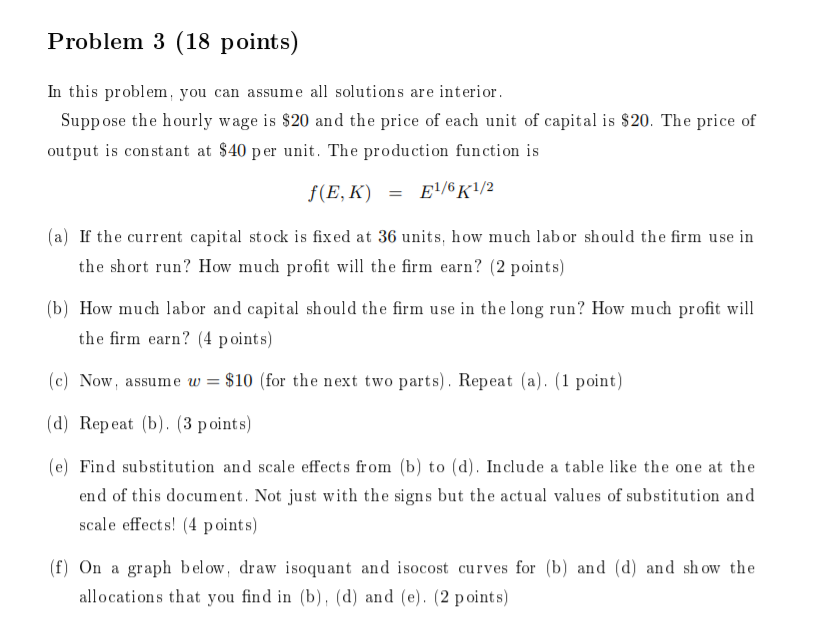
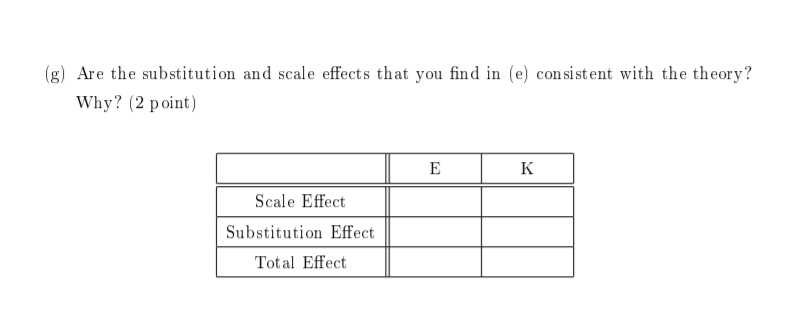
Problem 3 (18 points) In this problem, you can assume all solutions are interior. Suppose the hourly wage is $20 and the price of each unit of capital is $20. The price of output is constant at $40 per unit. The production function is f(E, K) E1/6K1/2 (a) If the current capital stock is fixed at 36 units, how much labor should the firm use in the short run? How much profit will the firm earn? (2 points) (b) How much labor and capital should the firm use in the long run? How much profit will the firm earn? (4 points) (c) Now, assume w = $10 (for the next two parts). Repeat (a). (1 point) (d) Repeat (b). (3 points) (e) Find substitution and scale effects from (b) to (d). Include a table like the one at the end of this document. Not just with the signs but the actual values of substitution and scale effects! (4 points) (f) On a graph below, draw isoquant and isocost curves for (b) and (d) and show the allocations that you find in (b), (d) and (e) (2 points) (g) Are the substitution and scale effects that you find in (e) consistent with the theory? Why? (2 point) E K Scale Effect Substitution Effect Total Effect Problem 3 (18 points) In this problem, you can assume all solutions are interior. Suppose the hourly wage is $20 and the price of each unit of capital is $20. The price of output is constant at $40 per unit. The production function is f(E, K) E1/6K1/2 (a) If the current capital stock is fixed at 36 units, how much labor should the firm use in the short run? How much profit will the firm earn? (2 points) (b) How much labor and capital should the firm use in the long run? How much profit will the firm earn? (4 points) (c) Now, assume w = $10 (for the next two parts). Repeat (a). (1 point) (d) Repeat (b). (3 points) (e) Find substitution and scale effects from (b) to (d). Include a table like the one at the end of this document. Not just with the signs but the actual values of substitution and scale effects! (4 points) (f) On a graph below, draw isoquant and isocost curves for (b) and (d) and show the allocations that you find in (b), (d) and (e) (2 points) (g) Are the substitution and scale effects that you find in (e) consistent with the theory? Why? (2 point) E K Scale Effect Substitution Effect Total Effect
Step by Step Solution
There are 3 Steps involved in it

Get step-by-step solutions from verified subject matter experts
 Study Help