







Question: Problem 3 9 : ( 1 5 points ) A key goal of EE 3 5 0 is to insure that you have a solid
Problem : points
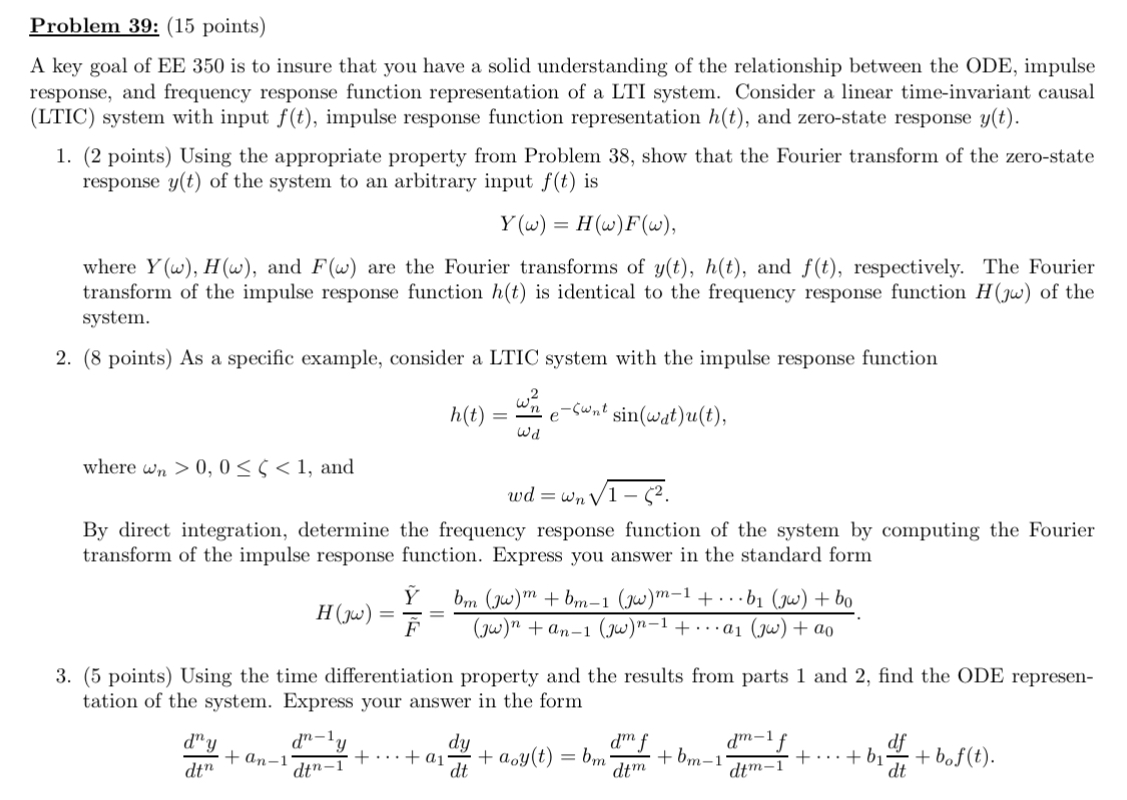
A key goal of EE is to insure that you have a solid understanding of the relationship between the ODE, impulse response, and frequency response function representation of a LTI system. Consider a linear timeinvariant causal LTIC system with input impulse response function representation and zerostate response
points Using the appropriate property from Problem show that the Fourier transform of the zerostate response of the system to an arbitrary input is
where and are the Fourier transforms of and respectively. The Fourier transform of the impulse response function is identical to the frequency response function of the system.
points As a specific example, consider a LTIC system with the impulse response function
where and
By direct integration, determine the frequency response function of the system by computing the Fourier transform of the impulse response function. Express you answer in the standard form
points Using the time differentiation property and the results from parts and find the ODE representation of the system. Express your answer in the form
cdotscdots
Step by Step Solution
There are 3 Steps involved in it
1 Expert Approved Answer
Step: 1 Unlock

Question Has Been Solved by an Expert!
Get step-by-step solutions from verified subject matter experts
Step: 2 Unlock
Step: 3 Unlock
 Study Help